How syphilis invades the body, on a molecular scale
Last reviewed November 16, 2026. OwieClear editorial team. Waiting for clinician review. Not medical advice. Talk with your doctor about your own care.
Most bacteria that cause sexually transmitted infections stay roughly where they land. Syphilis does the opposite: within hours of entering the body it is in the bloodstream, and from there it can go anywhere, including the brain and, in pregnancy, the placenta.
The organism that does this is one of the strangest in medicine. Here is how it works.
Related pages: Syphilis
The bottom line
- Treponema pallidum is a thin, tightly coiled spirochete that infects only humans.
- It moves by rotating internal filaments, so the whole cell corkscrews forward.
- It spreads through the blood and lymph very early, long before late-stage disease.
- It has a stripped-down genome and cannot make most of its own building blocks, so it takes them from human tissue.
- Exactly which molecules it uses to cross the cells lining blood vessels.
- It still cannot be grown easily in the laboratory, which has slowed research for over a century.
The story, step by step
- 1. What it is (Established microbiology)
- 2. The drill ()
- 3. Into the blood ()
- 4. Holding on ()
- 5. Why it matters ()
What the evidence labels mean
A bacterium that cannot live without you
What happens
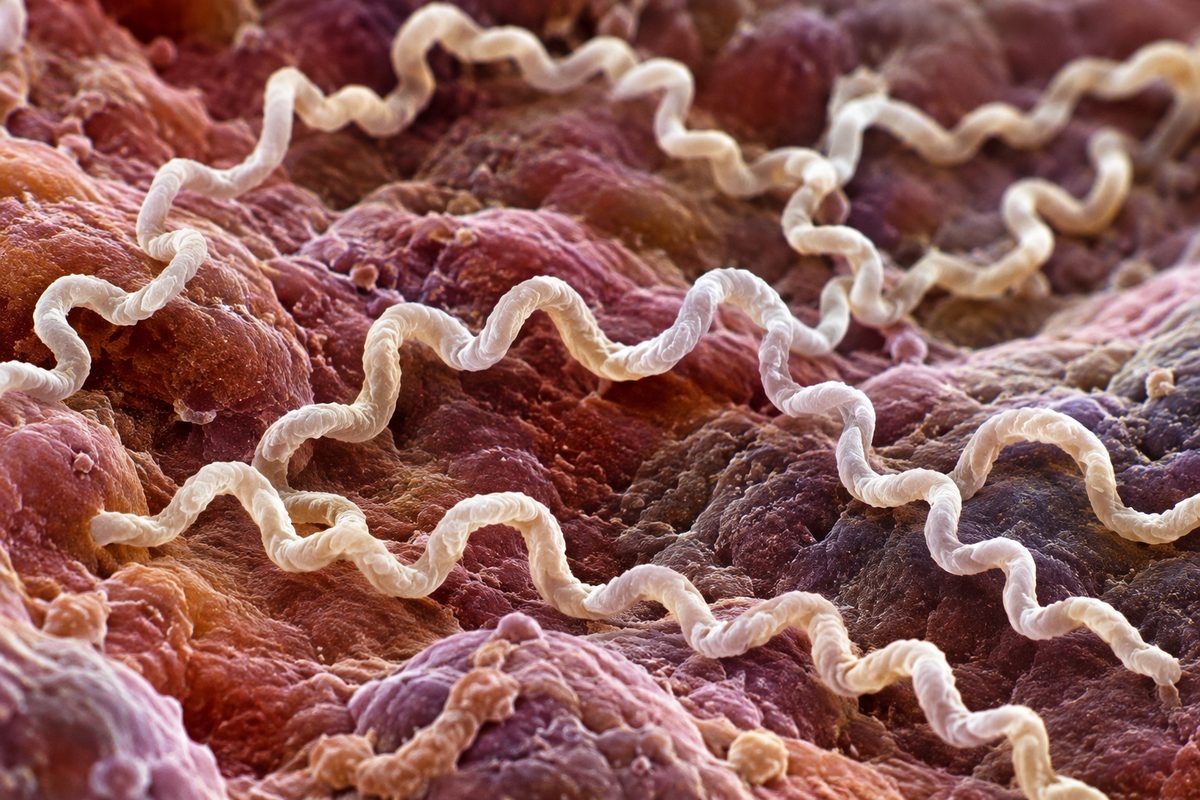
T. pallidum is a spirochete: a long, thin, tightly coiled bacterium, far narrower than most, which is why it is nearly invisible under an ordinary microscope.
What the research shows
- Its genome is unusually small and has lost the genes for making most fatty acids, nucleotides and amino acids.
- That means it cannot build its own components and must harvest them from living human tissue.
- It cannot be grown on standard laboratory media, so diagnosis uses antibody tests or direct visualization rather than culture.
- It infects only humans. There is no animal or environmental reservoir.
Why it matters
This extreme dependence is why it is fragile outside the body, and why it has never been easy to study.
What's still uncertain
- Only in recent years has continuous laboratory culture become possible at all, and it remains difficult.
Read more
- CDC: About syphilisGovernment
Next: The drill
Internal propellers make the whole cell corkscrew forward
What happens
Most swimming bacteria have external tails that whip around. Spirochetes do something different.
What the research shows
- T. pallidum wraps its flagella lengthwise inside its outer sheath, between the cell body and the outer membrane. These are called endoflagella.
- When they rotate, the entire coiled cell spins and bores forward, like a corkscrew.
- This lets it move through thick, viscous material such as mucus, where ordinary swimming bacteria stall.
- It gets in through microscopic breaks in skin or through mucous membranes, which it can penetrate.
Why it matters
The corkscrew is not decorative. It is a drill, and it is why a bacterium this delicate can get through barriers that stop other organisms.
What's still uncertain
- How much mechanical force it generates is hard to measure in living tissue.
Read more
Next: Into the blood
Between the cells lining the vessels, within hours
What happens
Blood vessels are lined with a continuous sheet of endothelial cells. Getting past them is how an infection becomes systemic.
What the research shows
- The spirochetes work their way between those cells and into the bloodstream and lymph.
- Dissemination happens remarkably early, within hours to days of infection, and long before any symptom appears.
- This is why the secondary stage affects the whole body rather than just the site of the sore.
- It can cross the blood-brain barrier into the nervous system, and the placenta during pregnancy.
Why it matters
By the time anyone notices a painless sore, the infection is already everywhere. That is why treatment is systemic injections rather than something applied to the sore.
What's still uncertain
- The precise molecules it uses to cross the endothelium are still being identified.
Read more
- CDC: About syphilisGovernment
- OwieClear: The four stagesOwieClear
Next: Holding on
Sticking to human tissue
What happens
To stay in tissue rather than be swept along, the bacterium has to attach.
What the research shows
- It carries surface proteins that bind to components of the human extracellular matrix, including fibronectin and laminin.
- Those are the scaffolding molecules that hold tissue together, and they are present throughout the body.
- The same stickiness helps it stay in the walls of small blood vessels, which matters for the damage it causes later.
Why it matters
Binding to the body's universal scaffolding is part of why this organism can set up in so many different tissues.
What's still uncertain
- Because the bacterium is so hard to manipulate genetically, proving the role of individual proteins has been slow.
Read more
Next: Why it matters
What the invasion explains
What happens
Several things that puzzle people about syphilis follow directly from the biology above.
What the research shows
- Why the sore is painless: there is little tissue-destroying toxin, so there is less of the inflammation that causes pain.
- Why the sore heals on its own: the local infection is controlled even though the organism has already spread.
- Why a baby can be infected at any stage of pregnancy: the organism is in the mother's blood and crosses the placenta.
- Why the nervous system can be involved early: it reaches the brain in the first weeks, not only after decades.
Why it matters
The old teaching that nerve damage is only a late complication is wrong, and it matters: eye, ear and nervous system symptoms need urgent attention at any stage.
What's still uncertain
- Why only some people develop nervous system disease is not understood.
Read more
- CDC STI treatment guidelines: syphilisGovernment
- OwieClear: The four stagesOwieClear