How the failing heart compensates, and why that makes it worse
Last reviewed November 17, 2026. OwieClear editorial team. Waiting for clinician review. Not medical advice. Talk with your doctor about your own care.
The body responds to a failing pump as if it were responding to bleeding: raise the heart rate, tighten the vessels, retain salt and water.
Those responses save a person who is haemorrhaging. In heart failure they are applied to a pump that cannot cope with the extra load, and over months and years they destroy it. Every major heart failure drug works by blocking one of them.
Related pages: Heart failure
The bottom line
- Reduced output triggers sympathetic nervous system and RAAS activation.
- These responses help briefly and harm over the long term.
- Chronic activation drives remodelling: the ventricle dilates and changes shape.
- The heart also releases natriuretic peptides that oppose these effects, which is the basis of the BNP test.
- All four pillars of treatment block a compensatory pathway rather than stimulating the heart.
- Why some people remodel rapidly and others not at all.
- How much remodelling can be reversed.
- Which pathway matters most in HFpEF.
The story, step by step
What the evidence labels mean
The sympathetic response
What happens
Adrenaline, applied to the wrong problem.
What the research shows
- Baroreceptors sense a drop in effective circulating output and interpret it as blood loss.
- The sympathetic nervous system responds: heart rate rises, contraction strengthens, blood vessels constrict.
- In the short term this maintains blood pressure and perfusion, and it is exactly what is needed after an injury.
- Sustained, it is destructive. Chronic adrenaline exposure is directly toxic to heart muscle cells, promotes cell death and fibrosis, and provokes arrhythmias.
- It also increases the work the failing ventricle must do, against tighter vessels.
- Higher circulating noradrenaline levels in heart failure predict worse survival.
Why it matters
This explains the single most counterintuitive fact in cardiology: beta blockers, which weaken each beat, make failing hearts live longer by removing chronic adrenaline drive.
What's still uncertain
- Why some patients cannot tolerate beta blockade at all.
- The optimal degree of heart-rate reduction.
Read more
- NHLBI: Heart failureGovernment
- American Heart Association: heart failure resourcesNonprofit
- American College of Cardiology: heart failure guideline resourcesNonprofit
Next: The salt switch
The renin-angiotensin-aldosterone system
What happens
Retaining what the body cannot handle.
What the research shows
- Reduced blood flow to the kidney triggers renin release, starting a cascade that produces angiotensin II.
- Angiotensin II constricts blood vessels, raising the resistance the heart pumps against, and stimulates aldosterone release.
- Aldosterone makes the kidney retain sodium and water, expanding blood volume.
- More volume plus more resistance means more work for a ventricle that is already failing, and it produces the congestion that causes symptoms.
- Angiotensin II and aldosterone both drive fibrosis in the heart, stiffening it and promoting arrhythmia.
- This is the system blocked by ACE inhibitors, ARBs, ARNIs and mineralocorticoid receptor antagonists, which between them account for three of the four treatment pillars.
Why it matters
The congestion that makes someone breathless is not simply fluid leaking out of a weak pump. It is actively retained by a hormonal system trying to help.
What's still uncertain
- How much residual aldosterone escape matters on treatment.
- The optimal degree of blockade.
Read more
- NHLBI: Heart failure treatmentGovernment
- American Heart Association: heart failure resourcesNonprofit
- MedlinePlus: Heart failureGovernment
Next: Remodelling
The shape change
What happens
The ventricle stretches and thins.
What the research shows
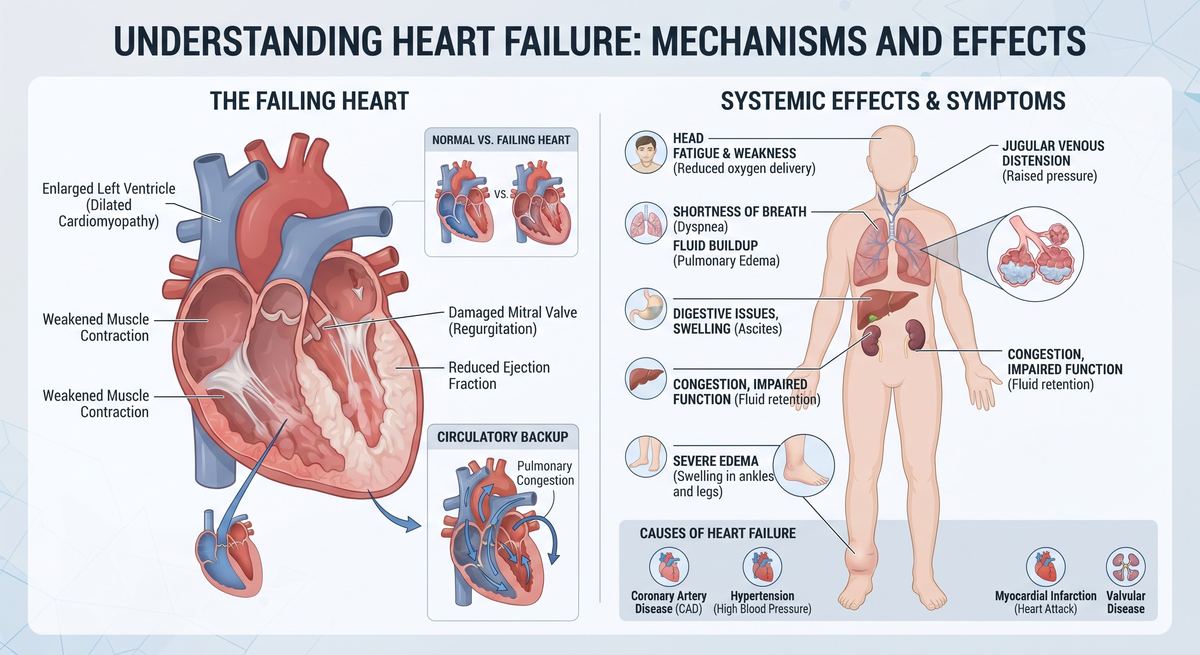
- Under chronic pressure, volume load and neurohormonal stimulation, the left ventricle enlarges and becomes more spherical.
- A sphere is a less efficient pump than the normal elongated shape, so each beat ejects a smaller fraction.
- Muscle cells enlarge, die and are replaced by fibrous tissue, which does not contract and conducts electricity poorly.
- Stretching the mitral valve ring can make the valve leak, adding a volume load on top of everything else.
- Remodelling is progressive and self-reinforcing: worse shape means worse output means more neurohormonal drive.
- Blocking the hormonal drive can reverse part of it. Reverse remodelling, with a smaller ventricle and a higher ejection fraction, is a well-documented effect of modern treatment.
Why it matters
Reverse remodelling is why ejection fraction often improves on treatment. The drugs do not strengthen muscle; they remove the forces deforming it.
What's still uncertain
- How much remodelling is reversible and in whom.
- Why some hearts recover fully and others not at all.
Read more
- American Heart Association: heart failure resourcesNonprofit
- NHLBI: CardiomyopathyGovernment
- American College of Cardiology: heart failure guideline resourcesNonprofit
Next: The counter-system
Natriuretic peptides
What happens
The body's own opposition, and a test.
What the research shows
- Stretched heart muscle releases natriuretic peptides, chiefly BNP and the fragment NT-proBNP.
- These promote sodium and water loss and relax blood vessels, opposing the RAAS directly.
- They are overwhelmed in established heart failure, but their blood levels rise with the degree of stretch, which makes them a useful test.
- A normal BNP in an untreated, breathless patient makes heart failure unlikely, which is why it is used to rule the diagnosis out in emergency departments.
- Levels are higher with age, kidney impairment and atrial fibrillation, and lower in obesity, which can mask the diagnosis.
- Sacubitril, half of the ARNI drug, blocks the enzyme that breaks these peptides down, so the body's own counter-system is strengthened. The valsartan half blocks angiotensin at the same time.
Why it matters
The ARNI is the clearest example of the whole logic: block the harmful compensation, and amplify the helpful one.
What's still uncertain
- The role of serial BNP measurement in guiding treatment.
- Why BNP is lower in obesity.
Read more
- NHLBI: Heart failure diagnosisGovernment
- American Heart Association: heart failure resourcesNonprofit
- MedlinePlus: Heart health testsGovernment