Managing asthma day to day
Last reviewed November 16, 2026. OwieClear editorial team. Waiting for clinician review. Not medical advice. Talk with your doctor about your own care.
Asthma control is not how someone feels about their asthma. It is a specific set of questions with specific answers, and most people have never been asked them.
The other half of this page is about the two reasons treatment most often appears not to work, both of which are fixable.
Related pages: Asthma
The bottom line
- Control is assessed with four standard questions about the past four weeks.
- Needing a reliever more than twice a week means control is not adequate.
- Treatment is stepped up or down based on control and risk.
- Poor inhaler technique and not taking the preventer are the commonest causes of apparent treatment failure.
- How best to support long-term adherence to preventer treatment.
- How to identify who can safely step down treatment.
The story, step by step
What the evidence labels mean
How control is actually measured
What happens
In the past four weeks, has the person had any of these.
What the research shows
- Daytime asthma symptoms more than twice a week.
- Any night waking due to asthma.
- Needing a reliever inhaler for symptoms more than twice a week. This excludes doses taken before exercise.
- Any limitation of activity because of asthma.
- None of these means well controlled. One or two means partly controlled. Three or four means uncontrolled.
Why it matters
Many people with daily symptoms describe their asthma as mild, because it has been that way for years. These questions are designed to cut through that.
What's still uncertain
- These questions assess current control and not future risk, which is assessed separately.
Read more
- Global Initiative for Asthma (GINA): ReportsNonprofit
- NHLBI: Asthma treatment and action planGovernment
Next: Risk
A separate question from control
What happens
Someone can have few symptoms now and still be at high risk of a severe attack.
What the research shows
- Any severe attack in the past year, especially one needing hospital admission or intensive care.
- Three or more reliever canisters in a year, which is a recognized risk marker.
- Not taking a preventer inhaler regularly, or not having one at all.
- Current smoking or vaping, and exposure to second-hand smoke.
- Low lung function on testing, even when symptoms seem fine.
Why it matters
Control and risk are different things, and someone with good control and poor adherence is still in danger.
What's still uncertain
- Risk factors are additive and no single one is decisive.
Read more
- Global Initiative for Asthma (GINA): ReportsNonprofit
- OwieClear: The modern treatment standardOwieClear
Next: The action plan
Written, personal, and in your hand
What happens
An asthma action plan is a written document saying what to do at each level of symptoms.
What the research shows
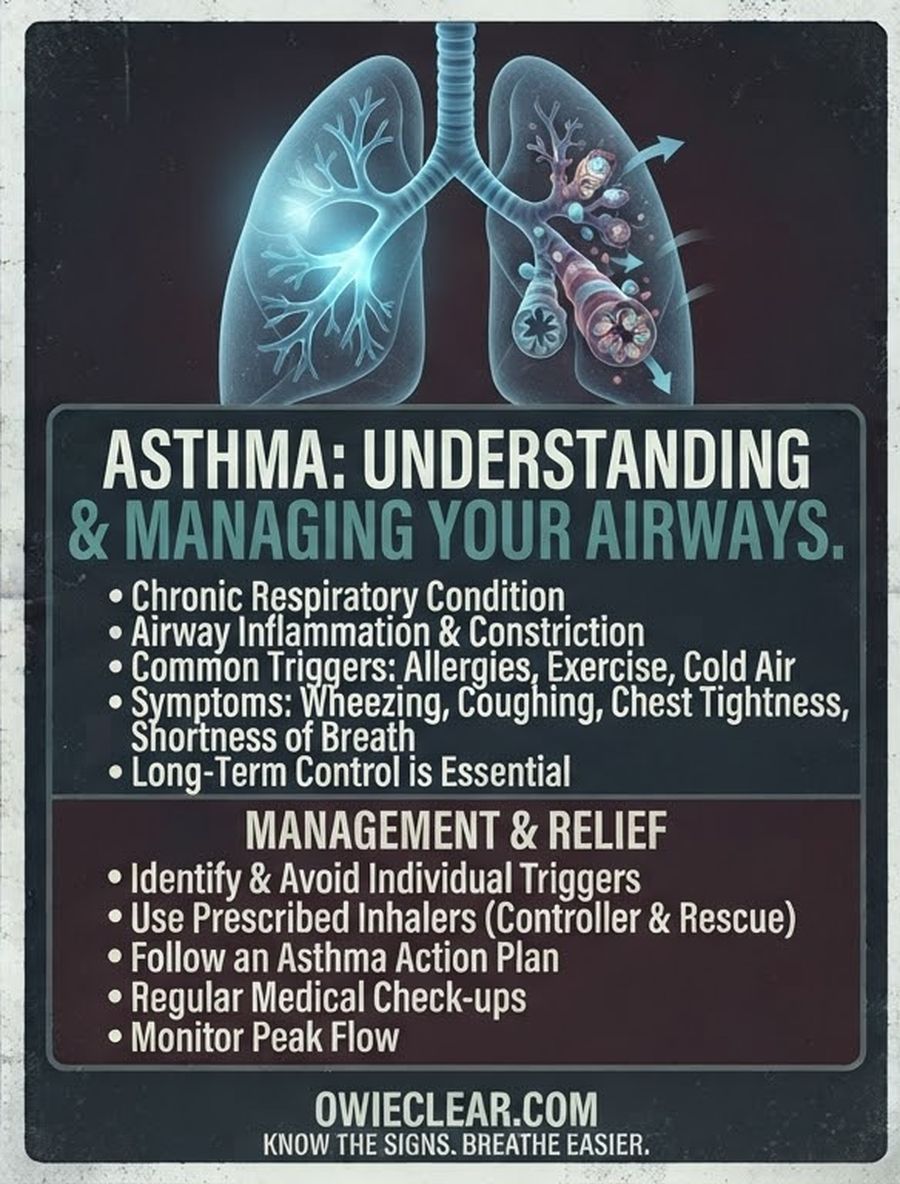
- Green zone: well, usual treatment, usual activity. Peak flow at or near personal best.
- Yellow zone: symptoms worsening, night waking, more reliever use, or peak flow dropping below about 80 percent of personal best. The plan says exactly what to change and when.
- Red zone: severe symptoms, reliever not helping, peak flow below about 50 percent. The plan says to seek emergency help.
- Having a written plan is associated with fewer emergency visits and hospital admissions, which is why guidelines emphasize it.
- Plans need updating after any attack and at reviews. A plan from five years ago describing a treatment you no longer take is not useful.
Why it matters
If you do not have a written action plan, asking for one at your next appointment is one of the most useful things you can do.
What's still uncertain
- Plans are most effective when combined with regular review rather than handed over once.
Read more
Next: Technique and adherence
Where treatment usually fails
What happens
Before concluding that a medicine does not work, two things should be checked.
What the research shows
- A large proportion of people use their inhaler incorrectly, and most of them have never been shown properly or have never been rechecked.
- Common errors: not breathing out first, breathing in too fast with a metered-dose inhaler or too slowly with a dry powder one, not holding the breath afterwards, not shaking the device, firing before starting to inhale.
- A spacer solves most metered-dose inhaler technique problems, and it is useful for adults as well as children.
- Preventer inhalers are frequently stopped once someone feels well, which is exactly when they are working and exactly when stopping causes the next attack.
- Pharmacists will check technique on request, and it takes a few minutes. Asking for it is reasonable at any appointment.
Why it matters
If an inhaler seems not to work, technique is the first thing to check, not the last.
What's still uncertain
- Technique deteriorates over time even in people who were taught well, so rechecking matters.
Read more
- NHLBI: Asthma treatment and action planGovernment
- Global Initiative for Asthma (GINA): ReportsNonprofit
Next: The rest
Triggers, vaccines, and stepping down
What happens
The surrounding measures that reduce attacks.
What the research shows
- Identify your own triggers rather than avoiding a generic list: common ones are house dust mite, pets, pollen, mould, cold air, exercise, smoke, strong smells, and viral infections.
- Not smoking, and not vaping. Smoking makes asthma worse and makes inhaled steroids work less well.
- Annual influenza vaccination, and other vaccines as recommended, because viral infections are a leading trigger of severe attacks.
- Weight management where relevant: obesity is associated with worse control and poorer response to treatment.
- Treatment can be stepped down after a period of good control, usually around three months, and this should be done deliberately with a clinician rather than by stopping on your own.
Why it matters
Stepping down is a legitimate goal and it is done carefully. Stopping a preventer because you feel well is not the same thing.
What's still uncertain
- Evidence for specific trigger avoidance measures, including dust mite interventions, is mixed.