The parasite that steals iron and fat: what Trichomonas is made of
Last reviewed November 16, 2026. OwieClear editorial team. Waiting for clinician review. Not medical advice. Talk with your doctor about your own care.
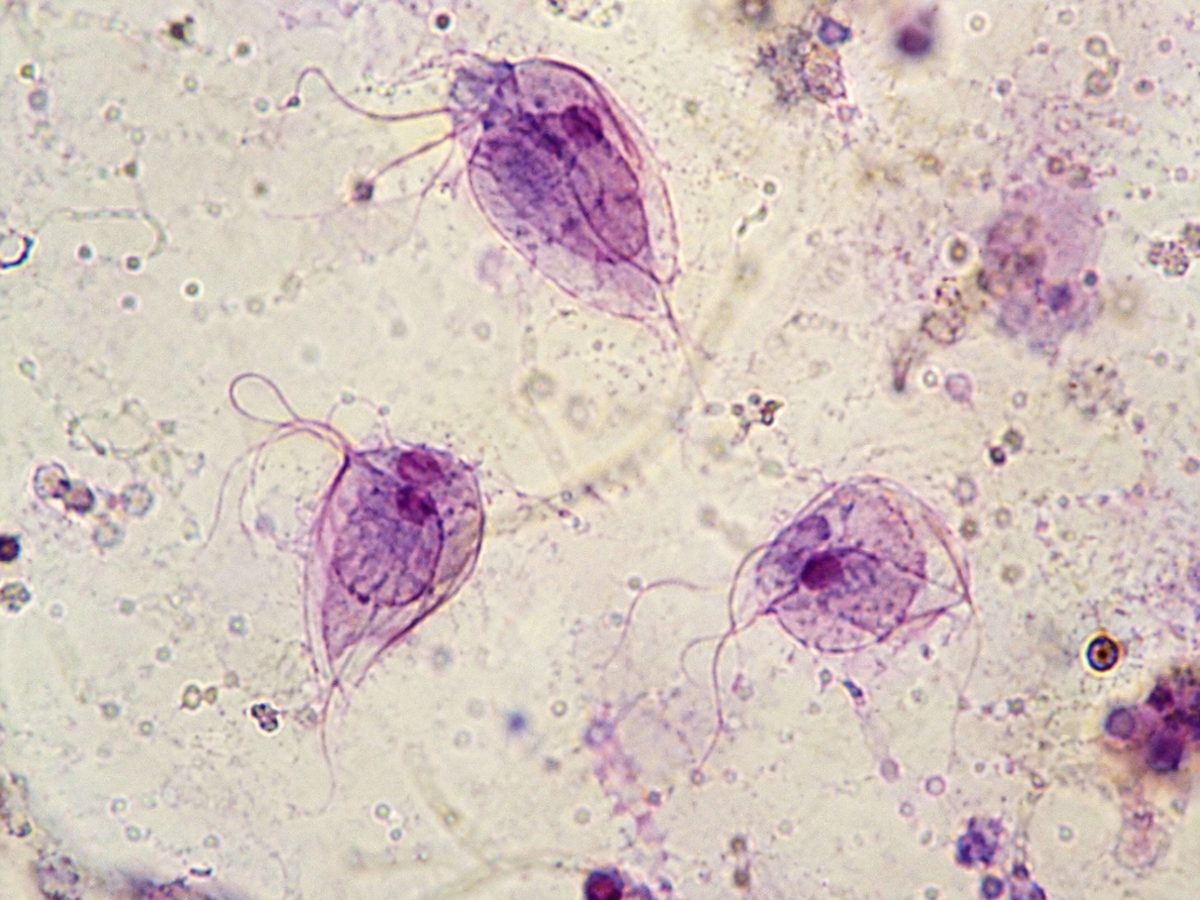
Trichomoniasis isn't caused by a virus or a bacterium. It's caused by a protozoan: a single-celled animal, with a nucleus, roughly the size of a white blood cell, that swims.
That difference matters practically, because antibiotics like penicillin do nothing to it. And its biology explains the rest: it is missing so many of its own manufacturing systems that it has to live by taking things from you.
Related pages: Trichomoniasis
The bottom line
- Trichomonas vaginalis is a flagellated protozoan parasite, the most common non-viral sexually transmitted infection worldwide.
- It has no mitochondria. It uses hydrogenosomes instead, which ferment sugars and release hydrogen gas.
- It cannot make its own purines, pyrimidines or cholesterol and must take them from human cells.
- Iron levels change how it behaves, switching on genes it uses to grip tissue.
- What exactly its best-known surface proteins do. Several turned out to be metabolic enzymes that also appear on the surface, and their role as adhesins is debated.
- Why it has one of the largest genomes of any protozoan studied.
The story, step by step
- 1. An animal, not a germ (Established parasitology)
- 2. No mitochondria ()
- 3. It can't build ()
- 4. Iron as a signal ()
- 5. The company it keeps ()
What the evidence labels mean
A single-celled eukaryote that swims
What happens
T. vaginalis is a eukaryote: it has a nucleus and internal compartments, like your own cells, rather than the simpler structure of a bacterium.
What the research shows
- It is pear-shaped when swimming, roughly 10 to 20 micrometres long, about the size of a white blood cell.
- It moves with four flagella at the front plus an undulating membrane along one side, which is what makes it recognisable under a microscope.
- It exists in only one form, the trophozoite. It cannot form a cyst, so it cannot survive long outside the body.
- That is why it is passed by direct sexual contact and not by toilet seats or swimming pools.
Why it matters
Being a eukaryote is why antibacterial antibiotics don't touch it and why treatment uses a different class of drug entirely.
What's still uncertain
- Survival outside the body in moist conditions can be longer than once assumed, but transmission that way is not established.
Read more
- CDC: About trichomoniasisGovernment
Next: No mitochondria
Hydrogenosomes: a different way to make energy
What happens
Almost all eukaryotes make energy in mitochondria using oxygen. This parasite lives in a low-oxygen environment and does it differently.
What the research shows
- It uses hydrogenosomes, compartments that ferment sugars and release hydrogen gas as a by-product.
- Hydrogenosomes are thought to be modified mitochondria that lost their usual machinery.
- This anaerobic chemistry is exactly what the treatment exploits: metronidazole is inert until an enzyme inside the hydrogenosome activates it into a compound that shreds the parasite's DNA.
- That is also why the drug is relatively specific: your own cells don't have the enzyme that switches it on.
Why it matters
The organelle that keeps the parasite alive is the one that kills it, which is a neat piece of pharmacology.
What's still uncertain
- The textbook claim that hydrogen gas is what makes the discharge frothy is a reasonable idea, but frothy discharge is neither universal nor required for diagnosis.
Read more
- CDC STI treatment guidelines: trichomoniasisGovernment
- OwieClear: Restoring the lining afterwardOwieClear
Next: It can't build
Missing the machinery to make its own parts
What happens
Researchers mapped what the parasite can and cannot synthesise.
What the research shows
- It cannot make purines or pyrimidines, the building blocks of DNA and RNA.
- It cannot make cholesterol or many lipids.
- It therefore has to take all of these from human cells and from red blood cells it breaks open.
- Its 2007 genome sequence was unexpected: around 160 million bases, among the largest of any protozoan, roughly two-thirds of it repetitive DNA, with around 800 genes for surface proteins.
Why it matters
Being unable to build its own components is why it has to damage your cells rather than just live alongside them. The harm is a consequence of how it eats.
What's still uncertain
- The huge genome's purpose isn't understood; much of it may be parasitic DNA rather than useful genes.
Read more
- NIH: sequencing the Trichomonas vaginalis genomeGovernment
- OwieClear: How it invades the liningOwieClear
Next: Iron as a signal
Iron doesn't just feed it. It tells it what to do
What happens
Like most pathogens, the parasite needs iron. Unlike most, it uses iron levels as a signal that changes its behaviour.
What the research shows
- High local iron switches on genes the parasite uses to grip host tissue and to resist being killed by the complement system in blood.
- Red blood cells provide both iron and lipids, so breaking them open serves two purposes at once.
- This is one reason symptoms are often reported as worse around menstruation.
- A group of proteins long described as its main adhesins, labelled AP65, AP51, AP33 and AP23, were later identified as hydrogenosomal metabolic enzymes that also appear on the surface. Whether they truly work as adhesins is debated.
Why it matters
An organism that reads iron as a cue is one whose behaviour changes through the menstrual cycle, which fits what people describe.
What's still uncertain
- The adhesin question is a genuinely unresolved argument in this field, and anything presenting those four proteins as settled adhesins is overstating it.
- Most of this work is in cell culture, not in people.
Read more
- OwieClear: How it invades the liningOwieClear
- OwieClear: How it evades immunityOwieClear
Next: The company it keeps
A parasite carrying its own bacteria and viruses
What happens
T. vaginalis is unusual in hosting other organisms inside itself.
What the research shows
- It can carry a bacterium, Mycoplasma hominis, living inside it.
- It can also carry double-stranded RNA viruses, known as Trichomonasvirus.
- Carrying the virus has been linked to how the parasite responds to metronidazole and to the strength of inflammation it provokes.
- This makes it one of the few human parasites known to be itself infected by both a bacterium and a virus.
Why it matters
What is being treated isn't always one organism but a small community, which may partly explain why outcomes differ between people.
What's still uncertain
- The clinical significance of these passengers is still being worked out, including the idea that releasing viral material during treatment worsens symptoms.
Read more
- OwieClear: How it evades immunityOwieClear