The two core domains
Last reviewed November 16, 2026. OwieClear editorial team. Waiting for clinician review. Not medical advice. Talk with your doctor about your own care.
Autism is diagnosed on observed features rather than on a test, and those features fall into two groups. A person needs features from both to meet the criteria.
What the two groups do not capture is how differently they appear in different people, which is why the word spectrum is in the name.
Related pages: Autism
The bottom line
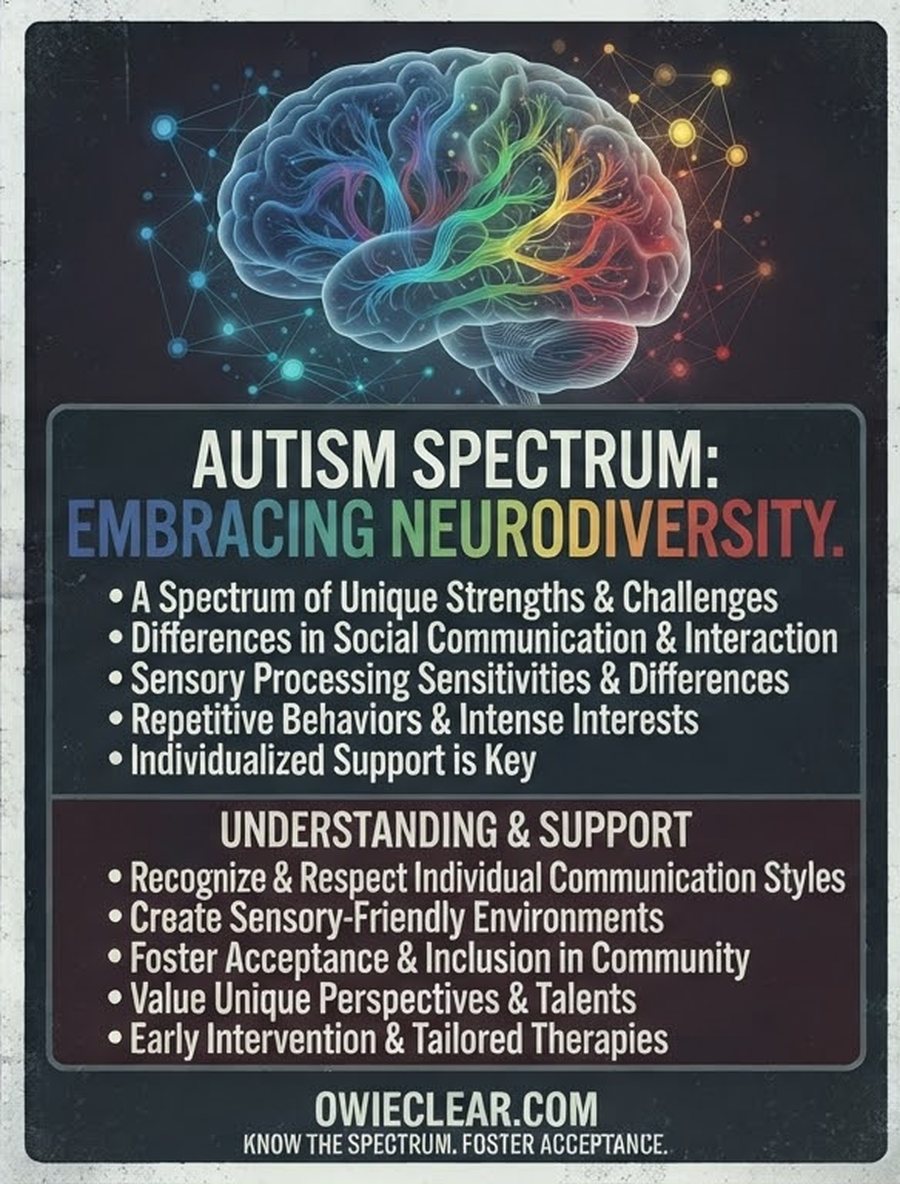
- Domain A covers social communication and social interaction.
- Domain B covers restricted and repetitive patterns, including sensory differences.
- Features must be present from early development, though they may be recognized much later.
- The same underlying difference can look completely different in two people.
- Why autism presents so differently between individuals.
- Whether the two domains reflect one underlying difference or several.
The story, step by step
What the evidence labels mean
Social communication and interaction
What happens
Three kinds of difference, and the word difference is doing real work here.
What the research shows
- Social-emotional reciprocity: the back-and-forth of conversation, sharing interests or feelings, approaching others in ways that may not match convention, reading cues that are implied rather than said.
- Nonverbal communication: differences in eye contact, facial expression, gesture and body language, or a mismatch between what is said and the nonverbal signals alongside it.
- Relationships: adjusting behaviour to different social contexts, imaginative play with others, forming and keeping friendships, and differing preferences about how much social contact is wanted.
- None of this means not wanting friends. Many autistic people want friendships very much and find the unwritten rules exhausting or opaque.
- Eye contact is worth a specific note: for many autistic people it is uncomfortable or makes listening harder, rather than signalling disinterest.
Why it matters
The common misreading is that these differences indicate not caring. Frequently the opposite is true, with considerable effort going into interactions that others find effortless.
What's still uncertain
- Features are judged against developmental level, which is why assessment is specialized.
Read more
- NIMH: Autism spectrum disorderGovernment
- CDC: Screening and diagnosis of autismGovernment
Next: Domain B
Restricted and repetitive patterns
What happens
Four kinds of feature, of which at least two are required.
What the research shows
- Repetitive movements or speech: hand-flapping, rocking, finger movements, lining objects up, echolalia or scripted speech. These are often called stimming.
- Insistence on sameness: strong preference for predictability, distress at small changes or transitions, rituals around daily routines.
- Intense focused interests, often called special interests: deep, sustained engagement with a topic or system.
- Sensory differences: over-reactivity to sound, light, texture or smell; under-reactivity, including to pain or temperature; or actively seeking sensory input.
- Sensory differences were only added to the formal criteria in 2013, despite being among the features autistic people most often describe as central.
Why it matters
Stimming is self-regulation. Suppressing it is usually counterproductive, and the instinct to stop it is one of the commonest well-meant mistakes.
What's still uncertain
- How much sensory difference contributes to other features is still being worked out.
Read more
- NIMH: Autism spectrum disorderGovernment
- OwieClear: Support and intervention principlesOwieClear
Next: Early signs
What is noticed first
What happens
In young children, particular features prompt assessment, and the review of our own page rightly insisted these are core rather than unusual.
What the research shows
- Not responding to their name by around 12 months.
- Not pointing at things to show them to someone, or not following a point, by around 12 to 14 months. This is joint attention, and it is one of the most useful early markers.
- Delayed speech, or loss of words or social skills, typically around 18 to 24 months. Regression is a reason for prompt assessment rather than watchful waiting.
- Limited social smiling, or little interest in back-and-forth games.
- Strong reactions to sensory input, unusual play such as lining things up, and distress at small changes.
Why it matters
Losing words or skills a child previously had is the single clearest reason to seek assessment without delay.
What's still uncertain
- Some autistic children develop typically until later; absence of early signs does not exclude autism.
Read more
- CDC: Screening and diagnosis of autismGovernment
- CDC: Autism spectrum disorderGovernment
Next: Why it looks different
The same features, different presentations
What happens
Two autistic people can appear to have nothing in common.
What the research shows
- Language varies from fluent and extensive to minimal or absent speech, and this does not track with intelligence.
- Cognitive ability spans the full range, with intellectual disability in a minority.
- Some people are visibly different from early childhood; others are not identified until adulthood.
- Presentation differs by gender: autistic girls and women are more often missed, partly because their interests may appear conventional and their social difficulties are better camouflaged.
- The same person presents differently in different settings, which is why reports from school and home can conflict without either being wrong.
Why it matters
A child who manages at school and falls apart at home is not being manipulative. They are depleted from holding it together all day.
What's still uncertain
- How much of the gender difference in diagnosis reflects real differences and how much reflects diagnostic bias is debated.
Read more
- NIMH: Autism spectrum disorderGovernment
- OwieClear: Masking, burnout and late diagnosisOwieClear
Next: How it is assessed
No blood test
What happens
Diagnosis is clinical, and knowing what that involves helps.
What the research shows
- Developmental history, usually with a parent or someone who knew the person in childhood.
- Direct observation, often using structured tools such as the ADOS-2, with a structured interview such as the ADI-R.
- Assessment of cognitive ability, language and adaptive functioning, because these shape support needs more than the diagnosis alone.
- Screening of all children at 18 and 24 months is recommended in the United States, typically using the M-CHAT questionnaire. A positive screen is not a diagnosis; it means a full assessment is needed.
- Early intervention should not wait for a formal diagnosis. Support can start on the basis of identified needs.
Why it matters
Waiting lists for assessment are long in most places. Starting support based on needs, rather than waiting for the label, is both allowed and sensible.
What's still uncertain
- Assessment tools were developed largely in young boys and perform less well in girls, adults and people with intellectual disability.
Read more
- CDC: Screening and diagnosis of autismGovernment
- OwieClear: The diagnostic evolutionOwieClear
More plain-language reading
- OwieClear: The support levelsOwieClear
- OwieClear: The diagnostic evolutionOwieClear
- OwieClear: Co-occurring conditionsOwieClear