What a stroke actually is
Last reviewed November 17, 2026. OwieClear editorial team. Waiting for clinician review. Not medical advice. Talk with your doctor about your own care.
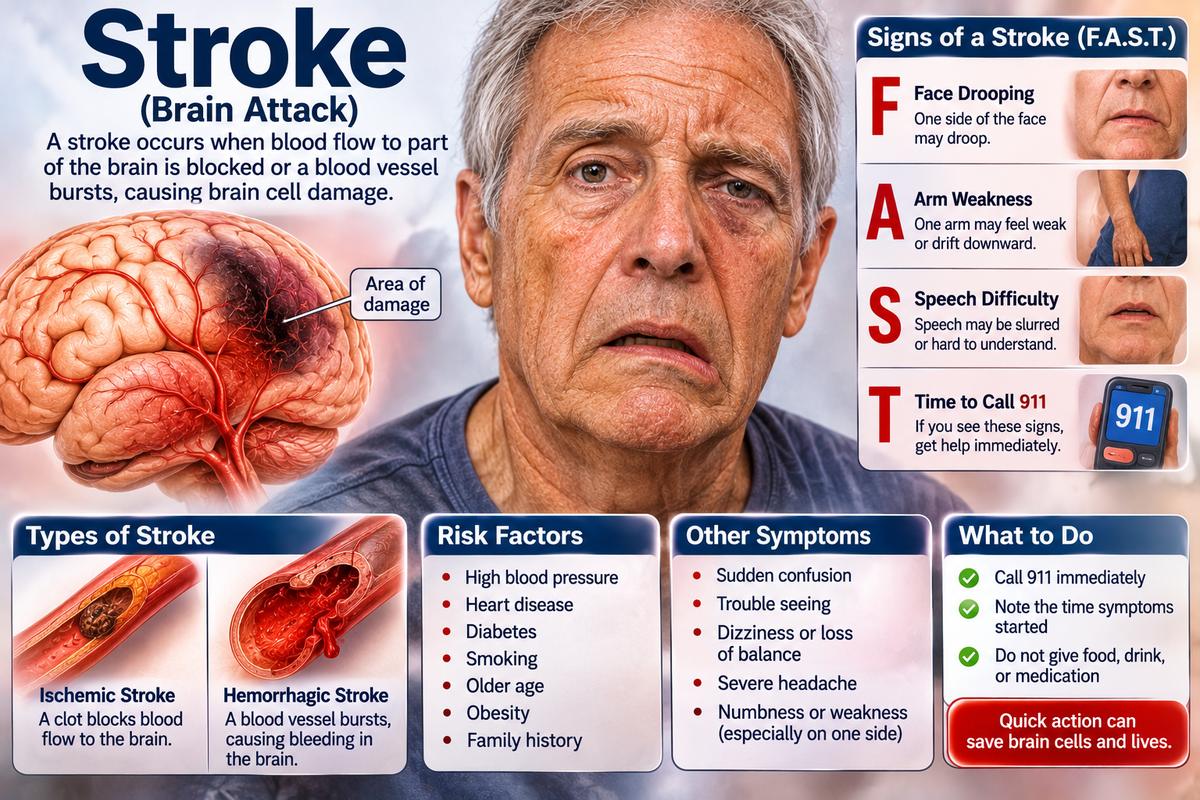
A stroke is a sudden loss of blood supply to part of the brain. Brain cells begin dying within minutes, which is why it is treated as an emergency on the same level as a heart attack.
There are two kinds with opposite causes and opposite treatments, which is why the first thing a hospital does is a scan rather than a drug.
Related pages: Stroke
The bottom line
- Most strokes are ischemic, from a blocked artery; a minority are hemorrhagic, from bleeding.
- Brain tissue starts dying within minutes of losing blood flow.
- A scan is needed before treatment, because the two kinds need opposite treatments.
- Stroke is a leading cause of long-term disability.
- Most strokes are preventable, and the biggest single factor is blood pressure.
- How much of the penumbra can be rescued in individual patients.
- Why recovery differs so much between people with similar scans.
- How to extend treatment to more people in time.
The story, step by step
What the evidence labels mean
Blocked or burst
What happens
Opposite problems, opposite treatments.
What the research shows
- Ischemic stroke, roughly 85 to 87 percent of cases, happens when a clot blocks an artery supplying the brain. The clot may form there or travel from the heart or neck arteries.
- Hemorrhagic stroke, roughly 13 to 15 percent, happens when a blood vessel bursts and blood leaks into or around the brain.
- Intracerebral haemorrhage is bleeding into the brain tissue itself, most often from long-standing high blood pressure.
- Subarachnoid haemorrhage is bleeding into the space around the brain, usually from a burst aneurysm, and classically causes a sudden, catastrophic headache.
- From the outside they can look identical, which is why no treatment is given before a brain scan.
- The distinction is critical: the clot-dissolving drug that saves an ischemic stroke would be catastrophic in a bleed.
Why it matters
This is why an ambulance and a scanner matter more than anything a bystander can do. The treatment depends on an answer only imaging can give.
What's still uncertain
- How to identify haemorrhage before imaging in the field.
- Whether mobile stroke units should be used more widely.
Read more
- NINDS: StrokeGovernment
- MedlinePlus: Ischemic strokeGovernment
- MedlinePlus: Hemorrhagic strokeGovernment
Next: Why minutes
Time is brain
What happens
The scale of the loss.
What the research shows
- A widely cited estimate is that a typical large-vessel ischemic stroke destroys around 1.9 million neurons every minute it goes untreated.
- Put another way, each hour without treatment ages the affected brain by roughly 3.6 years.
- The core of the stroke, where flow has stopped completely, dies quickly. Around it is the penumbra, tissue that is starved but still alive and still salvageable.
- Everything that acute treatment does is aimed at saving the penumbra, and it shrinks with every minute.
- Faster treatment produces better outcomes in a continuous way: it is not a cliff edge at the end of the time window, but a steady loss throughout.
- This is the entire reason for calling 911 rather than driving, arranging a lift, or waiting to see if it passes.
Why it matters
The instinct to wait and see is the single most costly response to stroke symptoms, and it is also the most common one.
What's still uncertain
- How much variability there is in how fast the penumbra dies.
- How to reduce time from symptom onset to calling for help.
Read more
- CDC: Stroke signs and symptomsGovernment
- NINDS: StrokeGovernment
- American Heart Association / American Stroke AssociationNonprofit
Next: Who it happens to
Not only the old
What happens
Risk rises with age, and it is not confined to it.
What the research shows
- Risk roughly doubles with each decade after 55, and most strokes occur in older adults.
- A meaningful share happen in people under 65, and rates in younger adults have been rising.
- Stroke can occur in children and even in newborns, where the causes are usually different.
- High blood pressure is the single biggest contributor, followed by atrial fibrillation, smoking, diabetes, abnormal cholesterol, inactivity and obesity.
- Black Americans have substantially higher stroke rates and tend to have strokes younger, reflecting higher rates of high blood pressure and differences in access to care rather than race being a biological cause in itself.
- Women have more strokes over a lifetime than men, partly because they live longer, with additional risks from pregnancy, some hormonal contraception and migraine with aura.
Why it matters
Assuming stroke is a disease of the very old delays recognition in exactly the people with most to lose from that delay.
What's still uncertain
- Why stroke rates are rising in younger adults.
- How to close the outcome gaps between groups.
Read more
- CDC: StrokeGovernment
- NINDS: StrokeGovernment
- American Heart Association / American Stroke AssociationNonprofit
Next: What happens after
Recovery is real and uneven
What happens
The brain rewires, to a point.
What the research shows
- Outcomes range from complete recovery to severe permanent disability, and the scan at the time does not fully predict which.
- Recovery is fastest in the first three months and continues for months to years, more slowly, with therapy.
- It works through neuroplasticity: surviving parts of the brain take on functions the damaged part performed, which requires repeated practice rather than rest.
- Stroke is a leading cause of long-term disability, and it is also something many people recover substantially from.
- The most important factor after the acute treatment is organised rehabilitation, started early and continued.
- A quarter of strokes happen in people who have had one before, which makes preventing the second one a central part of recovery.
Why it matters
The idea that recovery stops at six months is outdated and discouraging. It slows, but it does not have a deadline.
What's still uncertain
- How long meaningful recovery continues.
- Which rehabilitation approaches work best and when.