What acid reflux actually is: a valve problem, not an acid problem
Last reviewed November 16, 2026. OwieClear editorial team. Waiting for clinician review. Not medical advice. Talk with your doctor about your own care.
The standard mental model of reflux is that the stomach makes too much acid. It is a reasonable guess and it is mostly wrong.
Most people with reflux produce a perfectly normal amount of acid. The problem is that it ends up somewhere that has no defence against it.
Related pages: Acid reflux (GERD)
The bottom line
- Stomach acid is normally very strong, around pH 1.5 to 3.5.
- The stomach is protected by a thick mucus and bicarbonate layer. The oesophagus is not.
- Reflux is a failure of the barrier between them, not usually an excess of acid.
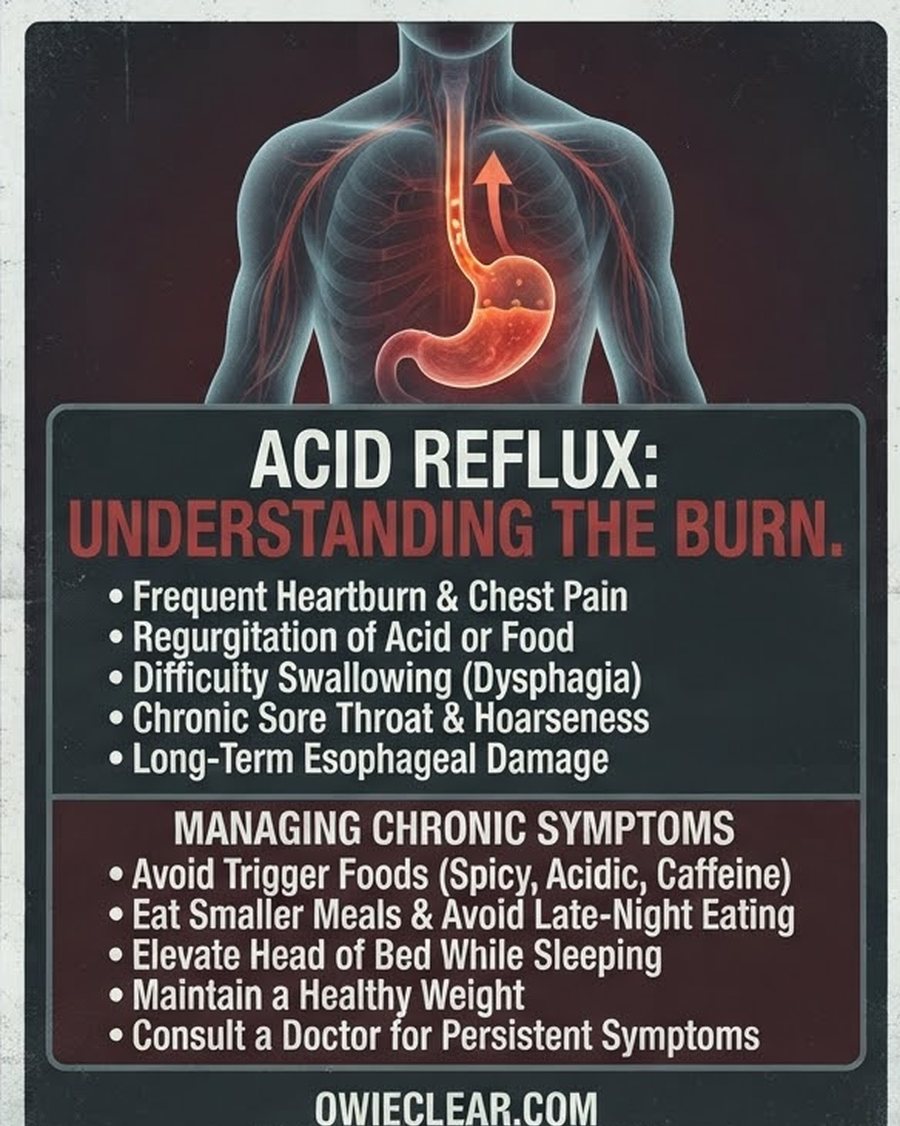
- Occasional reflux is normal; GERD is reflux that causes symptoms or damage.
- Why some people get severe symptoms with little visible damage and others the reverse.
- Why reflux has become more common in recent decades.
The story, step by step
What the evidence labels mean
Doing exactly what it should
What happens
The stomach is an intentionally hostile place, and that is the point.
What the research shows
- Gastric acid sits at roughly pH 1.5 to 3.5, strong enough to begin dissolving protein.
- It activates pepsin, the enzyme that digests protein, and kills most swallowed bacteria.
- The stomach survives this by producing a thick layer of mucus with bicarbonate trapped in it, which neutralizes acid right at the cell surface.
- That layer is constantly replaced, and the cells beneath it are built to cope.
- Measured acid production in most people with reflux is normal. The acid is not the abnormality.
Why it matters
This is why reducing acid treats the symptoms without fixing the cause, and why the symptoms return when the medicine stops.
What's still uncertain
- A minority of people do have excess acid production, from conditions such as Zollinger-Ellison syndrome, which is rare.
Read more
- NIDDK: Acid reflux (GER and GERD) in adultsGovernment
- MedlinePlus: GERDGovernment
Next: The oesophagus
No armour at all
What happens
The oesophagus is a muscular tube lined with squamous cells, built for transit rather than for acid.
What the research shows
- It has no thick mucus layer and no bicarbonate shield.
- Its defences are mechanical: muscular waves that sweep material back down, and swallowed saliva, which is slightly alkaline and neutralizes residue.
- Those defences work against brief, occasional exposure. They do not work against repeated or prolonged exposure.
- The throat and voice box have even less protection and no clearing waves at all, which is why reflux reaching that far causes different problems.
Why it matters
The asymmetry is the whole disease: a chemical designed to digest protein, meeting tissue that is made of protein and not designed to resist it.
What's still uncertain
- Individual sensitivity to acid varies widely and does not track with visible damage.
Read more
- NIDDK: Acid reflux (GER and GERD) in adultsGovernment
- OwieClear: Silent refluxOwieClear
Next: Reflux versus GERD
Everyone refluxes
What happens
A distinction that matters, because it decides whether anything needs doing.
What the research shows
- Gastro-oesophageal reflux, GER, is stomach contents moving up into the oesophagus. Everyone does this, usually after meals, usually without noticing.
- GERD is when reflux happens often enough or lasts long enough to cause troublesome symptoms or visible damage.
- The common working definition is symptoms twice a week or more, or any evidence of damage on endoscopy.
- Infants reflux constantly because the valve is immature and they lie flat. Most grow out of it.
- GERD is common in adults, affecting roughly a fifth of people in Western countries.
Why it matters
Occasional heartburn after a large meal is not a disease. The threshold is frequency, persistence and damage.
What's still uncertain
- Prevalence estimates vary considerably depending on the definition used.
Read more
Next: Not just acid
What is actually in the refluxate
What happens
What comes up is a mixture, and acid is only part of it.
What the research shows
- Pepsin, the protein-digesting enzyme, comes up with the acid. It can attach to tissue in the throat and oesophagus and stays there.
- Pepsin becomes active again whenever something acidic passes over it, which is one explanation for why throat symptoms can continue despite acid-blocking medicine.
- Bile salts and pancreatic enzymes can reflux back from the small intestine into the stomach and then upward, and these damage cell membranes directly.
- Bile-containing reflux is not neutralized by acid-blocking drugs, which is one reason some people do not respond to them.
- This is why the condition is better described as reflux than as acid reflux.
Why it matters
If acid-blocking medicine has not worked, it does not mean the diagnosis is wrong. It may mean acid was not the only problem.
What's still uncertain
- How much pepsin and bile contribute in individual patients is difficult to measure outside research settings.
Read more
Next: Why it matters
The reason to treat it
What happens
Reflux is uncomfortable, and the reason to take it seriously is what repeated exposure does over years.
What the research shows
- Inflammation of the oesophageal lining, oesophagitis, which can ulcerate and bleed.
- Scarring that narrows the tube, a stricture, so food sticks.
- Barrett's oesophagus, where the lining changes type, carrying a small increase in the risk of oesophageal cancer.
- Effects outside the oesophagus: chronic cough, hoarseness, dental erosion, and worsening of asthma in some people.
- Most people with reflux never develop any of these, which is worth saying plainly.
Why it matters
The point of treating reflux properly is not comfort alone. It is avoiding the small number of outcomes that are hard to reverse.
What's still uncertain
- The proportion of people with GERD who go on to develop Barrett's is low, and progression from Barrett's to cancer is lower still.
Read more
- NIDDK: Barrett's esophagusGovernment
- OwieClear: Oesophagitis, strictures and Barrett'sOwieClear
More plain-language reading
- OwieClear: How the one-way gate failsOwieClear
- OwieClear: Why pressure buildsOwieClear
- OwieClear: When heartburn isn't heartburnOwieClear