What atrial fibrillation actually is
Last reviewed November 17, 2026. OwieClear editorial team. Waiting for clinician review. Not medical advice. Talk with your doctor about your own care.
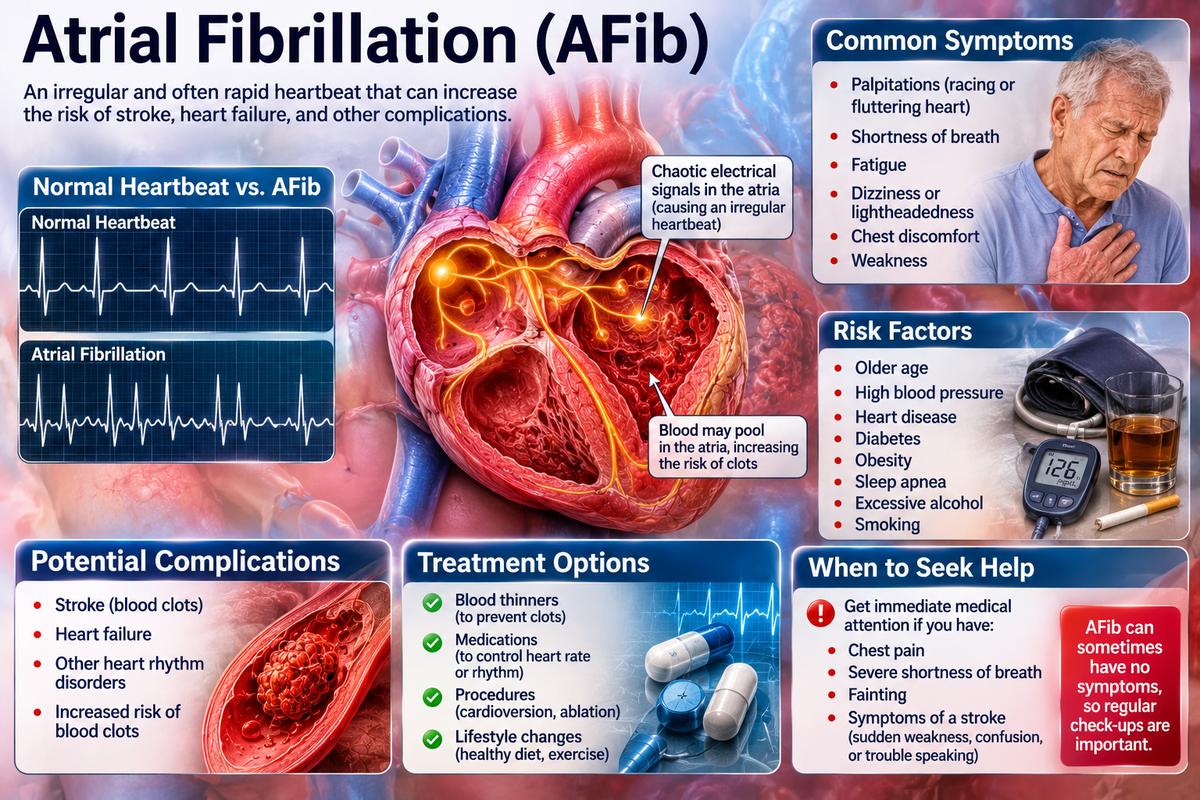
Atrial fibrillation is the most common sustained heart rhythm problem. The two upper chambers of the heart stop beating in an organised way and quiver instead, which makes the pulse irregular and often fast.
The symptoms range from nothing at all to a pounding, exhausting flutter. The danger, though, is the same either way: blood that sits still in a quivering chamber can clot, and that clot can travel to the brain.
Related pages: Atrial fibrillation (AFib)
The bottom line
- AFib is an irregular, often fast rhythm coming from the upper chambers of the heart.
- Stroke is the main danger, and it is largely preventable with the right medicine.
- A large share of people have no symptoms and are found on a pulse check or ECG.
- Fatigue and breathlessness are common symptoms, not rare ones.
- It usually gets more persistent over time if the drivers behind it are left alone.
- How much of the stroke risk comes from the rhythm itself versus the diseased atrium behind it.
- How best to find AFib in people who feel nothing.
- Whether very brief episodes picked up by watches carry the same risk.
The story, step by step
- 1. The normal rhythm ()
- 2. What goes wrong ()
- 3. Why it matters ()
- 4. Who gets it ()
- 5. What it feels like ()
What the evidence labels mean
How a heartbeat is supposed to work
What happens
One signal, one coordinated squeeze.
What the research shows
- A normal heartbeat starts in the sinus node, a small patch of cells in the right atrium that acts as the heart's own pacemaker.
- The signal spreads across both atria, making them contract and push blood down into the ventricles.
- It then passes through the atrioventricular node, the only electrical doorway between upper and lower chambers, which briefly delays it so the ventricles fill before they squeeze.
- The result is a regular rhythm, usually 60 to 100 beats a minute at rest, with each beat preceded by a single organised atrial contraction.
- That atrial contraction is often called the atrial kick. It adds roughly the last 10 to 30 percent of the blood that fills each ventricle.
- On an ECG the organised atrial signal shows up as a P wave before every beat.
Why it matters
Everything that goes wrong in AFib is a departure from this sequence, so the normal version is worth holding in mind.
What's still uncertain
- How much the atrial kick matters in people with otherwise healthy hearts.
Read more
- NHLBI: ArrhythmiasGovernment
- MedlinePlus: ArrhythmiaGovernment
Next: What goes wrong
Chaos instead of a signal
What happens
Hundreds of competing signals at once.
What the research shows
- In AFib the sinus node is drowned out. Rapid, disorganised electrical activity sweeps across the atria from several places at once, often at 300 to 600 impulses a minute.
- The atria cannot contract in response to that. They quiver, and the atrial kick is lost.
- The AV node blocks most of those impulses, which is the only reason the condition is survivable, but it lets them through unpredictably.
- That is why the pulse is irregular: the ventricles are responding to a random subset of a chaotic input.
- Untreated, the resulting heart rate is often 100 to 175 beats a minute, though it can be normal or even slow in people on rate-slowing medicine or with AV node disease.
- On an ECG the P waves are replaced by a wavy or flat baseline, with an irregular gap between beats. That pattern is the diagnosis.
Why it matters
An irregularly irregular pulse with no discernible pattern is the clinical hallmark, and it is something you can sometimes feel at your own wrist.
What's still uncertain
- Why the chaotic wavelets organise themselves the way they do.
- Why some atria tolerate the same triggers without fibrillating.
Read more
- NHLBI: Atrial fibrillationGovernment
- MedlinePlus: Atrial fibrillationGovernment
- CDC: Atrial fibrillationGovernment
Next: Why it matters
Stroke, and the slow drain
What happens
Two separate harms from the same rhythm.
What the research shows
- The first harm is clotting. Blood pools in the quivering left atrium, particularly in a small pouch called the left atrial appendage, and can form a clot that travels to the brain.
- AFib raises the risk of stroke several-fold, and strokes caused by AFib tend to be larger and more disabling than average.
- Anticoagulant medicine cuts that risk substantially. This is the single most important treatment decision in AFib.
- The second harm is the loss of pumping efficiency. Losing the atrial kick and running fast for long stretches reduces how much blood the heart moves.
- Over months a persistently fast rate can weaken the ventricle itself, a reversible problem called tachycardia-induced cardiomyopathy.
- AFib and heart failure often occur together and each makes the other worse.
Why it matters
Treatment is aimed at these two harms separately. Preventing stroke and controlling the rhythm are different jobs with different medicines, and doing one does not cover the other.
What's still uncertain
- How much of the stroke risk persists after a successful ablation.
- Whether very short episodes carry meaningful stroke risk.
Read more
- NHLBI: Atrial fibrillationGovernment
- MedlinePlus: StrokeGovernment
- American Heart Association: atrial fibrillationNonprofit
Next: Who gets it
Common, and commoner with age
What happens
Age is the dominant factor.
What the research shows
- AFib becomes markedly more common with age. It is uncommon before 50 and affects a substantial share of people in their 80s.
- Millions of adults in the United States have it, and the true number is higher than the diagnosed number because so many cases are silent.
- The main drivers are high blood pressure, obesity, obstructive sleep apnea, heavy alcohol use, overactive thyroid, heart valve disease, coronary disease and heart failure.
- Some cases follow surgery, acute illness, or a single heavy drinking episode, a pattern long nicknamed holiday heart.
- A minority of cases occur in young people with structurally normal hearts and no obvious cause.
- Long-term endurance athletes have a modestly raised risk, which is one of the few situations where more exercise is not better for the rhythm.
Why it matters
Most of the drivers on that list are treatable, which is why a new diagnosis of AFib normally triggers a search for what is behind it.
What's still uncertain
- Why some people develop AFib with none of the known drivers.
- How much of the inherited risk is explained by known genes.
Read more
- CDC: Atrial fibrillationGovernment
- NHLBI: Atrial fibrillationGovernment
- American Heart Association: atrial fibrillationNonprofit
Next: What it feels like
From nothing to debilitating
What happens
The symptom range is enormous.
What the research shows
- Many people have no symptoms whatsoever, and the rhythm is discovered during a routine pulse check, a blood pressure reading, an ECG before surgery, or by a smartwatch.
- When there are symptoms, the usual cluster is a racing, fluttering or skipping heartbeat, fatigue, breathlessness and reduced exercise tolerance.
- Fatigue and breathlessness are common complaints, not fringe ones, and they are often what finally brings someone in.
- Lightheadedness, chest discomfort and reduced ability to do familiar activities also occur.
- Fainting is not typical and needs prompt evaluation, because it may point to a very fast rate, long pauses, or another problem.
- Symptoms and severity do not track each other reliably. Someone who feels nothing can have the same stroke risk as someone who feels dreadful.
Why it matters
Because feeling fine is not reassurance, the treatment decisions in AFib are driven by risk factors on paper rather than by how bad the symptoms are.
What's still uncertain
- Why the same rhythm is debilitating for one person and imperceptible for another.
- How much of the fatigue is from the rhythm itself versus the medicines.
Read more
- MedlinePlus: Atrial fibrillationGovernment
- NHLBI: Atrial fibrillationGovernment
- American Heart Association: atrial fibrillationNonprofit