What is actually happening in the airway
Last reviewed November 16, 2026. OwieClear editorial team. Waiting for clinician review. Not medical advice. Talk with your doctor about your own care.
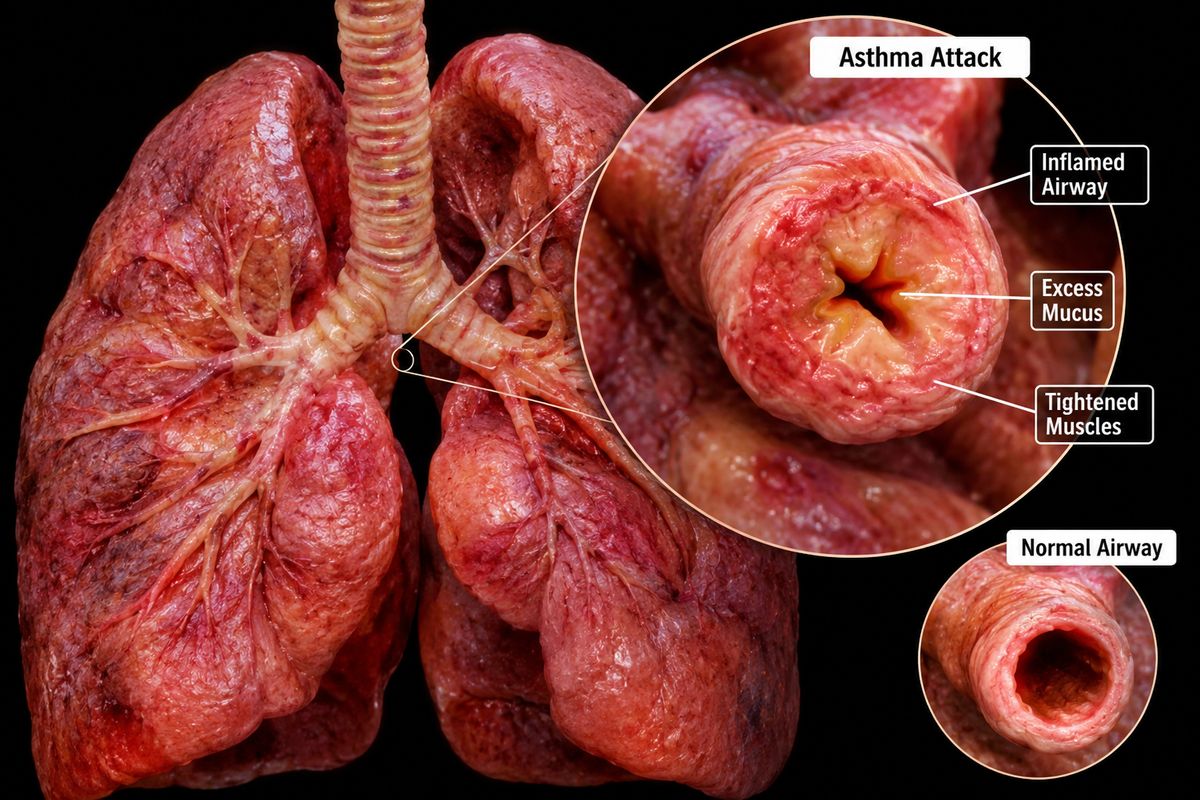
An airway is a tube with muscle wrapped around it and a lining inside it. Asthma attacks it from three directions at once.
Understanding which of the three a reliever inhaler fixes, and which two it does not, explains most of modern asthma treatment.
Related pages: Asthma
The bottom line
- Smooth muscle around the airway contracts, narrowing it.
- The lining becomes inflamed and swollen, narrowing it further.
- Mucus is overproduced and can plug small airways.
- Over years, persistent inflammation can cause permanent structural change.
- Why some people develop airway remodelling and others do not.
- How much remodelling can be prevented by early anti-inflammatory treatment.
The story, step by step
What the evidence labels mean
Smooth muscle contraction
What happens
The fastest of the three, and the only one a reliever reverses.
What the research shows
- Bands of smooth muscle wrap around the airways and normally adjust their diameter gently.
- In asthma these muscles are hyperresponsive: they contract strongly to stimuli that would do nothing in someone else, including cold air, exercise, smoke, dust and viral infections.
- Contraction narrows the airway within minutes, which is why an attack can come on suddenly.
- Short-acting beta-agonists relax this muscle within minutes, which is why a reliever works so quickly and feels so effective.
- In long-standing asthma the muscle layer itself thickens, so there is more of it to contract.
Why it matters
This is the part a blue inhaler fixes, and it is one of three problems. That is the whole argument for anti-inflammatory treatment.
What's still uncertain
- Why airways become hyperresponsive in the first place is not fully explained.
Read more
- NHLBI: AsthmaGovernment
- OwieClear: The modern treatment standardOwieClear
Next: The swelling
Inflammation of the lining
What happens
Slower, more persistent, and the underlying disease.
What the research shows
- The airway lining is infiltrated by immune cells: mast cells, eosinophils, type 2 helper T-cells, innate lymphoid cells, and in some people neutrophils.
- These release histamine, leukotrienes, prostaglandins and signalling molecules including interleukins 4, 5 and 13.
- The result is a swollen, leaky, irritable lining. In a tube only a few millimetres across, a small amount of swelling removes a large proportion of the space.
- This inflammation is present even when someone feels well, including in mild asthma. Biopsies confirm it.
- Inhaled corticosteroids act here, which is why they take days to weeks to show their full effect and why they must be continued when symptoms are absent.
Why it matters
Feeling fine is not evidence that the airways are quiet, and that single fact explains why preventer inhalers get stopped and attacks follow.
What's still uncertain
- Different people have different inflammatory patterns, which is the basis of the phenotypes.
Read more
- NHLBI: AsthmaGovernment
- OwieClear: Phenotypes and biologicsOwieClear
Next: The mucus
Plugging the small airways
What happens
The least discussed of the three and a major contributor in severe attacks.
What the research shows
- Goblet cells multiply and submucosal glands enlarge, producing far more mucus than normal.
- The mucus in asthma is unusually thick and sticky, and it adheres to the airway wall.
- In severe attacks it forms plugs that block small airways completely. Post-mortem studies of fatal asthma consistently find extensive mucus plugging.
- A plugged airway cannot be reached by inhaled medicine, which is one reason severe attacks become refractory.
- Imaging studies have shown mucus plugs persisting for years in some people with severe asthma, contributing to fixed airflow limitation.
Why it matters
Mucus plugging is why a severe attack can stop responding to inhalers altogether, and it is a reason not to wait it out.
What's still uncertain
- How best to target mucus plugging therapeutically is an active research question.
Read more
- NHLBI: AsthmaGovernment
Next: Two phases
Why an attack can come back hours later
What happens
Allergic triggers produce a characteristic two-stage response that matters practically.
What the research shows
- The early phase begins within minutes: mast cells release their stored mediators, the muscle contracts, and symptoms appear.
- A reliever treats this, and the person feels better.
- The late phase begins four to twelve hours later, as eosinophils and other cells arrive and inflammation builds.
- Symptoms can return, sometimes more severely, long after the trigger has gone and after the initial relief.
- This is one reason systemic steroids are given after significant attacks, and why someone who improves in an emergency department is not necessarily out of danger.
Why it matters
Feeling better after a reliever does not mean the episode is over. The second wave can be worse than the first.
What's still uncertain
- Not everyone shows a clear late-phase response, and it is most typical of allergic triggers.
Read more
- NHLBI: AsthmaGovernment
- OwieClear: Asthma attack: what to doOwieClear
Next: Remodelling
When the changes become permanent
What happens
Repeated inflammation over years changes the structure of the airway itself.
What the research shows
- The basement membrane beneath the lining thickens with deposited collagen.
- The smooth muscle layer grows, through both enlargement and multiplication of cells.
- New blood vessels form in the airway wall, adding to its bulk.
- The result is narrowing that does not fully reverse with a bronchodilator: fixed airflow obstruction in someone who has asthma rather than COPD.
- Good anti-inflammatory control is thought to limit this, which is one of the arguments for treating inflammation early rather than waiting for severity.
Why it matters
Asthma that is well controlled for decades generally does not do this. Asthma that is repeatedly inflamed can.
What's still uncertain
- How much remodelling is preventable, and at what stage, is not established.
Read more
- NHLBI: AsthmaGovernment
- OwieClear: COPD (chronic lung disease)OwieClear