What happens in demyelination
Last reviewed November 16, 2026. OwieClear editorial team. Waiting for clinician review. Not medical advice. Talk with your doctor about your own care.
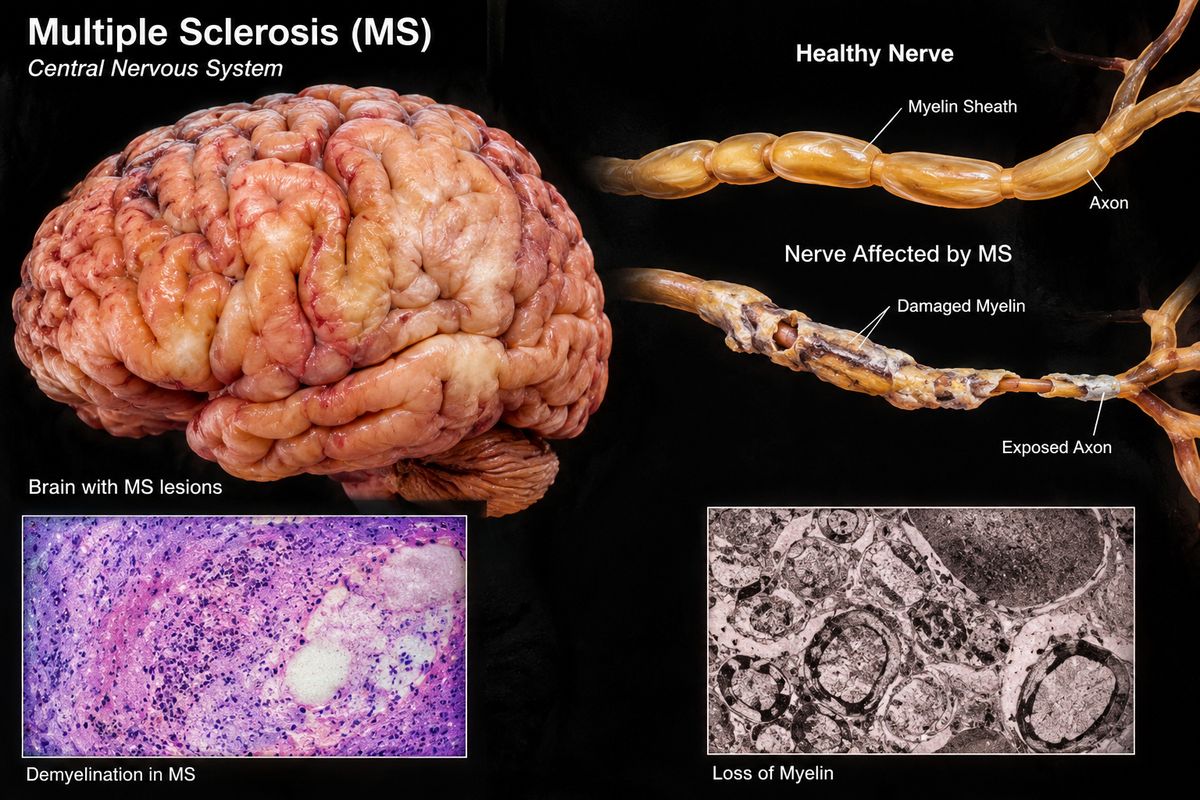
Nerve fibres carry signals as electrical impulses, and most are wrapped in myelin, a fatty insulating sheath. The insulation makes signals travel far faster than they otherwise would.
In MS the immune system attacks that insulation. What follows depends on how much gets stripped, how well it is rebuilt, and whether the fibre underneath survives.
Related pages: Multiple sclerosis (MS)
The bottom line
- MS is an immune-mediated disease of the central nervous system.
- Immune cells cross into the brain and spinal cord and strip myelin from nerve fibres.
- Damaged nerve fibres conduct signals slowly or not at all.
- Nerve fibres themselves are lost over time, and that loss is not reversible.
- Exactly what the immune system is reacting to, which is still not established.
- Why remyelination works well in some people and fails in others.
The story, step by step
What the evidence labels mean
What the insulation does
What happens
Myelin lets nerve signals move at speed, and it also keeps the fibre underneath alive.
What the research shows
- Oligodendrocytes, a type of support cell, wrap layers of membrane around nerve fibres in the brain and spinal cord.
- The wrapping is interrupted at regular gaps. The electrical signal jumps from gap to gap rather than travelling along the whole length, which is called saltatory conduction and makes signals up to a hundred times faster.
- Myelin also supplies the axon with energy and support molecules, so it is not only insulation.
- One oligodendrocyte myelinates many fibres at once, so losing a few of these cells affects a lot of wiring.
- In the body outside the brain and spinal cord, different cells do this job, which is why MS affects the central nervous system and not the peripheral nerves.
Why it matters
Speed is the point. A signal that arrives late or incompletely produces a symptom even though the fibre is still there.
What's still uncertain
- How myelin supports axon metabolism is still being worked out.
Read more
- NINDS: Multiple SclerosisGovernment
- MedlinePlus: Multiple SclerosisGovernment
Next: The barrier opens
How immune cells get in
What happens
The brain is normally sealed off from the circulating immune system. In MS, that seal breaks down in patches.
What the research shows
- Blood vessels in the brain have unusually tight junctions between their lining cells, forming the blood-brain barrier.
- In MS, activated T cells and B cells cross the barrier at small veins, and once inside they recruit more cells.
- The inflammation forms around those veins, which is why MS lesions on a scan often sit in a characteristic pattern around the ventricles.
- Gadolinium contrast on an MRI shows where the barrier is currently leaking, which is how a scan can tell a new lesion from an old one.
- What makes these cells react against myelin in the first place is unresolved. Prior Epstein-Barr virus infection is the strongest environmental association found.
Why it matters
The barrier breach is where disease-modifying treatment acts: most of these drugs work on immune cells in the blood, before they ever reach the brain.
What's still uncertain
- Whether the barrier breaks first or the inflammation breaks it is debated.
Read more
- NINDS: Multiple SclerosisGovernment
- OwieClear: Does the mono virus cause MS?OwieClear
Next: The attack
Stripping the sheath
What happens
Immune cells, antibodies and the brain's own resident immune cells remove myelin and kill the cells that make it.
What the research shows
- Macrophages and activated microglia strip myelin from the fibre and digest it.
- Antibodies and complement proteins mark myelin for destruction in some lesion types.
- Oligodendrocytes die, which removes the capacity to rebuild in that patch.
- The resulting area of damage is called a plaque or lesion, and the scarring that follows gives the disease its name: sclerosis means hardening, and multiple refers to the scattered lesions.
- Lesions appear in the optic nerves, brainstem, cerebellum, spinal cord and the white matter around the ventricles, and the symptoms depend entirely on where they land.
Why it matters
The same disease produces completely different symptoms in different people, because the location of the damage decides what is lost.
What's still uncertain
- Several distinct patterns of lesion pathology exist, and what they mean is not settled.
Read more
- NINDS: Multiple SclerosisGovernment
- National Multiple Sclerosis SocietyNonprofit
Next: The signal fails
Why symptoms come and go
What happens
An exposed fibre conducts badly, and this explains some of the odd features of MS.
What the research shows
- Without insulation the signal leaks and slows, and may stop entirely. That is a relapse.
- Some function returns as inflammation settles and the fibre redistributes its ion channels along the bare segment. Partial remyelination also occurs.
- Recovery is often incomplete, and repeated damage in the same place recovers less each time.
- Heat makes conduction in a damaged fibre worse. A hot bath, a fever or exercise can temporarily bring back old symptoms, which is called Uhthoff's phenomenon and is not a relapse.
- Exposed fibres can also fire spontaneously, which produces the shock-like sensations, spasms and the electric feeling down the spine on bending the neck known as Lhermitte's sign.
Why it matters
Symptoms returning on a hot day are usually a temperature effect on old damage, not new damage. Cooling resolves it.
What's still uncertain
- How much early recovery comes from remyelination and how much from other adaptations is unclear.
Read more
- NINDS: Multiple SclerosisGovernment
- National Multiple Sclerosis SocietyNonprofit
Next: The slow part
Nerve loss and progression
What happens
Alongside the relapses, a quieter process removes nerve fibres permanently.
What the research shows
- Stripped axons are vulnerable and many are eventually severed. Unlike myelin, they are not replaced.
- Inflammation also continues inside the central nervous system, behind a partly repaired barrier, where drugs acting on the blood reach it poorly. This is sometimes called smouldering or compartmentalized inflammation.
- Brain volume falls faster in MS than with normal ageing, and that loss tracks disability better than lesion counts do.
- Disability can accumulate without any relapse at all, now described as progression independent of relapse activity, or PIRA. It is increasingly recognized as happening from early in the disease, not only late.
- This is the reason current practice favours effective treatment early, before fibres are lost, rather than escalating slowly after damage accumulates.
Why it matters
Relapses are the visible part of MS. The quiet nerve loss underneath is what determines long-term disability, and it is why waiting is costly.
What's still uncertain
- No treatment yet clearly halts the progressive component, and remyelination therapies remain experimental.
Read more
- NINDS: Multiple SclerosisGovernment
- National Multiple Sclerosis SocietyNonprofit