What heart failure actually is
Last reviewed November 17, 2026. OwieClear editorial team. Waiting for clinician review. Not medical advice. Talk with your doctor about your own care.
Heart failure does not mean the heart has stopped or is about to. It means the heart cannot pump or fill well enough to meet the body's needs at normal pressures.
It is the end point of many different heart problems rather than a disease of its own, and the treatment has improved enormously in the last thirty years.
Related pages: Heart failure
The bottom line
- Heart failure is a syndrome, not a single disease.
- The two main types are reduced ejection fraction and preserved ejection fraction.
- Most symptoms come from fluid backing up rather than from poor forward flow.
- Four classes of medicine improve survival in heart failure with reduced ejection fraction.
- Hospital admissions for fluid overload predict worse outcomes and are largely preventable.
- Why heart failure with preserved ejection fraction has been so resistant to treatment.
- How much of the risk is genetic.
- How best to prevent repeat hospital admissions.
The story, step by step
What the evidence labels mean
What it does not mean
What happens
Not an arrest, not the end.
What the research shows
- Heart failure means the pump is not keeping up. The heart is still beating, and for many people it keeps beating for decades.
- It is not a heart attack. A heart attack is a sudden blockage of a coronary artery killing muscle. Heart failure can follow one, but they are different events.
- It is not cardiac arrest, where the heart stops entirely.
- Congestive heart failure is the older term, referring to the fluid congestion that is its most visible feature. The two names mean the same thing.
- Many people have no idea they are in one of the milder categories, because early heart failure feels like getting older or being unfit.
- The word failure is unfortunate and frightens people more than the condition warrants at diagnosis.
Why it matters
A large part of the fear attached to this diagnosis comes from the name rather than from the prognosis, which for a treated patient is far better than most people assume.
What's still uncertain
- Whether renaming the condition would improve engagement with treatment.
- How much diagnostic delay the name itself causes.
Read more
- NHLBI: Heart failureGovernment
- MedlinePlus: Heart failureGovernment
- CDC: Heart failureGovernment
Next: The two types
Weak squeeze, stiff fill
What happens
Defined by ejection fraction.
What the research shows
- Ejection fraction is the share of blood in the left ventricle pumped out with each beat. Normal is roughly 50 to 70 percent.
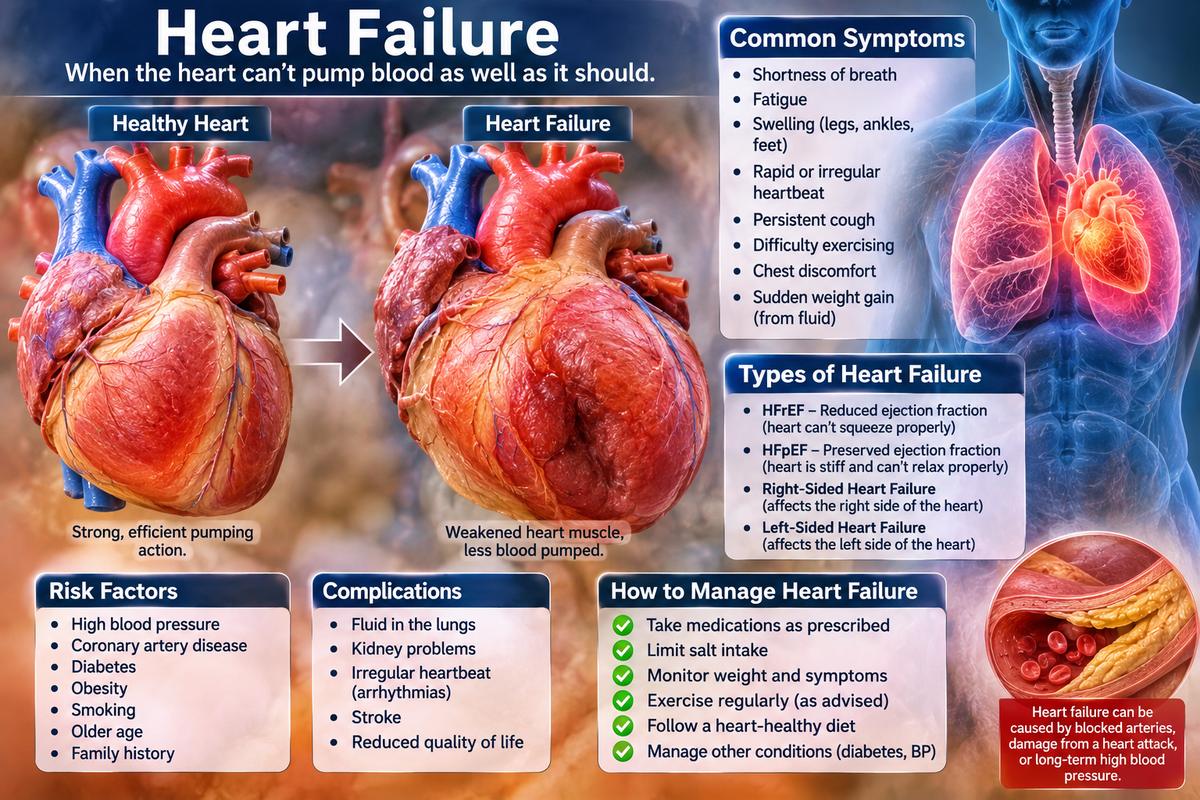
- Heart failure with reduced ejection fraction, HFrEF, means 40 percent or less. The muscle is weakened and squeezes poorly.
- Heart failure with preserved ejection fraction, HFpEF, means 50 percent or more. The muscle squeezes normally but is stiff and fills poorly.
- A middle category, mildly reduced, covers 41 to 49 percent.
- Roughly half of all heart failure is the preserved type, and it is more common in older adults, women, and people with high blood pressure, obesity, diabetes or atrial fibrillation.
- Symptoms are similar in both. You cannot tell which type someone has without an echocardiogram.
Why it matters
The distinction matters because it determines treatment. Until recently there was very little proven for the preserved type; SGLT2 inhibitors changed that.
What's still uncertain
- Whether HFpEF is one condition or several.
- Why so few drugs have worked in HFpEF.
Read more
- NHLBI: Heart failure diagnosisGovernment
- American Heart Association: heart failure resourcesNonprofit
- MedlinePlus: Heart failureGovernment
Next: The symptoms
Mostly about fluid
What happens
Backward pressure, not forward failure.
What the research shows
- Breathlessness on exertion is usually the first symptom, and it is easy to attribute to age or weight.
- Breathlessness lying flat, called orthopnea, and waking at night gasping are more specific. People often start using extra pillows without connecting it to anything.
- Swelling of the ankles, feet and legs, worse through the day, comes from fluid backing up on the right side.
- Rapid weight gain from fluid, two to three pounds in a day or five in a week, is one of the earliest and most actionable signs.
- Fatigue, reduced exercise tolerance, abdominal bloating, a persistent cough and needing to pass urine at night are all common.
- In older adults it can present as confusion, falls or simply slowing down, with no breathlessness mentioned at all.
Why it matters
Most of these come from congestion rather than from the heart pumping too little forward. That is why diuretics make people feel better so quickly without changing the pump at all.
What's still uncertain
- Why presentation differs so much between individuals.
- How to improve recognition of atypical presentation in older adults.
Read more
- NHLBI: Heart failureGovernment
- MedlinePlus: Heart failureGovernment
- MedlinePlus: EdemaGovernment
Next: The outlook
Better than its reputation
What happens
Transformed, and still serious.
What the research shows
- Heart failure remains a serious condition, and survival statistics quoted online are often drawn from older cohorts before modern treatment.
- Four classes of medicine, used together, substantially reduce death and hospital admission in heart failure with reduced ejection fraction.
- Ejection fraction improves significantly in a meaningful share of people on full treatment, sometimes back into the normal range.
- Prognosis varies enormously with the cause, the ejection fraction, the symptoms, kidney function and how well treatment is tolerated.
- Hospital admissions for fluid overload are the main marker of a worsening course, and most of them are preventable with daily weights and early action.
- Heart failure is also a leading cause of hospital admission in older adults, which is why self-monitoring is given so much emphasis.
Why it matters
The single most useful thing most people can do is catch fluid build-up early at home, before it needs a hospital.
What's still uncertain
- How much ejection fraction recovery is durable.
- How to reduce readmission rates reliably.
Read more
- NHLBI: Heart failure treatmentGovernment
- CDC: Heart failureGovernment
- American Heart Association: heart failure resourcesNonprofit