How airflow becomes limited
Last reviewed November 17, 2026. OwieClear editorial team. Waiting for clinician review. Not medical advice. Talk with your doctor about your own care.
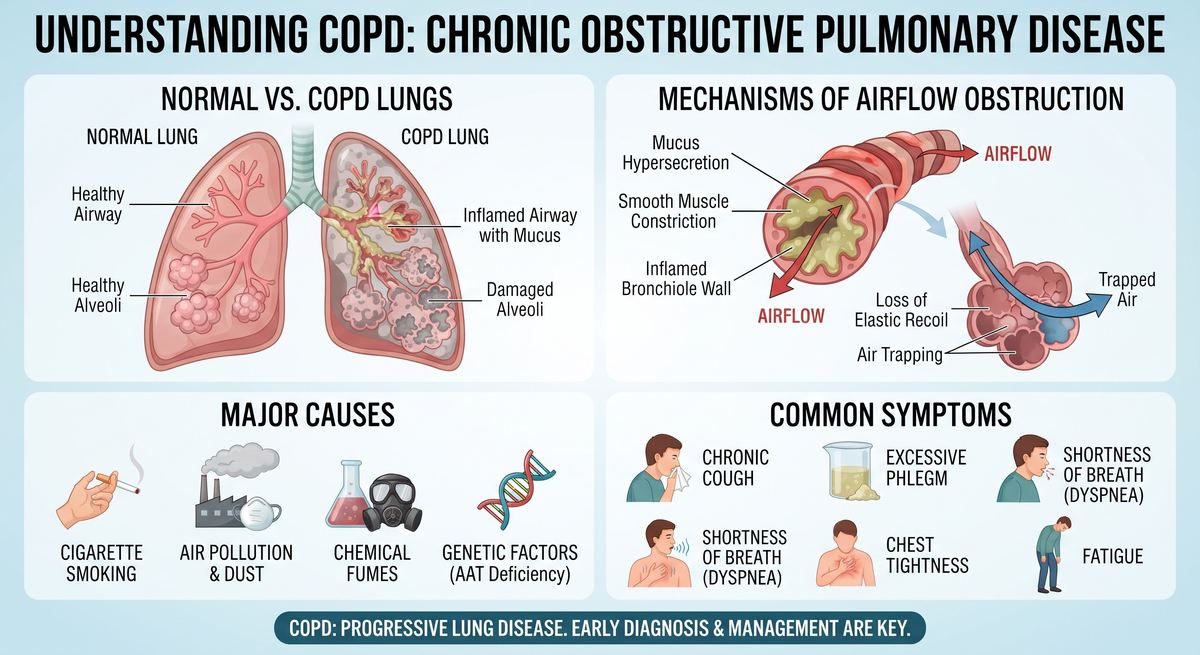
The lungs have about 300 million air sacs and a branching tree of airways ending in passages narrower than a hair. COPD damages both ends of that system at once.
What follows explains why breathing out is the problem, why the chest becomes barrel-shaped, and why nothing yet repairs it.
Related pages: COPD (chronic lung disease)
The bottom line
- Small airway inflammation and mucus narrow the passages.
- Alveolar destruction removes the elastic recoil that drives exhalation.
- Loss of alveolar attachments allows small airways to collapse on exhalation.
- Trapped air progressively overinflates the lungs and flattens the diaphragm.
- Alveolar tissue does not regenerate in adults.
- Why inflammation persists after smoking stops.
- Whether alveolar regeneration will ever be achievable.
- Which phenotype predicts the fastest decline.
The story, step by step
- 1. The small airways ()
- 2. The air sacs ()
- 3. Losing the spring ()
- 4. Hyperinflation ()
- 5. Beyond the lungs ()
What the evidence labels mean
Where it starts
What happens
Narrowing before symptoms.
What the research shows
- The damage begins in airways less than about 2 mm across, deep in the lung, long before anything is noticeable.
- Inhaled smoke and particles provoke persistent inflammation: immune cells infiltrate the airway walls, which thicken and scar.
- Goblet cells multiply and enlarge, producing excess mucus, while the cilia that normally sweep mucus out are damaged and paralysed.
- The result is narrowed, partly blocked passages that also clear themselves poorly, which is why infections take hold more easily.
- Imaging studies suggest large numbers of small airways are lost entirely before emphysema becomes visible on a scan.
- Because these airways contribute little to total resistance individually, a great deal can be lost before spirometry becomes abnormal.
Why it matters
The silent-zone problem is why COPD is usually diagnosed at a moderate stage: the lungs hide early damage well.
What's still uncertain
- How early small airway loss can be detected.
- Whether early intervention at that stage changes outcomes.
Read more
- NHLBI: COPD diagnosisGovernment
- GOLD: Global Initiative for Chronic Obstructive Lung DiseaseNonprofit
- MedlinePlus: Chronic bronchitisGovernment
Next: The air sacs
Emphysema
What happens
Walls destroyed, spaces merged.
What the research shows
- Alveoli are tiny, thin-walled sacs where oxygen and carbon dioxide cross into and out of the blood.
- In emphysema, enzymes released by inflammatory cells digest the elastic fibres in the alveolar walls.
- Normally alpha-1 antitrypsin protects against those enzymes. Smoking both increases enzyme release and inactivates the protector, which is the protease-antiprotease imbalance.
- In alpha-1 antitrypsin deficiency the protector is inherited in short supply, which is why emphysema develops early and in non-smokers.
- Destroyed walls merge small sacs into larger floppy spaces, reducing the surface area available for gas exchange.
- Alveolar tissue does not regenerate in adults, which is why this damage is permanent.
Why it matters
The enzyme-versus-protector model explains why one inherited deficiency produces the same disease as decades of smoke, and it is the clearest mechanistic story in COPD.
What's still uncertain
- Whether alveolar regeneration is achievable.
- Why some smokers develop emphysema and others chronic bronchitis.
Read more
- NHLBI: Alpha-1 antitrypsin deficiencyGovernment
- MedlinePlus: EmphysemaGovernment
- NHLBI: COPDGovernment
Next: Losing the spring
Why airways collapse
What happens
Recoil and tethering, both lost.
What the research shows
- Exhalation at rest is passive. The stretched elastic lung simply recoils, pushing air out, the way a balloon empties.
- Emphysema destroys that elastic tissue, so the recoil pressure driving air out falls.
- The alveolar walls also tether the small airways open, holding them apart like guy ropes. When the walls are destroyed, that support goes.
- Unsupported airways collapse during exhalation, when pressure around them rises, trapping air behind the collapse.
- This is dynamic airway collapse, and it is why forced exhalation makes things worse rather than better.
- Breathing out slowly through pursed lips creates back-pressure that splints the airways open, which is why people discover the technique on their own.
Why it matters
The mechanism explains a counterintuitive instruction: in COPD, blowing harder empties the lungs less, not more.
What's still uncertain
- How much of the collapse is potentially preventable.
- Why pursed-lip breathing helps some people more than others.
Read more
- NHLBI: COPD diagnosisGovernment
- MedlinePlus: EmphysemaGovernment
- GOLD: Global Initiative for Chronic Obstructive Lung DiseaseNonprofit
Next: Hyperinflation
The chest that cannot empty
What happens
The cause of most breathlessness.
What the research shows
- Air left behind after each breath accumulates, so the lungs sit permanently overinflated at rest.
- During exertion, breathing is faster, so there is even less time to empty and trapping worsens. This is dynamic hyperinflation.
- Overinflated lungs push the diaphragm down and flatten it. A flat diaphragm pulls inefficiently, generating less movement for the same effort.
- The chest becomes barrel-shaped, and accessory neck and shoulder muscles are recruited, which costs energy.
- Breathing in becomes hard because the lungs are already near full, so each breath starts from a disadvantaged position.
- This, rather than low oxygen, is the main reason people with COPD feel breathless on exertion.
Why it matters
Treatments that reduce hyperinflation, long-acting bronchodilators and some surgical procedures, improve breathlessness even when they barely change spirometry.
What's still uncertain
- The best way to measure hyperinflation in routine care.
- How much of exertional breathlessness it explains.
Read more
- GOLD: Global Initiative for Chronic Obstructive Lung DiseaseNonprofit
- NHLBI: COPD treatmentGovernment
- NHLBI: COPDGovernment
Next: Beyond the lungs
Why it is not only a lung disease
What happens
Systemic effects.
What the research shows
- Inflammation spills into the circulation, and COPD is associated with cardiovascular disease, osteoporosis, diabetes and depression at higher rates than expected.
- Skeletal muscle weakens and wastes, partly from inactivity and partly from systemic inflammation, which worsens exercise capacity independently of the lungs.
- Weight loss and muscle loss in advanced COPD predict worse outcomes, and are often mistaken for simply being unwell.
- Low oxygen over years can raise pressure in the lung arteries, straining the right side of the heart, called cor pulmonale, which causes ankle swelling.
- Lung cancer risk is substantially raised, beyond what smoking alone explains.
- This is why treatment includes exercise, nutrition and mood, and not only inhalers.
Why it matters
Treating COPD as a lung-only disease misses the muscle wasting and the cardiovascular risk, which between them do much of the harm.
What's still uncertain
- Whether systemic inflammation is cause or consequence.
- How best to prevent muscle loss.
Read more
- NHLBI: COPDGovernment
- CDC: COPDGovernment
- GOLD: Global Initiative for Chronic Obstructive Lung DiseaseNonprofit