How the immune system destroys beta cells
Last reviewed November 17, 2026. OwieClear editorial team. Waiting for clinician review. Not medical advice. Talk with your doctor about your own care.
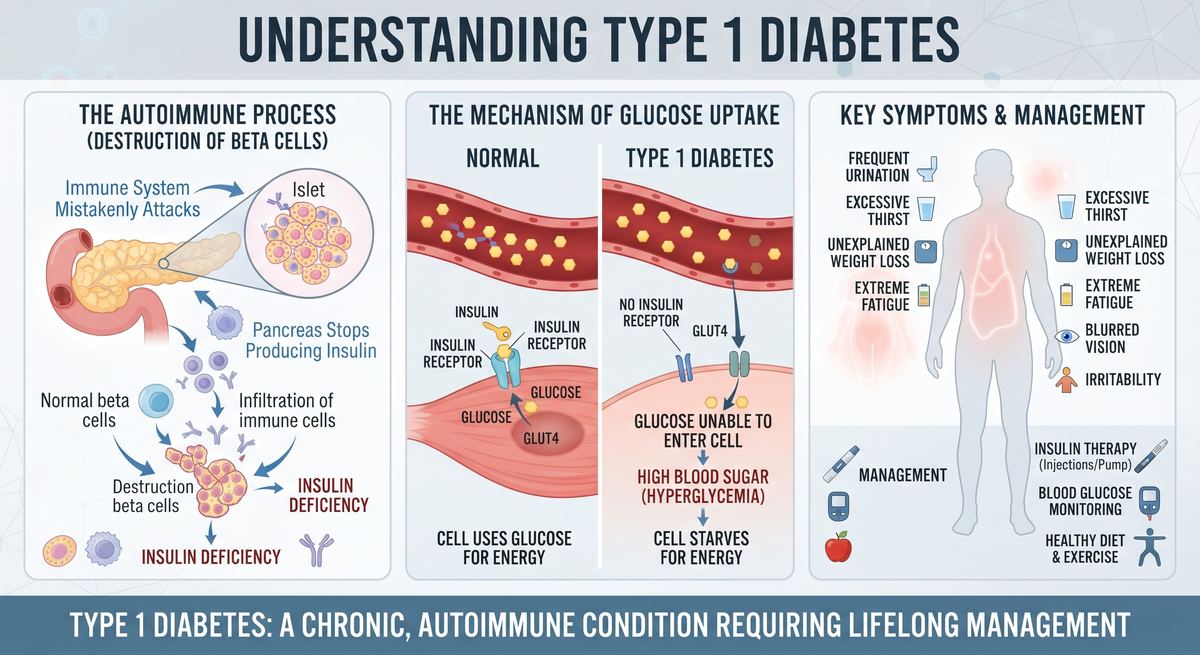
Type 1 diabetes is a case of mistaken identity carried out by the immune system's most precise weapon. T cells that should patrol for infected cells instead identify beta cells as targets.
The genetics are partly understood, the trigger is not, and the antibodies everyone tests for turn out to be witnesses rather than culprits.
Related pages: Type 1 diabetes
The bottom line
- T lymphocytes, not antibodies, destroy the beta cells.
- Islet autoantibodies are markers of the process and predict risk.
- HLA genes account for a large share of genetic susceptibility.
- An environmental trigger is strongly suspected but not identified.
- Beta-cell destruction is usually well advanced before symptoms appear.
- What the environmental trigger actually is.
- Why some people with high-risk genes never develop it.
- Whether residual beta cells can be protected or regrown.
The story, step by step
- 1. The attackers ()
- 2. The genetics ()
- 3. The trigger ()
- 4. The antibodies ()
- 5. The destruction curve ()
What the evidence labels mean
T cells, not antibodies
What happens
A common misunderstanding.
What the research shows
- The destruction is carried out mainly by cytotoxic T lymphocytes, which recognise fragments of beta-cell proteins displayed on the cell surface and kill the cell.
- Helper T cells coordinate the attack, and the whole process is called insulitis: inflammatory cells infiltrating the islets.
- Autoantibodies are produced too, but they are not what does the damage. They are evidence that the immune system has started targeting beta cells.
- That distinction matters because it explains why removing antibodies does not help, while therapies aimed at T cells can delay the disease.
- Regulatory T cells, which normally prevent attacks on the body's own tissues, appear to function poorly in this setting.
- Only beta cells are destroyed. Neighbouring alpha and delta cells in the same islet survive, which is a striking degree of specificity.
Why it matters
The precision of the attack is the reason immune-modulating therapy is plausible at all: there is one specific process to interrupt.
What's still uncertain
- Why the attack is so specific to beta cells.
- What causes regulatory T cell failure.
Read more
- NIDDK: Type 1 diabetesGovernment
- MedlinePlus: Autoimmune diseasesGovernment
- NIH: TrialNet and type 1 diabetes prevention researchGovernment
Next: The genetics
HLA and the rest
What happens
Susceptibility, not destiny.
What the research shows
- The strongest genetic associations are with HLA genes, which control how the immune system displays protein fragments for inspection.
- The HLA-DR3 and HLA-DR4 types, particularly in combination, carry the highest risk, and some other HLA types are strongly protective.
- HLA accounts for roughly half of the inherited risk. Dozens of other gene variants contribute smaller amounts, including the insulin gene itself.
- Even with the highest-risk genotype, most people never develop type 1 diabetes.
- An identical twin of someone with type 1 diabetes has a substantially raised risk but far from certainty, which demonstrates that genes alone are not sufficient.
- Most people diagnosed have no family history, because the high-risk genes are common in the population while the disease is not.
Why it matters
Genetic risk scoring is useful for identifying who to screen, and useless as a prediction for an individual.
What's still uncertain
- Which non-HLA variants matter most.
- How to combine genetic and antibody screening efficiently.
Read more
- NIH: TrialNet and type 1 diabetes prevention researchGovernment
- NIDDK: Type 1 diabetesGovernment
- American Diabetes Association: standards of care resourcesNonprofit
Next: The trigger
The part nobody has pinned down
What happens
Strong suspicion, no verdict.
What the research shows
- Something appears to initiate the process in genetically susceptible people, and decades of research have not identified it conclusively.
- Enteroviruses, particularly coxsackie B, are the most studied candidates, with viral material found in the pancreas of some people with recent-onset disease.
- Rising incidence over decades, and seasonal patterns in diagnosis, both point toward environmental factors rather than genetic change.
- Other hypotheses include gut microbiome differences, early infant diet, vitamin D status and reduced early immune exposure.
- The hygiene hypothesis, that reduced early exposure to infections leaves the immune system poorly calibrated, is consistent with rising rates but unproven.
- Vaccines do not cause type 1 diabetes. This has been examined repeatedly in large studies and no link exists.
Why it matters
The absence of a known trigger is also why primary prevention does not exist yet. You cannot avoid an exposure nobody has identified.
What's still uncertain
- Whether enteroviruses are causal or coincidental.
- What role the gut microbiome plays.
Read more
- NIH: TrialNet and type 1 diabetes prevention researchGovernment
- CDC: Type 1 diabetesGovernment
- NIDDK: Type 1 diabetesGovernment
Next: The antibodies
Markers, and useful ones
What happens
What testing actually detects.
What the research shows
- Four main islet autoantibodies are measured: GAD65, IA-2, insulin autoantibodies, and ZnT8.
- They appear months to years before symptoms, which makes them the basis of presymptomatic screening.
- The number matters more than which ones. A single antibody carries modest risk; two or more indicates the process is established and progression is highly likely over time.
- Insulin autoantibodies become unmeasurable after insulin treatment starts, so testing is more informative before or soon after diagnosis.
- Antibody testing is what distinguishes type 1 from type 2 when the clinical picture is ambiguous, particularly in adults.
- A small share of people with clinical type 1 diabetes test negative for all of them, which does not exclude the diagnosis.
Why it matters
Two or more antibodies in a person with normal blood sugar now counts as early-stage type 1 diabetes in its own right, which changed how the condition is defined.
What's still uncertain
- Why some people are antibody-negative.
- Whether broader population screening is worthwhile.
Read more
- NIH: TrialNet and type 1 diabetes prevention researchGovernment
- American Diabetes Association: standards of care resourcesNonprofit
- NIDDK: Type 1 diabetesGovernment
Next: The destruction curve
Why symptoms come late
What happens
Most of it happens silently.
What the research shows
- Beta-cell mass declines over months to years, and the pancreas compensates until the loss is substantial.
- Symptoms typically appear only when a large majority of beta-cell function is gone.
- The decline is faster in young children, who tend to present more acutely and more often in ketoacidosis.
- In adults it can be slow enough that tablets appear to work for a time, which is how LADA is usually missed.
- Some beta cells often survive after diagnosis, which is the basis of the honeymoon phase and of efforts to preserve what remains.
- Low-level insulin production detectable years after diagnosis is now recognised in many people, and preserving it is associated with fewer complications and fewer severe lows.
Why it matters
The long silent phase is exactly what makes screening and early intervention possible, and it is why the disease is now described in stages.
What's still uncertain
- How much residual function can be preserved.
- Whether preserving it changes long-term outcomes meaningfully.