What type 1 diabetes actually is
Last reviewed November 17, 2026. OwieClear editorial team. Waiting for clinician review. Not medical advice. Talk with your doctor about your own care.
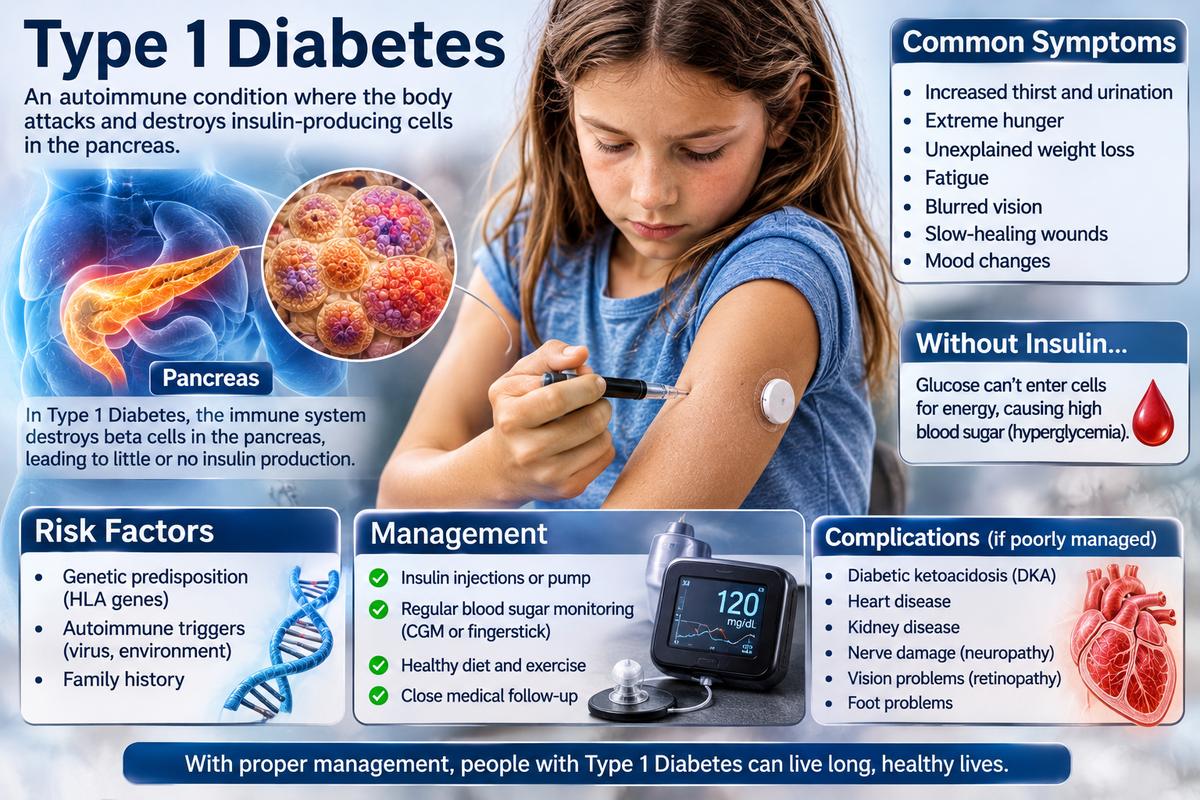
In type 1 diabetes the immune system destroys the cells in the pancreas that make insulin. Without insulin, glucose cannot get into cells, and the body starts breaking down fat for fuel instead.
It is not caused by diet or weight, it is not a milder or more severe version of type 2, and insulin is not a treatment option among several. It is a replacement for something the body no longer makes.
Related pages: Type 1 diabetes
The bottom line
- Type 1 diabetes is autoimmune destruction of pancreatic beta cells.
- It causes absolute insulin deficiency, so insulin is required for survival.
- It can begin at any age, and about half of new cases are in adults.
- It is not caused by lifestyle, diet or weight.
- With modern insulin and monitoring, people live full lives, but the daily management never stops.
- What triggers the autoimmune process in the first place.
- Why beta-cell destruction is fast in some people and slow in others.
- Whether beta-cell replacement or immune therapy will eventually cure it.
The story, step by step
What the evidence labels mean
What is actually destroyed
What happens
Beta cells, by the immune system.
What the research shows
- Insulin is made by beta cells, which sit in clusters called islets scattered through the pancreas. They make up a tiny fraction of the organ.
- In type 1 diabetes, immune cells, mainly T lymphocytes, identify beta cells as foreign and destroy them.
- The rest of the pancreas, including the parts that make digestive enzymes and the alpha cells that make glucagon, is left intact.
- By the time symptoms appear, most beta-cell function has usually been lost.
- The result is absolute insulin deficiency. This is the key difference from type 2 diabetes, where insulin is present but works poorly.
- Because the deficiency is absolute, no tablet can replace it. Insulin has to be given.
Why it matters
Insulin in type 1 diabetes is not a drug that improves a process. It is replacement of a hormone the body can no longer produce, in the same way thyroid hormone is replaced.
What's still uncertain
- Why the immune attack is so specific to beta cells.
- Whether any beta cells survive long term in most people.
Read more
- NIDDK: Type 1 diabetesGovernment
- MedlinePlus: Type 1 diabetesGovernment
- CDC: Type 1 diabetesGovernment
Next: Who gets it
Not only children
What happens
Any age, and often adults.
What the research shows
- The old name, juvenile diabetes, is misleading. Type 1 diabetes can begin at any age, including in people in their fifties, sixties and beyond.
- Roughly half of new cases occur in adults, and adult-onset type 1 is frequently misdiagnosed as type 2 at first.
- In children there are two peaks of onset, around ages 4 to 6 and around puberty.
- Type 1 accounts for roughly 5 to 10 percent of all diabetes.
- Most people diagnosed have no family history at all. Having a close relative with it raises the risk substantially but most cases arise without one.
- Incidence has been rising in many countries for decades, which points to environmental factors that are not yet understood.
Why it matters
The assumption that type 1 is a childhood disease is the main reason adults are misdiagnosed, put on tablets that cannot work, and sometimes reach ketoacidosis before the error is found.
What's still uncertain
- Why incidence has been rising.
- How often adult-onset type 1 is initially misclassified.
Read more
- NIDDK: Type 1 diabetesGovernment
- CDC: Type 1 diabetesGovernment
- American Diabetes Association: standards of care resourcesNonprofit
Next: What it is not
Clearing up the usual assumptions
What happens
Not lifestyle, not reversible, not contagious.
What the research shows
- It is not caused by eating sugar, by being overweight, or by anything a parent did or did not do. This matters, because families are frequently left searching for a cause that does not exist.
- It is not contagious.
- It cannot be reversed by diet, exercise or weight loss. Those matter for health and for dosing, but they do not restore beta cells.
- It is not a milder form of type 2 diabetes. If anything, the day-to-day management is more demanding.
- Insulin is not a sign that things have got worse, as it often is in type 2. It is the treatment from day one.
- Stopping insulin, even for a day, is dangerous and leads to ketoacidosis rather than simply high readings.
Why it matters
Several of these misconceptions carry real harm: blame directed at families, advice to try reversing it with diet, and the belief that insulin can be paused.
What's still uncertain
- How to reduce public confusion between the two types.
- How often insulin omission contributes to admissions.
Read more
- MedlinePlus: Type 1 diabetesGovernment
- NIDDK: Type 1 diabetesGovernment
- CDC: Type 1 diabetesGovernment
Next: The outlook
Transformed, and demanding
What happens
A full life, with constant work.
What the research shows
- Before insulin became available in 1922, type 1 diabetes was fatal within months to a couple of years of diagnosis.
- Life expectancy today is far closer to the general population than it once was, though a gap remains, driven mainly by cardiovascular disease and by severe hypoglycemia and ketoacidosis.
- Better outcomes correlate strongly with time in target glucose range, which modern monitoring and automated insulin delivery have improved substantially.
- Complication rates have fallen considerably over recent decades.
- The burden is relentless rather than severe: hundreds of small decisions a week, every week, indefinitely.
- That relentlessness is why burnout and mental health are treated as core parts of care rather than as side issues.
Why it matters
The condition no longer limits what most people can do. What it takes is sustained attention, and that is the part that wears people down.
What's still uncertain
- How much automated insulin delivery closes the remaining life expectancy gap.
- How best to prevent and treat diabetes distress.
Read more
- NIDDK: Type 1 diabetesGovernment
- American Diabetes Association: standards of care resourcesNonprofit
- CDC: Type 1 diabetesGovernment