The symptom clusters of long COVID
Last reviewed November 16, 2026. OwieClear editorial team. Waiting for clinician review. Not medical advice. Talk with your doctor about your own care.
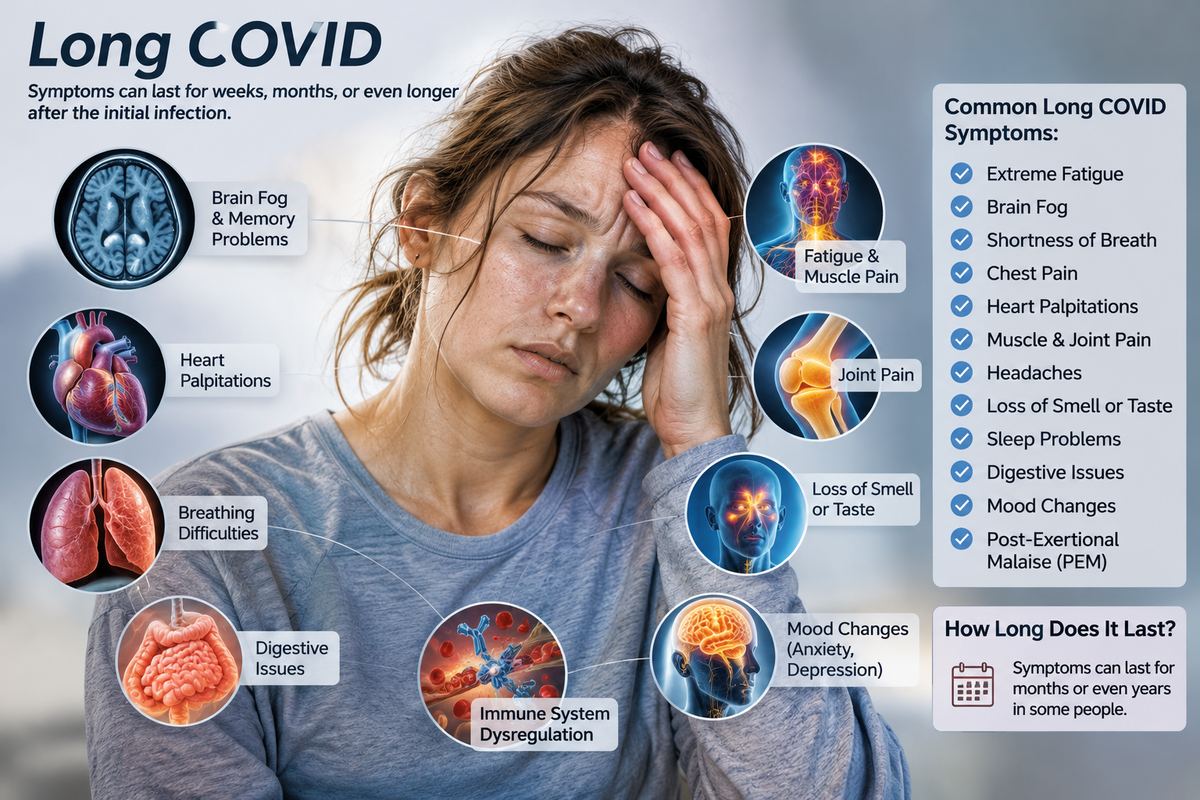
More than two hundred symptoms have been reported in long COVID, which makes the condition sound shapeless. In practice most people fall into a few recognizable patterns.
Knowing which pattern dominates matters, because the management differs completely: pacing for one, fluids and compression for another, smell training for a third.
Related pages: Long COVID · Chronic fatigue syndrome (ME/CFS)
The bottom line
- Long COVID can follow mild as well as severe infection.
- Symptoms typically fluctuate rather than decline steadily.
- Post-exertional malaise is one of the most disabling features.
- Many people improve over months to years.
- Why some people develop long COVID and most do not.
- Whether the clusters reflect different underlying mechanisms.
The story, step by step
What the evidence labels mean
The most disabling cluster
What happens
Exhaustion with worsening after exertion, which behaves unlike ordinary tiredness.
What the research shows
- Post-exertional malaise is a disproportionate worsening of symptoms after physical, mental or emotional effort.
- It is typically delayed by 12 to 48 hours, which is why the cause is so easily missed, and it can last days.
- Triggers can be trivial by previous standards: a shower, a supermarket trip, a long conversation.
- It overlaps closely with ME/CFS, and a proportion of people with long COVID meet the diagnostic criteria for it.
- This is the cluster where pushing through does harm rather than building fitness, and where pacing is the central approach.
Why it matters
If effort reliably produces a crash a day or two later, say that explicitly at appointments. It changes what should be recommended.
What's still uncertain
- The biological basis of post-exertional malaise is not established.
Read more
- CDC: Long COVIDGovernment
- OwieClear: Pacing and the energy envelopeOwieClear
Next: Autonomic
Heart rate, standing and blood flow
What happens
Dysregulation of the automatic nervous system, which is common and often unrecognized.
What the research shows
- Racing heart on standing, lightheadedness, palpitations, temperature swings, sweating changes, and digestive slowing.
- POTS, postural orthostatic tachycardia syndrome, is a defined pattern of heart rate rise on standing and occurs after COVID as it does after other viral illnesses.
- Symptoms are often worse in the morning, after meals, in heat, and after standing still.
- It is one of the more treatable parts of long COVID, which is a reason to have it assessed specifically.
- A simple lying and standing heart rate measurement in a clinic room, or at home over ten minutes, can show it.
Why it matters
If standing makes everything worse, ask for lying and standing observations. It takes ten minutes and often changes management.
What's still uncertain
- How often POTS follows COVID specifically is debated.
Read more
- OwieClear: POTS (postural orthostatic tachycardia syndrome)OwieClear
- CDC: Long COVIDGovernment
Next: Cognitive
Brain fog
What happens
Changes in thinking that are real, measurable, and not a mood problem.
What the research shows
- Slowed processing, difficulty finding words, losing track mid-sentence, and difficulty holding several things in mind.
- Studies using objective testing have found measurable deficits, particularly in processing speed and attention, rather than purely subjective complaints.
- It fluctuates with fatigue, heat, poor sleep and after exertion, which is why a good day can look like recovery.
- Mental effort draws on the same budget as physical effort in people with post-exertional malaise, and can trigger the same crash.
- It usually improves, often slowly, and strategies help considerably in the meantime.
Why it matters
Brain fog being invisible and fluctuating is exactly why it gets dismissed. Objective testing exists and can be requested.
What's still uncertain
- Mechanisms remain under investigation, with several proposed.
Read more
- OwieClear: Brain fog in long COVIDOwieClear
- NIH RECOVER: Researching COVID to enhance recoveryGovernment
Next: Heart and lungs
Breathlessness and chest symptoms
What happens
Symptoms that must be investigated before being managed as long COVID.
What the research shows
- Breathlessness on exertion, chest tightness, chest pain and palpitations.
- Some of this is breathing pattern disorder, where the pattern of breathing itself becomes disordered after illness, and it responds to breathing retraining.
- Some is deconditioning, some is autonomic, and some is a separate problem that needs finding.
- Blood clots in the lungs, heart inflammation and lung damage all occur after COVID and need excluding before symptoms are attributed to long COVID.
- New or worsening chest pain, severe breathlessness, fainting, or a swollen painful calf are reasons for urgent assessment rather than for pacing.
Why it matters
Breathlessness and chest pain get investigated first and paced second. That order matters.
What's still uncertain
- Distinguishing breathing pattern disorder from other causes requires assessment.
Read more
- CDC: Long COVIDGovernment
- MedlinePlus: Long COVIDGovernment
Next: The rest
Smell, gut, skin and more
What happens
Other common clusters, several of which have specific treatments.
What the research shows
- Loss or distortion of smell and taste, including parosmia where familiar smells become unpleasant. Smell training has reasonable evidence and is low cost.
- Digestive symptoms: nausea, bloating, altered bowel habit, reflux and appetite change.
- Headaches, nerve pain, tingling, muscle and joint pain.
- Skin flushing, hives, and reactions to foods or smells, which in some people fits a mast cell pattern.
- Menstrual cycle changes, which are commonly reported and under-studied.
- Mood changes, anxiety and depression, which occur both as a response to a disabling illness and apparently as part of it. They are treatable either way, and treating them does not mean the illness is psychological.
Why it matters
Several of these have specific treatments. Listing symptoms in order of how much they limit daily life helps an appointment focus on the ones that can be addressed.
What's still uncertain
- Many of these symptom clusters are under-researched.
Read more
- CDC: Long COVIDGovernment
- OwieClear: Treating long COVID symptomsOwieClear