The HPV vaccine: who, when, and how many doses
Last reviewed November 16, 2026. OwieClear editorial team. Waiting for clinician review. Not medical advice. Talk with your doctor about your own care.
The HPV vaccine is one of only two vaccines that prevent cancer. It works by exposing the immune system to empty shells that look like the virus but contain no viral DNA and cannot cause infection.
Timing matters more than anything else: it works by preventing infection, so it works best before any exposure has happened.
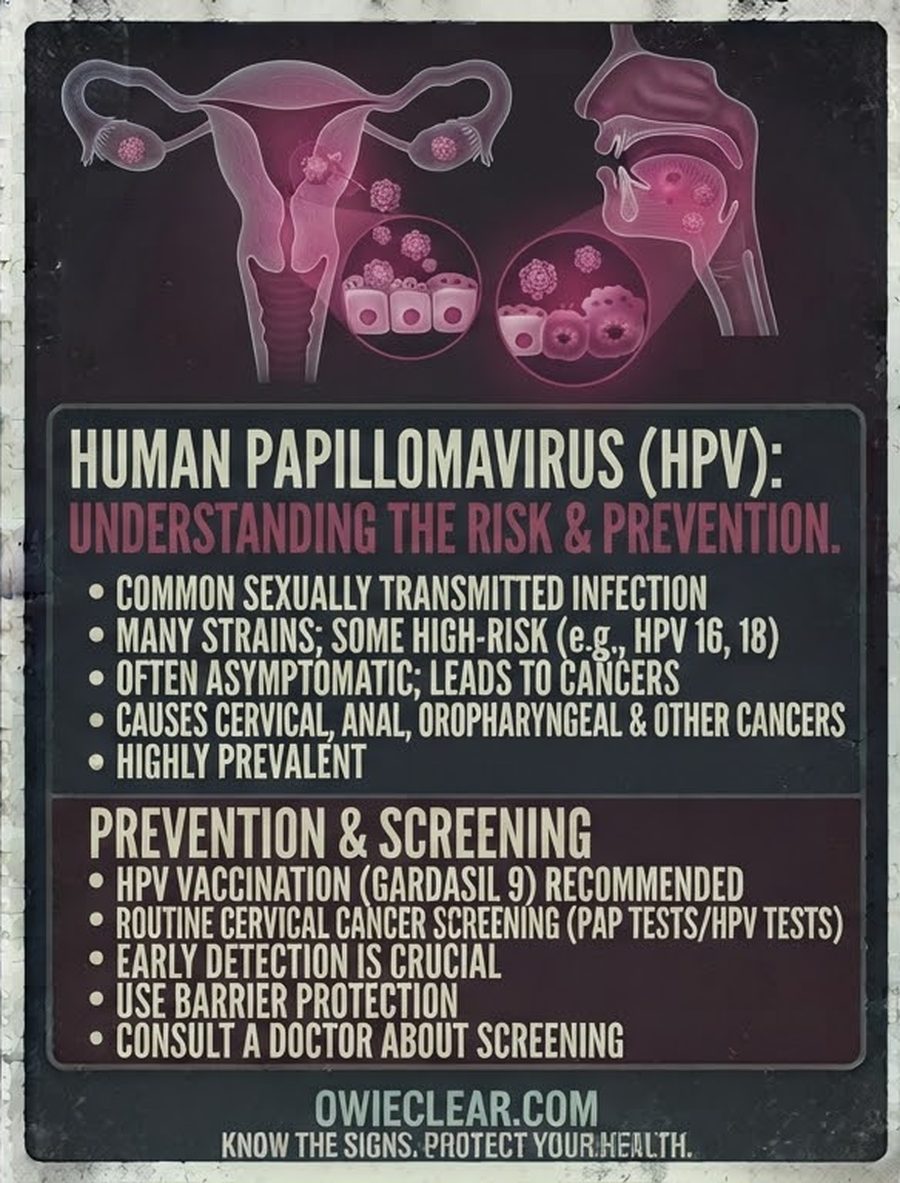
Related pages: HPV infection · Genital warts (HPV) · Cervical precancer or cancer (needs checking)
The bottom line
- Gardasil 9 protects against nine HPV types, including 16 and 18.
- Two doses are enough if the first is given before the 15th birthday.
- It prevents over 90 percent of HPV-attributable cancers when given before exposure.
- It does not treat an infection already present.
- How long protection lasts, with no waning seen so far in follow-up out to more than a decade.
- Whether a single dose is sufficient, which several studies now support and guidance is moving toward.
The story, step by step
What the evidence labels mean
Empty shells
What happens
The vaccine contains no virus, which is central to both how it works and its safety.
What the research shows
- It uses virus-like particles: the outer shell protein assembled into a sphere that looks like HPV to the immune system but contains no DNA.
- It cannot cause HPV infection, and it cannot cause cancer. There is nothing in it capable of either.
- Gardasil 9 covers types 16, 18, 31, 33, 45, 52 and 58, which cause the large majority of HPV-related cancers, plus types 6 and 11, which cause most genital warts.
- Antibody levels after vaccination are far higher than after natural infection, which is why the vaccine protects better than having had the virus.
- It is not a live vaccine, so it is safe for people who are immunocompromised.
Why it matters
The vaccine prevents infection. It does nothing to an infection already established, which is why age at vaccination matters so much.
What's still uncertain
- Protection against types not in the vaccine is partial and varies by type.
Read more
- FDA: Gardasil 9Government
- CDC: HPV vaccinationGovernment
Next: The schedule
Doses by age
What happens
How many doses depends on age at the first one.
What the research shows
- Routine age is 11 to 12, and it can be started from age 9.
- Two doses, six to twelve months apart, if the first dose is given before the 15th birthday.
- Three doses, at 0, 1 to 2, and 6 months, if the first is given at 15 or older.
- Three doses are also used for anyone immunocompromised at any eligible age, including people with HIV and transplant recipients, regardless of starting age.
- If a series is interrupted it does not need restarting; it is simply completed.
Why it matters
Starting before 15 halves the number of injections needed. That is a practical reason not to defer it.
What's still uncertain
- Evidence increasingly supports a single dose, and recommendations in some countries have changed.
Read more
- CDC: HPV vaccinationGovernment
- FDA: Gardasil 9Government
Next: Who it is for
Boys too, and adults
What happens
The age range and who benefits.
What the research shows
- It is recommended for everyone, not only girls. HPV causes anal, penile and oropharyngeal cancers, and oropharyngeal cancer is now the most common HPV-associated cancer in the United States, affecting men more often than women.
- Vaccinating boys also reduces transmission, which protects partners.
- Catch-up vaccination is recommended for everyone up to age 26 who was not adequately vaccinated, regardless of previous sexual activity or previous abnormal results.
- Between 27 and 45 it is available as a shared decision with a clinician. The population benefit is smaller because many people have already met some types, but an individual who has not met all nine still gains protection.
- Vaccination after a positive HPV test is still worthwhile, for the types not yet encountered. It will not clear the current infection.
Why it matters
The question for an adult is not whether they have had HPV but whether they have had all nine types, which is unlikely.
What's still uncertain
- Benefit in the 27 to 45 group varies a lot by individual exposure history.
Read more
- CDC: HPV vaccinationGovernment
- National Cancer Institute: HPV and cancerGovernment
Next: How well it works
The evidence
What happens
This is one of the better-evidenced vaccines in use.
What the research shows
- It prevents over 90 percent of cancers caused by the types it covers, when given before exposure.
- In Scotland, no cases of invasive cervical cancer have been found in women vaccinated at age 12 or 13.
- In Sweden, a study of 1.7 million women found substantially reduced cervical cancer incidence, with the largest reduction in those vaccinated before 17.
- Genital warts fell sharply in vaccinated populations, within a few years of programmes starting, because types 6 and 11 are covered.
- Protection has held with no sign of waning in follow-up beyond a decade, and no booster is currently recommended.
Why it matters
The effect sizes here are unusually large for any preventive intervention, and the earlier the vaccination, the larger they are.
What's still uncertain
- Long-term duration beyond current follow-up is still being measured.
Read more
- OwieClear: Can a vaccine stop cancer? The HPV story, study by studyOwieClear
- National Cancer Institute: HPV and cancerGovernment
Next: Safety
What is actually reported
What happens
The vaccine has been studied in very large populations, and the safety profile is well characterized.
What the research shows
- The common effects are local: a sore arm, redness, swelling, sometimes headache, fever or tiredness for a day or two.
- Fainting after injection is more common in adolescents than with some other vaccines, which is why a short seated observation period is standard. The fainting is a reaction to the injection, not the vaccine contents.
- Severe allergic reaction is rare, as with any vaccine, and is the reason for the waiting period.
- Large studies have found no association with primary ovarian insufficiency, infertility, autoimmune disease, or chronic fatigue syndrome. These claims have been examined specifically in studies covering millions of people and have not been supported.
- Pregnancy: it is not recommended during pregnancy, not because harm has been shown but because it has not been studied there. A dose given before a pregnancy was known is not a reason for concern, and the series is completed afterwards.
- Screening continues after vaccination, because the vaccine does not cover every high-risk type.
Why it matters
The fertility claim in particular has been tested directly in very large datasets and has not held up. It remains the most common reason people decline.
What's still uncertain
- Rare events are hard to rule out entirely even in large studies, and monitoring continues.
Read more
- CDC: HPV vaccinationGovernment
- FDA: Gardasil 9Government
More plain-language reading
- OwieClear: Preventing HPV transmissionOwieClear
- OwieClear: HPV complicationsOwieClear
- OwieClear: Can a vaccine stop cancer?OwieClear