The stages of Alzheimer's, and what helps at each
Last reviewed November 16, 2026. OwieClear editorial team. Waiting for clinician review. Not medical advice. Talk with your doctor about your own care.
Alzheimer's is usually described in three stages, and the boundaries are blurry. People move through them at very different speeds, and the same person can have a good week and a bad one.
What the stages are useful for is planning: each one has a window in which certain decisions are much easier to make than they will be later.
Related pages: Memory loss and dementia (Alzheimer's)
The bottom line
- Alzheimer's is progressive and changes over years.
- Brain changes begin 15 to 20 years before symptoms appear.
- Emotional memory and response to tone persist well into late stages.
- Progression speed varies widely between people.
- Why progression speed varies so much.
- Whether treatment changes the long-term course meaningfully.
The story, step by step
What the evidence labels mean
The silent years
What happens
The brain changes begin long before anyone notices anything.
What the research shows
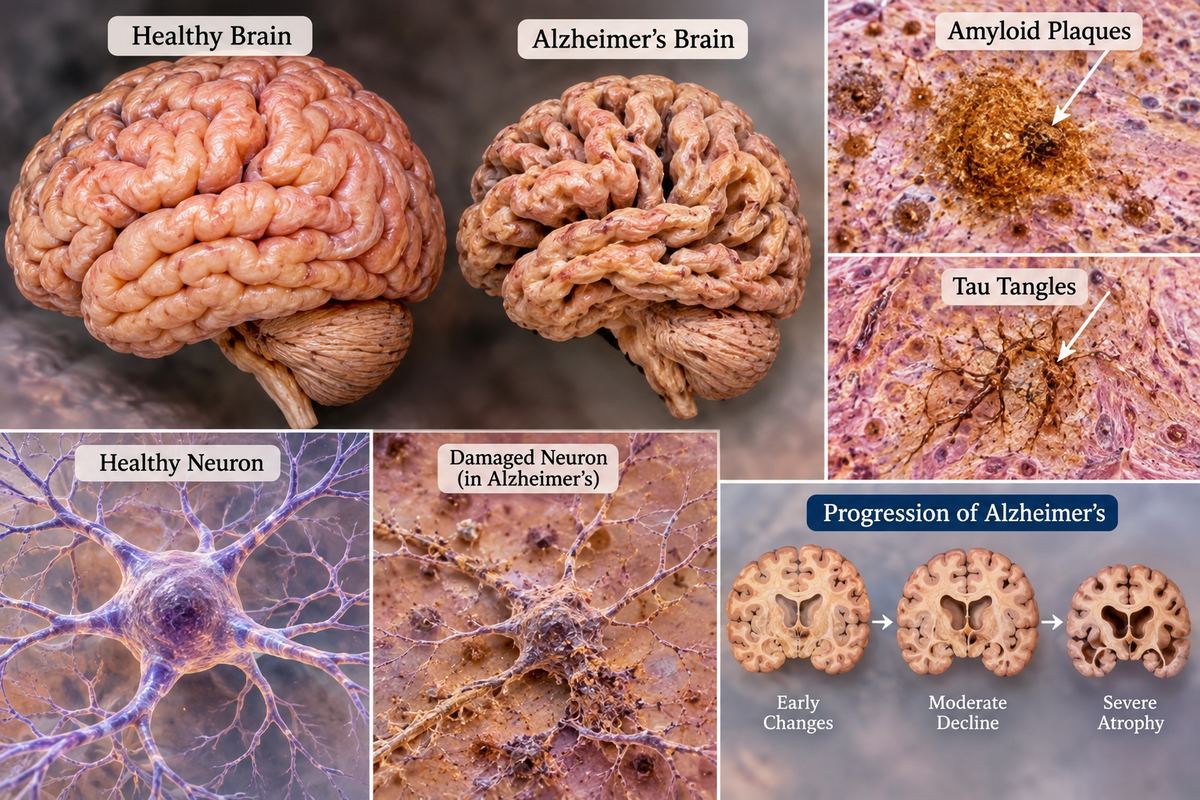
- Amyloid and tau accumulate for roughly 15 to 20 years before memory symptoms begin.
- This is why prevention efforts target midlife rather than old age, and why treatments given late have so little to work with.
- Mild cognitive impairment is an intermediate stage: measurable memory or thinking changes that do not yet interfere much with daily life.
- Not everyone with mild cognitive impairment goes on to develop dementia. Some stay stable and some improve, particularly where another cause is found and treated.
- This is the stage where a proper assessment is most worthwhile, because reversible causes are easiest to catch and planning is easiest to do.
Why it matters
Noticing changes early is not alarmism. It is the point at which the most useful decisions can still be made by the person themselves.
What's still uncertain
- Who with mild cognitive impairment will progress cannot be reliably predicted.
Read more
- National Institute on Aging: Alzheimer's diseaseGovernment
- OwieClear: Memory loss and dementiaOwieClear
Next: Early stage
Still independent
What happens
Memory and planning gaps appear while independence is largely preserved.
What the research shows
- Repeating questions, losing track of recent conversations, difficulty with planning, handling money, or finding words.
- Insight is often preserved, which means the person may be frightened and aware, and that deserves acknowledging rather than managing around.
- This is the window for legal and financial planning: a power of attorney for health and finances, advance directives, and a conversation about wishes. Capacity to make those decisions is strongest now.
- Practical scaffolding helps: one large wall calendar, a pill dispenser, phone reminders, labelled drawers, a fixed place for keys and wallet.
- Driving needs an honest conversation and, usually, a formal assessment. Rules on reporting vary by state, and an occupational therapy driving evaluation gives an objective answer rather than a family argument.
- Financial exploitation risk rises early, often before anyone notices. Simplifying accounts, setting up alerts and adding a trusted second signatory are worth doing now.
Why it matters
The legal and financial planning is the single most valuable thing done at this stage, and it gets much harder once capacity declines.
What's still uncertain
- How long this stage lasts varies from a year or two to considerably longer.
Read more
- National Institute on Aging: Alzheimer's diseaseGovernment
- Alzheimer's AssociationNonprofit
Next: Middle stage
The longest one
What happens
Usually the longest stage, with increasing need for cueing and supervision.
What the research shows
- Greater memory loss, confusion about time and place, difficulty with dressing and other self-care, and changes in mood and behaviour.
- Routine does more work than anything else: consistent wake, meal, activity and sleep times reduce distress substantially.
- Simplify rather than restrict. Two outfits to choose from rather than a full closet, one instruction at a time, tasks broken into single steps.
- Sundowning, late-afternoon restlessness and confusion, is common. Dimming glare, reducing noise, a light snack and a short walk often help more than medication.
- A sudden change in behaviour or confusion is usually something physical: pain, constipation, a urinary infection, dehydration or a new medication. That deserves checking before it is treated as the dementia progressing.
- Wandering becomes a safety issue. Door chimes, an ID bracelet or GPS device, and a current photo matter. If someone goes missing, call 911 immediately rather than searching first.
Why it matters
Sudden change is a medical question, not a behavioural one. Delirium on top of dementia is common, treatable and frequently missed.
What's still uncertain
- How much structured routine helps is hard to quantify in trials.
Read more
Next: Late stage
Comfort and connection
What happens
Full assistance is needed, and the goals change.
What the research shows
- Speech becomes limited, mobility declines, and help is needed with all personal care.
- Priorities shift to comfort: skin care and repositioning, safe swallowing, pain that cannot be reported, and gentle sensory connection.
- Familiar music from young adulthood, hand massage, soft lighting, reading aloud and reassuring touch continue to reach people when words no longer do.
- Swallowing difficulty is common and feeding tubes are not recommended in advanced dementia: trials show no improvement in survival, nutrition or pressure sores, and careful hand feeding is preferred.
- Hospice care is available in advanced dementia and is frequently brought in later than it could be. Asking about eligibility is reasonable well before a crisis.
- Pain is under-recognized here because it cannot be described. Grimacing, restlessness, resistance to care and groaning are often pain, and treating it changes everything.
Why it matters
Two things are worth knowing in advance: feeding tubes do not help in advanced dementia, and hospice is usually available earlier than families realize.
What's still uncertain
- Prognosis in advanced dementia is difficult to predict, which complicates hospice timing.
Read more
- National Institute on Aging: Alzheimer's diseaseGovernment
- Alzheimer's AssociationNonprofit
Next: What persists
What does not go away
What happens
The part that changes how care feels.
What the research shows
- Emotional memory outlasts factual memory. A person may not recall a visit an hour later and will still carry the feeling of it.
- Response to tone, facial expression and touch persists deep into the illness.
- Music learned in youth is often retained when much else is gone, and can reach someone who seems unreachable.
- Procedural memory, long-practised physical skills, can persist: folding laundry, gardening, playing an instrument.
- This is why the way something is said matters more than its accuracy, and why a calm room is a form of treatment.
Why it matters
Visits are not wasted because they are not remembered. The feeling they leave behind lasts longer than the memory of them.
What's still uncertain
- Why emotional memory is preserved is not fully explained.
Read more
More plain-language reading
- OwieClear: The core care philosophyOwieClear
- OwieClear: Adapting to each stageOwieClear
- OwieClear: How Alzheimer's is diagnosedOwieClear