The subtypes, and why naming them matters
Last reviewed November 16, 2026. OwieClear editorial team. Waiting for clinician review. Not medical advice. Talk with your doctor about your own care.
AIDS-related lymphoma is not one disease, and treating it as one is the most common error in material written about it.
The subtypes differ so much that the CD4 count at diagnosis often predicts which one it will be, before anyone looks down a microscope.
Related pages: AIDS-related lymphoma
The bottom line
- Diffuse large B-cell lymphoma is the most common subtype.
- Burkitt lymphoma tends to occur at higher CD4 counts and grows extremely fast.
- Primary CNS lymphoma occurs at very low CD4 counts and is almost always EBV-positive.
- Hodgkin lymphoma is not AIDS-defining but occurs far more often in people with HIV.
- Why particular subtypes occur at particular CD4 ranges.
- How best to treat the rarer subtypes, where evidence is limited.
The story, step by step
- 1. DLBCL ()
- 2. Burkitt ()
- 3. Primary CNS lymphoma ()
- 4. Plasmablastic and primary effusion ()
- 5. Hodgkin lymphoma ()
What the evidence labels mean
The most common one
What happens
Diffuse large B-cell lymphoma accounts for roughly half of AIDS-related lymphomas.
What the research shows
- It occurs across the whole range of CD4 counts, including in people with well-controlled HIV.
- EBV is found in a substantial minority of cases, more often in the immunoblastic variant seen at lower CD4 counts.
- It usually presents at an advanced stage, with disease in several areas and often outside the lymph nodes: the gut, the liver, the bone marrow.
- Treatment is chemotherapy combined with rituximab, an antibody against the CD20 molecule on the surface of the cells.
- With HIV controlled and modern regimens, cure rates approach those seen in people without HIV.
Why it matters
This is the subtype most people with this diagnosis will have, and it is the one with the best-established treatment and the best outcomes.
What's still uncertain
- Testing for MYC, BCL2 and BCL6 rearrangements is needed because double-hit disease is treated differently.
Read more
- NCI: AIDS-related lymphoma treatmentGovernment
- OwieClear: Diffuse large B-cell lymphoma (DLBCL)OwieClear
Next: Burkitt
The fastest-growing cancer known
What happens
Burkitt lymphoma accounts for roughly a fifth to a third of cases and behaves unlike anything else.
What the research shows
- It tends to occur in people with relatively preserved CD4 counts, often above 200.
- It is defined by a translocation moving MYC next to an antibody gene, switching cell growth permanently on.
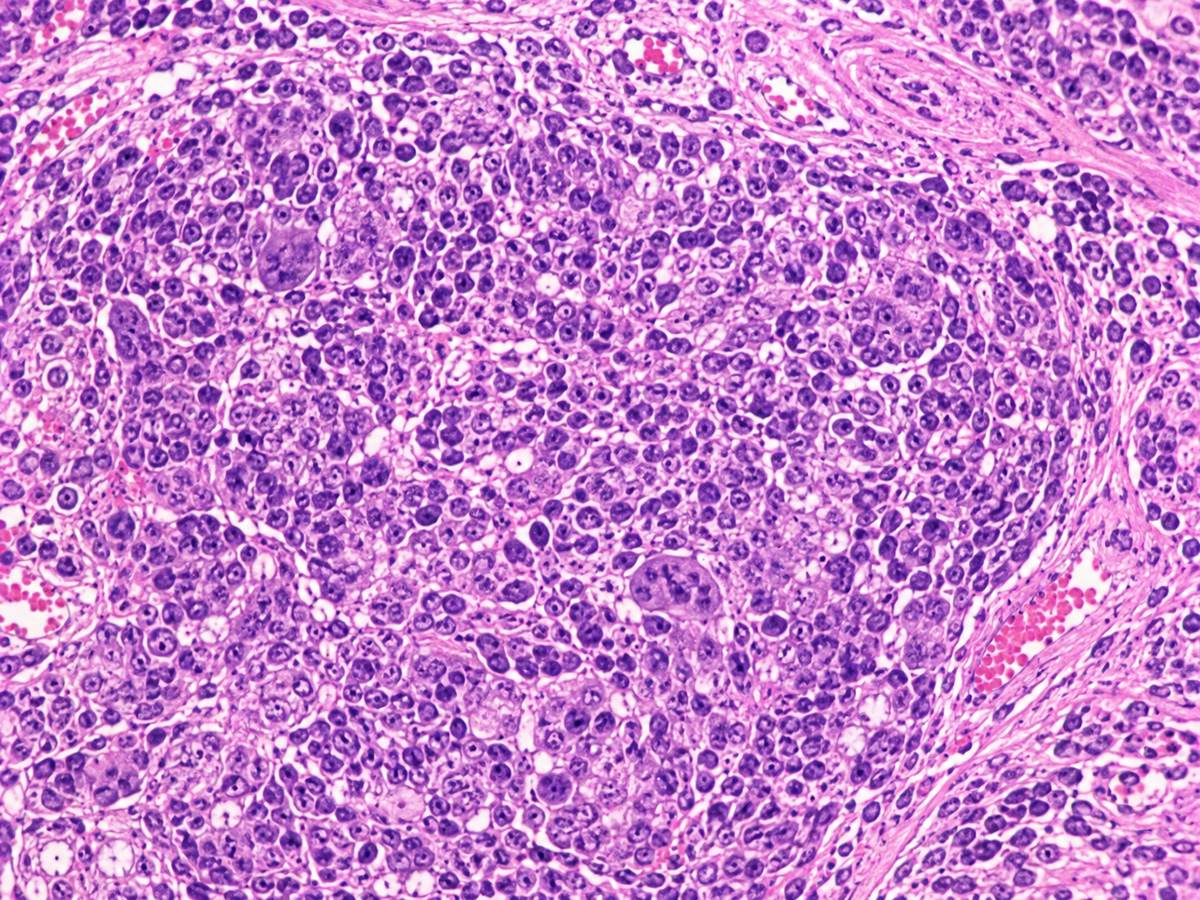
- Under the microscope it has a characteristic starry-sky appearance, from scavenging cells clearing the debris of cells dying as fast as they are made.
- Essentially every cell is dividing. Tumour volume can double in roughly a day, which makes it a medical emergency rather than an outpatient problem.
- That speed creates a specific danger: tumour lysis syndrome, where cells destroyed by treatment release their contents fast enough to damage the kidneys and the heart.
Why it matters
Burkitt lymphoma is one of the few cancers where treatment must start within days, and where the first danger is the treatment working too well.
What's still uncertain
- Despite its aggressiveness it is highly curable with appropriate intensive treatment.
Read more
- NCI: AIDS-related lymphoma treatmentGovernment
- OwieClear: Burkitt lymphomaOwieClear
Next: Primary CNS lymphoma
Confined to the brain
What happens
This subtype occurs at the lowest CD4 counts of all and is almost entirely a disease of advanced immunosuppression.
What the research shows
- It typically occurs with CD4 counts below 50, and in this setting EBV is found in essentially 100 percent of cases.
- It stays within the brain, spinal cord, the covering membranes and the eyes, rather than involving lymph nodes.
- It presents with confusion, personality change, headache, seizures, or weakness on one side.
- On MRI it produces enhancing lesions that can closely resemble cerebral toxoplasmosis, which is far more common and completely different to treat.
- Treatment is based on high-dose methotrexate, given with antiretroviral therapy, because restoring immune control of EBV is part of the treatment.
Why it matters
The distinction from toxoplasmosis is the most consequential diagnostic decision in HIV neurology, and it has its own page.
What's still uncertain
- Whole-brain radiotherapy is now generally avoided because of long-term cognitive effects.
Read more
The rare, difficult ones
What happens
Two uncommon subtypes behave very differently from the rest and are worth recognizing.
What the research shows
- Plasmablastic lymphoma occurs at low CD4 counts, is usually EBV-positive, and has a characteristic preference for the mouth and jaw before the gut.
- Its cells have lost the usual B-cell surface markers and look like plasma cells instead, which means rituximab does not work, because there is no CD20 for it to bind.
- Primary effusion lymphoma is driven by KSHV in essentially every case and usually EBV-positive as well.
- It presents as fluid collecting in the chest, around the heart or in the abdomen, with no solid tumour mass, which makes it easy to mistake for infection or heart failure.
- Both are treated with intensive chemotherapy, sometimes with bortezomib or stem cell transplant, and both remain difficult.
Why it matters
An oral or jaw mass in someone with HIV is the classic presentation of plasmablastic lymphoma, and it is frequently assumed to be dental at first.
What's still uncertain
- Evidence for treating both of these comes from small series rather than randomized trials.
Read more
- NCI: AIDS-related lymphoma treatmentGovernment
- OwieClear: Primary effusion lymphomaOwieClear
Next: Hodgkin lymphoma
Not AIDS-defining, and far more common
What happens
Hodgkin lymphoma sits in an odd category and is often left out of discussions of this topic.
What the research shows
- It is not classified as an AIDS-defining illness, yet it occurs many times more often in people with HIV than in the general population.
- Unusually, its incidence did not fall after effective HIV treatment arrived, and in some analyses it rose, possibly because partial immune recovery provides the inflammatory environment these tumours depend on.
- In people with HIV it is more often of the mixed cellularity or lymphocyte-depleted type, and almost always EBV-positive.
- It presents at a more advanced stage, more often with bone marrow involvement and B symptoms, than in people without HIV.
- Treatment is standard Hodgkin chemotherapy given alongside antiretroviral therapy, and outcomes are now good.
Why it matters
Hodgkin lymphoma behaving differently from every other subtype in the ART era is one of the genuinely surprising findings in this field.
What's still uncertain
- Why its incidence did not fall with treatment is not settled.
Read more
- NCI: AIDS-related lymphoma treatmentGovernment
- OwieClear: Hodgkin lymphomaOwieClear