How it shows up, and how it is diagnosed
Last reviewed November 16, 2026. OwieClear editorial team. Waiting for clinician review. Not medical advice. Talk with your doctor about your own care.
Fever, night sweats and weight loss in someone with HIV have a long list of possible causes, and most of them are infections.
That overlap is the central diagnostic problem here, and it is why no amount of blood testing substitutes for a piece of tissue.
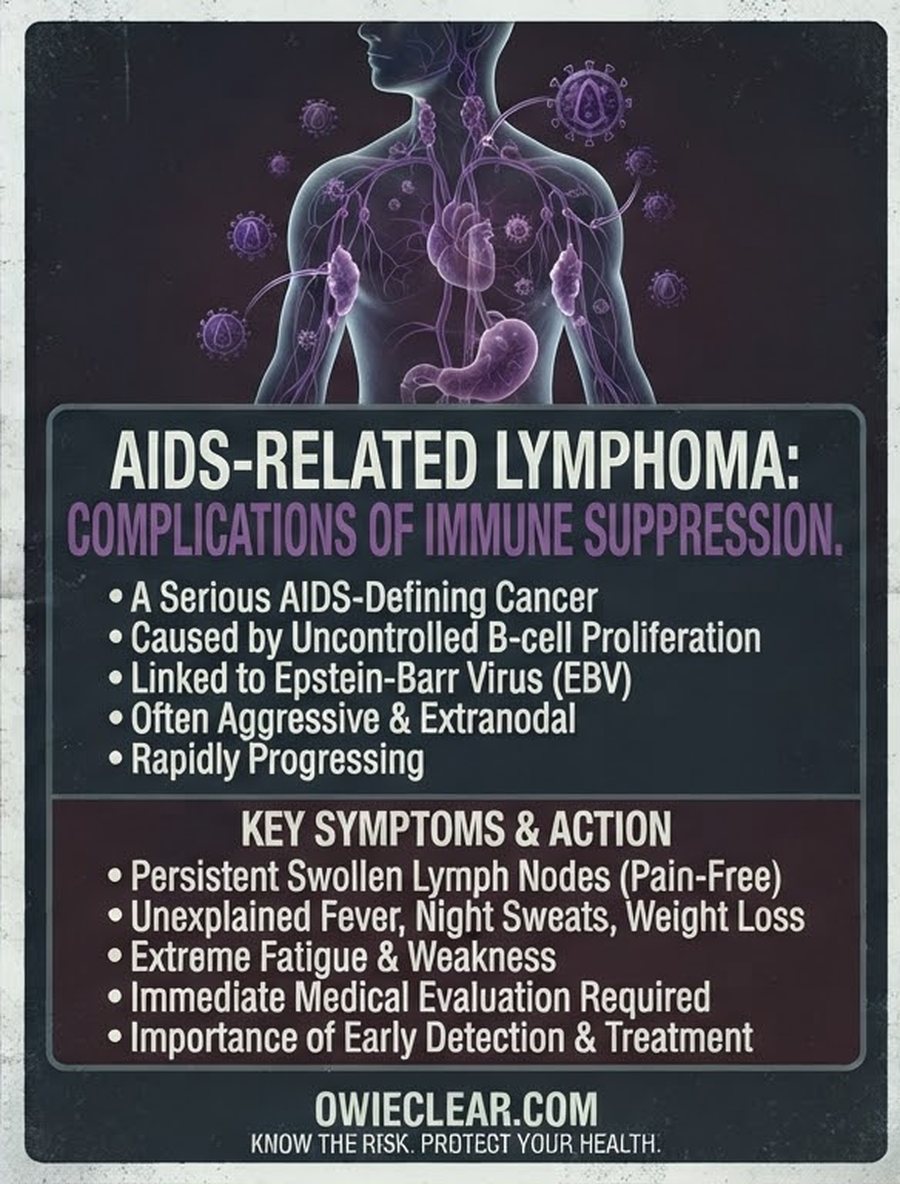
Related pages: AIDS-related lymphoma
The bottom line
- Painless swollen lymph nodes and B symptoms are the classic presentation.
- More than three quarters of people have disease outside the lymph nodes at diagnosis.
- Symptoms overlap substantially with opportunistic infections.
- An adequate tissue biopsy is required; fine-needle aspiration alone is not enough.
- How much of the diagnostic delay is attributable to attributing symptoms to infection.
- How reliably PET-CT distinguishes lymphoma from reactive or infectious changes in HIV.
The story, step by step
- 1. The classic picture ()
- 2. Outside the nodes ()
- 3. The overlap problem ()
- 4. The biopsy ()
- 5. Staging ()
What the evidence labels mean
Nodes and B symptoms
What happens
The presentation that most people recognize.
What the research shows
- Painless, firm, enlarged lymph nodes that persist and grow, most often in the neck, armpit or groin.
- B symptoms: unexplained fever, drenching night sweats, and unintentional weight loss of more than ten percent over six months. These occur in a large majority of people with these lymphomas.
- Profound fatigue, often out of proportion to anything else.
- Painless matters: infected nodes and reactive nodes are usually tender, and lymphoma nodes usually are not.
- Persistent generalized lymphadenopathy is also common in untreated HIV without any lymphoma, which complicates the picture further.
Why it matters
A node that keeps growing, is painless, and is accompanied by fevers and weight loss is the combination that needs a biopsy rather than observation.
What's still uncertain
- Distinguishing lymphoma from HIV-related lymphadenopathy on examination alone is not reliable.
Read more
- NCI: AIDS-related lymphoma treatmentGovernment
- MedlinePlus: LymphomaGovernment
Next: Outside the nodes
Where else it appears
What happens
This is the feature that most distinguishes HIV-associated lymphoma from lymphoma in people without HIV.
What the research shows
- More than three quarters of people have extranodal disease at diagnosis.
- Gastrointestinal tract: abdominal pain, swelling, bleeding, obstruction, or perforation. This is the commonest extranodal site.
- Bone marrow: low blood counts, which may be the first abnormality noticed.
- Liver and spleen: enlargement, abnormal liver tests.
- Central nervous system: headache, confusion, seizures or focal weakness, present in roughly ten to twenty percent.
- Oral cavity and jaw: a mass here is characteristic of plasmablastic lymphoma and is often first seen by a dentist.
Why it matters
Abdominal symptoms, unexplained low blood counts and an oral mass are all presentations of this disease, and none of them looks like lymphoma to most people.
What's still uncertain
- Extranodal disease makes staging more complex and is one reason PET-CT is used.
Read more
- NCI: AIDS-related lymphoma treatmentGovernment
- OwieClear: The subtypesOwieClear
Next: The overlap problem
What else causes these symptoms
What happens
Fever, night sweats and weight loss in someone with HIV have a long differential, and most of it is infection.
What the research shows
- Tuberculosis, which can also cause enlarged nodes and B symptoms and is far more common worldwide.
- Disseminated Mycobacterium avium complex, histoplasmosis and other opportunistic infections.
- Cytomegalovirus disease, and acute infections of many kinds.
- Immune reconstitution inflammatory syndrome, where symptoms flare as the immune system recovers after starting antiretroviral therapy, which can mimic both infection and progressing cancer.
- Lymphoma and infection can also coexist, which is why finding one does not exclude the other.
Why it matters
This is the reason tissue is taken rather than treating empirically. Several of these conditions look identical and are treated completely differently.
What's still uncertain
- Diagnostic delay is common and is largely a consequence of this overlap.
Read more
- Clinicalinfo (NIH): Guidelines for opportunistic infections in adults with HIVGovernment
- NCI: AIDS-related lymphoma treatmentGovernment
Next: The biopsy
Why a needle is not enough
What happens
The single most important diagnostic point, and one people frequently ask about.
What the research shows
- An excisional biopsy, removing a whole lymph node, or a generous core biopsy of a mass, is what is needed.
- Fine-needle aspiration, which draws out cells with a thin needle, is not sufficient on its own. It can show that something abnormal is present and cannot classify it.
- Classification requires seeing how the cells are arranged, staining them for surface markers, and testing for chromosome rearrangements in MYC, BCL2 and BCL6.
- Those answers determine the subtype, and the subtype determines the treatment, which differs enormously between them.
- If a needle sample has been taken and is inconclusive, a larger biopsy is the appropriate next step rather than a delay.
Why it matters
If you are told a needle test was inconclusive, asking about an excisional biopsy is the right question.
What's still uncertain
- Biopsy of some sites carries its own risks, which is why the site is chosen carefully.
Read more
- NCI: AIDS-related lymphoma treatmentGovernment
Next: Staging
What the rest of the workup is for
What happens
Once the diagnosis is made, several tests establish how far it has spread and how to treat it safely.
What the research shows
- PET-CT of the whole body, to map every site of disease. In HIV, some nodes light up for reactive or infectious reasons, so results are interpreted alongside the clinical picture.
- Bone marrow aspirate and biopsy, since marrow involvement is common and changes the stage.
- Lumbar puncture to check the spinal fluid, which is mandatory in Burkitt lymphoma and high-risk large B-cell lymphoma because of the risk of central nervous system spread.
- HIV viral load and CD4 count, which guide both the HIV regimen and the infection prophylaxis.
- Hepatitis B and C testing, because rituximab can reactivate hepatitis B, sometimes severely, and antiviral cover is needed if someone is a carrier.
- Heart function tests before anthracycline chemotherapy, and a discussion about fertility preservation before treatment starts.
Why it matters
The hepatitis B test is not a formality. Reactivation during rituximab treatment can be severe, and it is entirely preventable with antiviral cover.
What's still uncertain
- PET-CT interpretation in people with HIV requires experience, since reactive uptake is common.
Read more
- NCI: AIDS-related lymphoma treatmentGovernment
- OwieClear: Treatment and supportive careOwieClear