Treating strep throat
Last reviewed November 16, 2026. OwieClear editorial team. Waiting for clinician review. Not medical advice. Talk with your doctor about your own care.
Strep throat is one of the few infections where the treatment has barely changed in seventy years, for a good reason: group A strep has never become resistant to penicillin.
The ten-day course is not about the sore throat, which improves in a day or two either way. It is about clearing the bacteria thoroughly enough to prevent rheumatic fever.
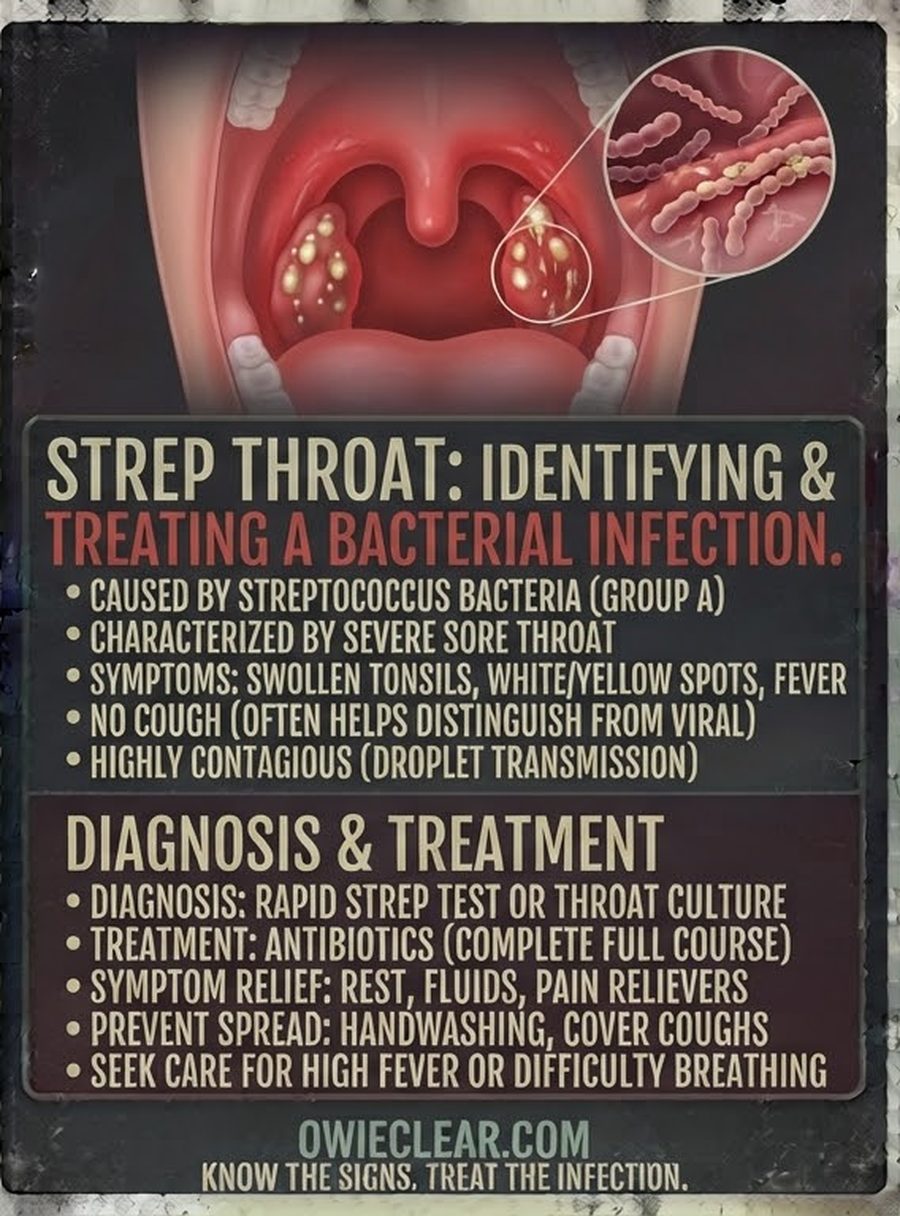
Related pages: Strep throat · Sore throat (pharyngitis)
The bottom line
- Penicillin and amoxicillin remain first-line and effective.
- Group A strep has never developed penicillin resistance.
- Antibiotics shorten symptoms by about a day.
- Treatment prevents acute rheumatic fever.
- Whether shorter courses of some antibiotics are equally effective.
- Whether antibiotics prevent post-streptococcal kidney inflammation, which has not been shown.
The story, step by step
What the evidence labels mean
Penicillin and amoxicillin
What happens
The standard treatment, and why it has not changed.
What the research shows
- Penicillin V or amoxicillin, taken for ten days, is first-line everywhere.
- Group A strep remains universally susceptible to penicillin. Despite decades of use, resistance has never emerged, which is unusual and is the reason these drugs are still used.
- Amoxicillin is often chosen for children because it tastes better and can be given once or twice daily, which makes finishing the course more likely.
- A single long-acting penicillin injection is an option where taking ten days of tablets is not realistic.
- Symptoms usually improve within 24 to 48 hours of starting, and fever typically settles first.
Why it matters
Nothing newer is better here. Penicillin remains the right drug, which is not something that can be said about many infections.
What's still uncertain
- Whether shorter courses of penicillin are adequate is not established.
Read more
- CDC: Strep throatGovernment
- MedlinePlus: Streptococcal infectionsGovernment
Next: If penicillin is out
Alternatives
What happens
What is used for people who cannot take penicillins.
What the research shows
- For a mild previous reaction such as a rash, a cephalosporin like cephalexin or cefdinir is usually used, often for a shorter course.
- For a severe allergy, clindamycin or a macrolide such as azithromycin is used instead.
- Macrolide resistance in group A strep does occur and varies by region, which is why these are not first-line.
- A great many people labelled penicillin-allergic are not. A common cause is a rash that appeared during mono after amoxicillin was given for a presumed strep throat.
- Allergy testing can remove an incorrect label, which matters because the alternatives are less effective and have more side effects over a lifetime.
Why it matters
If your penicillin allergy label came from a childhood rash, it is worth asking whether it can be formally tested. Most such labels turn out to be wrong.
What's still uncertain
- Macrolide resistance rates differ substantially by country.
Read more
- CDC: Strep throatGovernment
- MedlinePlus: Streptococcal infectionsGovernment
Next: Finishing it
Why ten days
What happens
The reason the course outlasts the symptoms by a week.
What the research shows
- Symptoms improve within a day or two. The bacteria are not fully cleared from the tonsils by then.
- The ten-day course exists to eradicate the bacteria thoroughly, which is what prevents acute rheumatic fever.
- Rheumatic fever can follow an untreated strep throat two to four weeks later and can permanently damage heart valves. It has become rare where strep is treated and remains a major cause of heart disease worldwide.
- Treatment started within about nine days of symptoms still prevents it, which is why there is time to test rather than guess.
- One important nuance: antibiotics prevent rheumatic fever, but they have not been shown to prevent post-streptococcal kidney inflammation, which is a different complication.
- Never use leftover antibiotics or someone else's prescription. The dose and duration matter here specifically.
Why it matters
The sore throat is better in two days and the course runs for ten. That gap is the entire point of the treatment.
What's still uncertain
- Whether the full ten days is necessary with every alternative antibiotic is debated.
Read more
- CDC: Acute rheumatic feverGovernment
- OwieClear: Rheumatic feverOwieClear
Next: Contagion
When it is safe to go back
What happens
How long someone remains infectious.
What the research shows
- Untreated, a person with strep throat is contagious for two to three weeks, even as symptoms settle.
- Antibiotics change this quickly: after 12 to 24 hours of treatment, and once fever has gone without fever-reducing medicine, return to school or work is generally considered safe.
- That is the rule used by most schools and workplaces, and it is one of the practical benefits of treating.
- During the contagious period, avoid sharing drinks, utensils, towels and lip balm, cover coughs, and wash hands.
- Replacing a toothbrush after starting antibiotics is commonly advised. The evidence for it is weak, and it is harmless, so it falls into reasonable rather than necessary.
Why it matters
Fever-free without medication, plus a full day of antibiotics, is the usual threshold. Both parts matter.
What's still uncertain
- Exact infectivity duration after starting treatment is not precisely established.
Read more
- CDC: Strep throatGovernment
- CDC: Group A strep infectionGovernment
Next: Comfort
Treating the pain
What happens
What helps while the antibiotics work.
What the research shows
- Paracetamol or ibuprofen, taken regularly for the first couple of days, does more for the pain than anything else available.
- Do not give aspirin to children or teenagers with a fever, because of the risk of Reye's syndrome.
- Cold things numb the throat: ice chips, ice pops, cold water, yogurt, smoothies. Warm drinks and honey soothe for some people, and honey is not given under one year old.
- Salt water gargles help some people and are not suitable for young children who cannot gargle safely.
- A single dose of a steroid is sometimes given for severe pain or difficulty swallowing. It reduces pain modestly and is a clinician's decision rather than routine.
- Throat sprays and lozenges with local anaesthetic give short-lived relief. Lozenges are a choking risk in young children.
Why it matters
Regular paracetamol or ibuprofen for the first 48 hours, rather than waiting for the pain to peak, is the approach that works best.
What's still uncertain
- Steroid use for sore throat remains selective and debated.
Read more
- MedlinePlus: Sore throatGovernment
- CDC: Strep throatGovernment