What anal cancer is, and why it is not colorectal cancer
Last reviewed November 16, 2026. OwieClear editorial team. Waiting for clinician review. Not medical advice. Talk with your doctor about your own care.
Anal cancer and colorectal cancer are neighbours separated by a few centimetres, and almost everything about them differs: the cell type, the cause, the treatment and the outlook.
The difference comes down to a boundary inside the anal canal where one kind of lining meets another.
Related pages: Anal cancer
The bottom line
- Most anal cancer is squamous cell carcinoma, not adenocarcinoma.
- The large majority is caused by persistent infection with high-risk HPV, mainly type 16.
- It arises at the anal transformation zone, where two kinds of lining meet.
- First-line treatment for localized disease is chemoradiation, not surgery.
- Why incidence has been rising in some groups over recent decades.
- Why a minority of cases occur in people with no detectable HPV.
The story, step by step
What the evidence labels mean
Where two linings meet
What happens
The anal canal is only about three to four centimetres long, and a critical transition happens inside it.
What the research shows
- Above the dentate line the lining is glandular columnar epithelium, like the rectum.
- Below it the lining becomes layered squamous epithelium, like skin.
- Where the two meet is the anal transformation zone, where cells are actively dividing and remodelling.
- The cervix has an equivalent zone, and cancer arises there for the same reasons.
Why it matters
Transformation zones are where HPV-driven cancers happen, in the anus and the cervix alike. The anatomy explains the pattern.
What's still uncertain
- The exact position of the transformation zone varies between people and shifts with age.
Read more
- NCI: Anal cancer treatmentGovernment
- OwieClear: How HPV takes over anal cellsOwieClear
Next: The cell type
Squamous, which changes everything
What happens
Which cell the cancer comes from decides how it is treated.
What the research shows
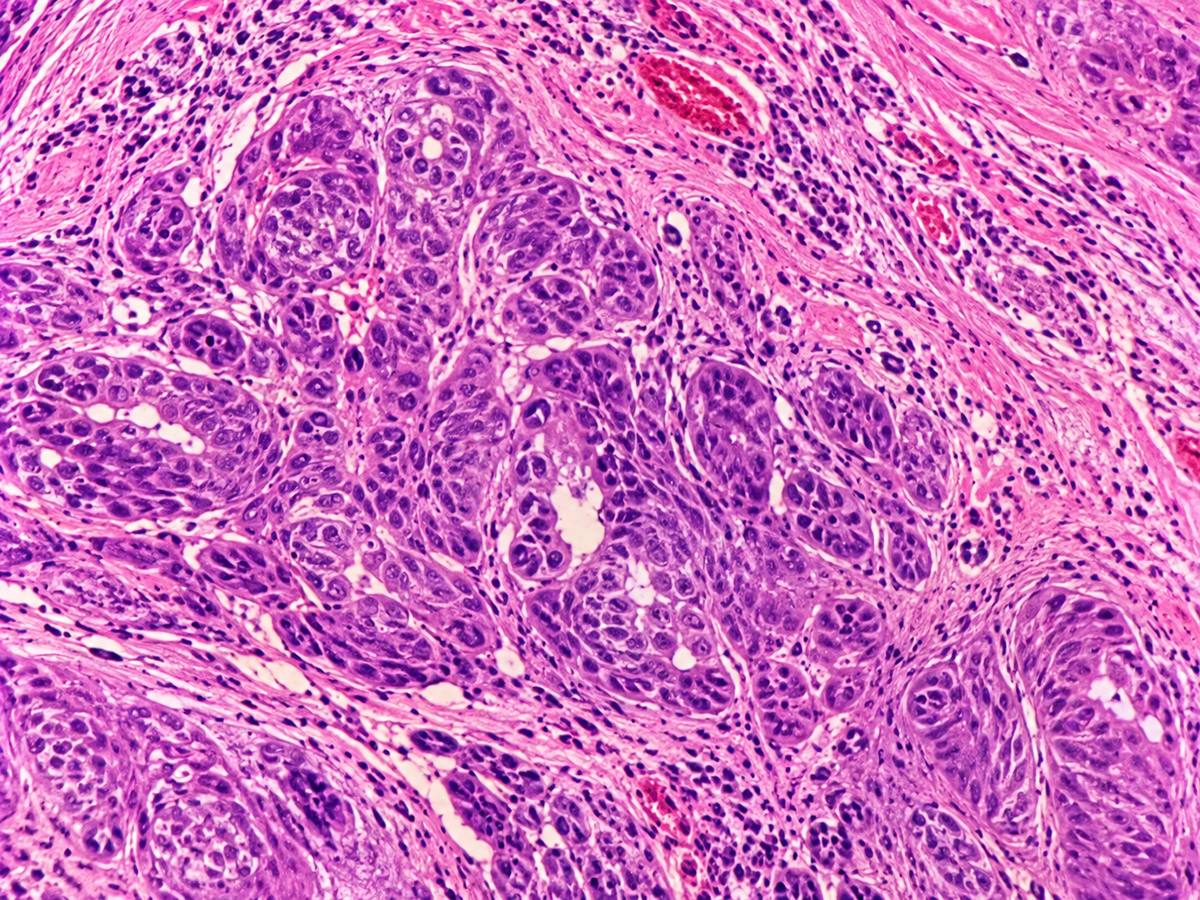
- Roughly 85 to 90 percent of anal cancers are squamous cell carcinomas.
- Rarer types include adenocarcinoma arising from anal glands, and anal melanoma, which behave differently and are treated differently.
- Squamous cancers are unusually sensitive to radiation combined with chemotherapy.
- Colorectal cancer is adenocarcinoma, is not caused by HPV, and is treated primarily with surgery.
Why it matters
Being a squamous cancer is the reason most people with anal cancer keep their anus. Surgery is not the first move.
What's still uncertain
- Tumours at the anal margin, on the skin just outside, are sometimes classified and treated differently from those inside the canal.
Read more
- NCI: Anal cancer treatmentGovernment
- OwieClear: The Nigro protocolOwieClear
Next: The cause
A virus, in most cases
What happens
Anal cancer is one of a small group of cancers with a known infectious cause.
What the research shows
- The large majority of anal squamous cell carcinomas are caused by persistent infection with high-risk human papillomavirus.
- HPV-16 dominates, accounting for most HPV-positive anal cancers. Other high-risk types contribute far less than they do in cervical cancer.
- HPV is extremely common, and most infections clear on their own within one to two years. Cancer follows only from infections that persist.
- Because the cause is a vaccine-preventable virus, most anal cancer is in principle preventable.
Why it matters
A cancer caused by a virus is a cancer a vaccine can prevent, which is why the HPV vaccine matters well beyond cervical cancer.
What's still uncertain
- A minority of cases are HPV-negative and appear to arise by a different route, which is not well understood.
Read more
- CDC: HPV and cancerGovernment
- OwieClear: How HPV disables the cell's tumour suppressorsOwieClear
Next: Who gets it
Uncommon, and rising
What happens
Anal cancer is uncommon compared with colorectal cancer, and the pattern of who gets it has been changing.
What the research shows
- Incidence has been rising in the United States over recent decades, including among older women.
- People living with HIV, particularly men who have sex with men, have substantially higher rates.
- People who are immunosuppressed after an organ transplant are at increased risk.
- A history of cervical, vulvar or vaginal precancer or cancer raises the risk, because the same virus is involved.
- Smoking is an independent risk factor and one of the few modifiable ones.
Why it matters
The group most people do not expect on this list is women with a history of cervical precancer. The virus does not respect anatomical boundaries.
What's still uncertain
- Reasons for the rising incidence are not fully established and may include changes in exposure and better detection.
Read more
- American Cancer Society: Anal cancerNonprofit
- OwieClear: Progression and the cofactors that speed itOwieClear
Next: The symptoms
And the trap in them
What happens
The symptoms of anal cancer overlap almost completely with those of far more common and harmless conditions.
What the research shows
- Bleeding, a lump, pain, itching and discharge are all features of haemorrhoids, fissures and other benign problems.
- They are also the symptoms of anal cancer, which is the entire difficulty.
- The difference is not in the type of symptom but in its behaviour: persistent, worsening, or not improving with treatment.
- Most people with these symptoms do not have cancer. The ones who do are often treated for haemorrhoids first.
Why it matters
Anything at the anus that does not settle within a few weeks of treatment deserves a proper look, not a second tube of cream.
What's still uncertain
- No symptom distinguishes cancer from benign causes reliably; only examination and biopsy do.