What chronic kidney disease actually is
Last reviewed November 17, 2026. OwieClear editorial team. Waiting for clinician review. Not medical advice. Talk with your doctor about your own care.
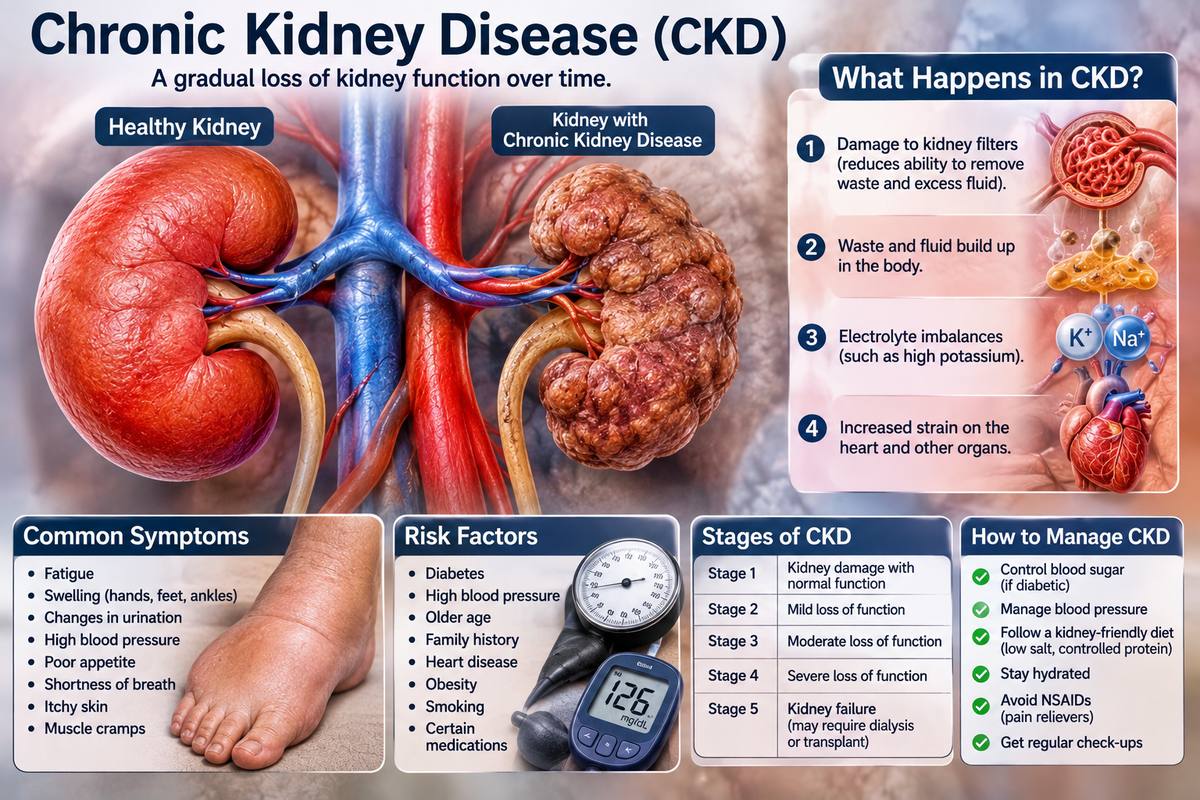
Chronic kidney disease means the kidneys have been damaged, or are filtering less well than they should, for at least three months.
It is common, it is usually silent until late, and most people who have it will never need dialysis. The point of finding it early is to keep it that way.
Related pages: Chronic kidney disease
The bottom line
- CKD is defined as kidney damage or reduced filtering lasting three months or more.
- Diabetes and high blood pressure cause the majority of cases.
- Early CKD causes no symptoms at all, so it is found on blood and urine tests.
- Most people with CKD die of heart disease rather than reaching kidney failure.
- Treatment can slow the decline substantially, and modern medicines have changed the outlook.
- How much of the age-related decline in filtering should count as disease.
- Whether population-wide screening is worthwhile, which guidelines still disagree on.
- How to predict which individuals will progress quickly.
The story, step by step
What the evidence labels mean
What kidneys actually do
What happens
Far more than making urine.
What the research shows
- Each kidney contains about a million filtering units called nephrons. Together they filter the entire blood volume many times a day.
- They remove waste products and excess fluid, and they hold on to the things the body needs, including protein and most salts.
- They regulate blood pressure, partly through fluid balance and partly through hormone signals.
- They make erythropoietin, the hormone that tells bone marrow to produce red blood cells.
- They activate vitamin D, which is why bone problems follow kidney problems.
- They keep potassium, sodium, phosphate and acid balance within narrow limits. Most of the trouble in advanced CKD comes from these jobs, not from waste removal.
Why it matters
Understanding the full job list explains the complications: anaemia, bone disease, high potassium and high blood pressure are all kidney jobs failing, not separate illnesses.
What's still uncertain
- How much reserve capacity the kidneys actually have.
- Why some functions fail earlier than others.
Read more
- NIDDK: Your kidneys and how they workGovernment
- MedlinePlus: Chronic kidney diseaseGovernment
Next: The definition
Three months, and two ways to qualify
What happens
Damage or reduced filtering.
What the research shows
- CKD is defined as abnormalities of kidney structure or function present for three months or more, with implications for health.
- Either of two findings qualifies: an eGFR below 60, or evidence of kidney damage such as albumin in the urine, regardless of eGFR.
- The three-month requirement separates CKD from acute kidney injury, which comes on over days and often recovers.
- This is why a single abnormal result does not make the diagnosis. It must be confirmed and persistent.
- Someone can have normal eGFR and still have CKD if they are leaking albumin, which is stage 1.
- Structural abnormalities such as polycystic kidneys also qualify even when filtering is normal.
Why it matters
The definition matters because people are often told their kidney function is fine when their eGFR is normal but their urine test was never done.
What's still uncertain
- Whether the eGFR threshold of 60 should vary with age.
- How best to capture the three-month requirement in routine care.
Read more
- KDIGO: CKD evaluation and management guidelineNonprofit
- NIDDK: Tests and diagnosis of chronic kidney diseaseGovernment
- MedlinePlus: Kidney testsGovernment
Next: Silent
Why it is found by accident
What happens
No symptoms until very late.
What the research shows
- The kidneys have enormous reserve. Filtering can fall by half with no symptoms and no change in how a person feels.
- Symptoms typically appear only in stage 4 or 5, when filtering is below about 30 and waste products accumulate.
- By then much of the damage is irreversible, which is why screening the people at risk matters.
- Around one in seven United States adults has CKD, and most do not know. Awareness is lowest in the early stages, where treatment helps most.
- Early signs when they do appear are vague: tiredness, needing to pass urine at night, foamy urine, swelling in the ankles.
- Advanced signs are more specific: itch, muscle cramps, poor appetite, nausea, difficulty concentrating and reduced urine output.
Why it matters
Waiting to feel unwell means arriving late. Everything useful in CKD happens before symptoms start.
What's still uncertain
- How much earlier detection changes outcomes at population level.
- Why awareness remains low despite simple tests.
Read more
- CDC: Chronic kidney disease basicsGovernment
- NIDDK: Chronic kidney diseaseGovernment
- MedlinePlus: Chronic kidney diseaseGovernment
Next: The outlook
Most people do not reach dialysis
What happens
The common endpoint is the heart.
What the research shows
- Most people with CKD never progress to kidney failure. Many remain stable for decades, particularly those found at stage 3a with no albuminuria.
- Cardiovascular disease is the leading cause of death in CKD, and the risk rises as filtering falls.
- That is why blood pressure, cholesterol and smoking are treated as aggressively as the kidney numbers themselves.
- Progression is strongly predicted by albuminuria. Someone with heavy protein leak and moderate eGFR is at higher risk than someone with lower eGFR and no leak.
- Rate of decline matters as much as the current number. A stable eGFR of 40 is a very different situation from one falling by 5 a year.
- Modern treatment, particularly SGLT2 inhibitors, has measurably slowed progression in trials, changing the outlook for people diagnosed now.
Why it matters
The most useful framing for a new diagnosis is not how close dialysis is, but how fast the number is moving and whether protein is leaking.
What's still uncertain
- How well current risk equations predict individual progression.
- How much the newer drugs will change long-term dialysis rates.
Read more
- NIDDK: Chronic kidney diseaseGovernment
- KDIGO: CKD evaluation and management guidelineNonprofit
- CDC: Chronic kidney disease basicsGovernment
Next: What helps
The levers that exist
What happens
Several, and they work.
What the research shows
- Blood pressure control, usually with an ACE inhibitor or ARB when albumin is leaking, slows decline substantially.
- SGLT2 inhibitors slow progression in CKD with and without diabetes, and are now standard for many people.
- Blood sugar control in diabetes, the most common cause.
- Avoiding things that injure kidneys further: NSAIDs, dehydration, untreated obstruction and some contrast procedures.
- Treating the underlying cause where one is treatable, such as glomerulonephritis or urinary obstruction.
- Cardiovascular risk reduction, because that is the most likely cause of harm.
Why it matters
CKD is not a condition where nothing can be done. The treatments are unglamorous and they measurably change the trajectory.
What's still uncertain
- How best to combine the available kidney-protective drugs.
- Whether treating early-stage CKD aggressively is cost-effective at scale.