What COPD actually is
Last reviewed November 17, 2026. OwieClear editorial team. Waiting for clinician review. Not medical advice. Talk with your doctor about your own care.
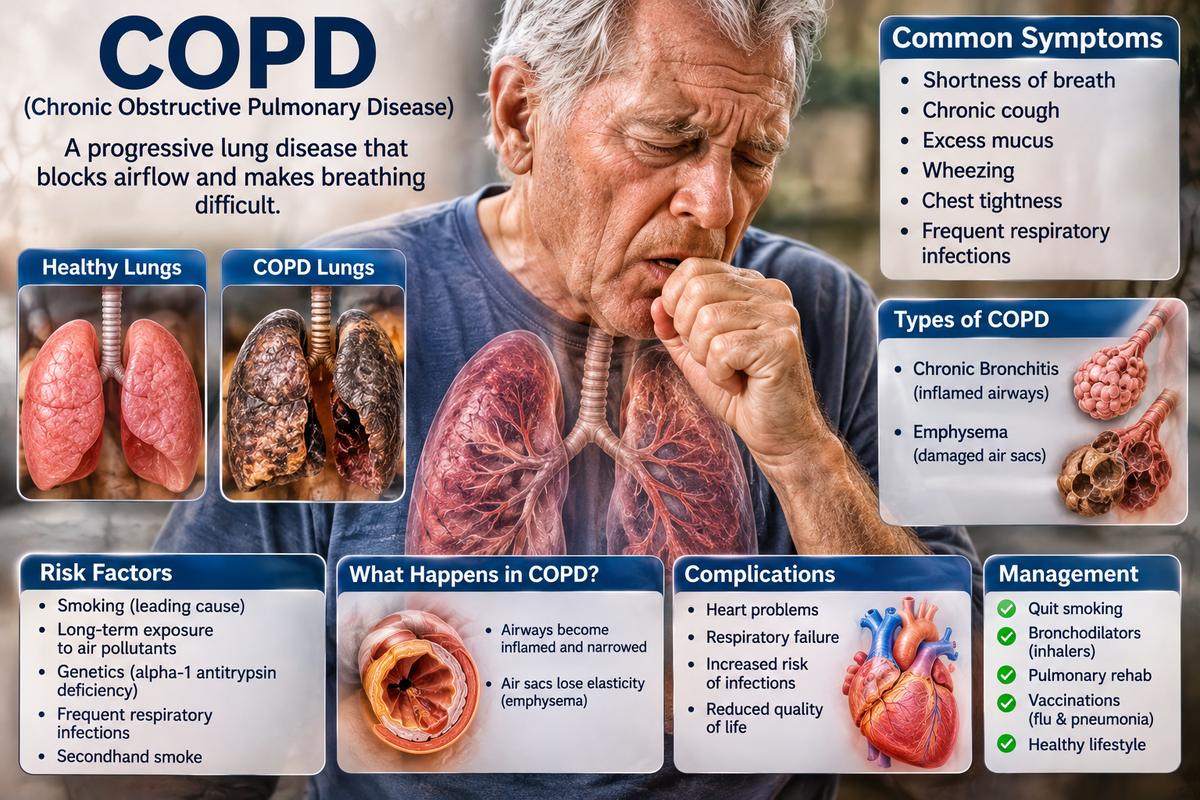
COPD is a lung condition in which airflow out of the lungs is persistently limited, by a combination of inflamed, narrowed small airways and destroyed air sacs.
It is not contagious. It is largely preventable, it cannot be reversed, and the decline in lung function can be slowed considerably, chiefly by stopping smoking.
Related pages: COPD (chronic lung disease)
The bottom line
- COPD combines small airway disease and destruction of air sacs.
- The airflow limitation does not fully reverse, which distinguishes it from asthma.
- Smoking is the dominant cause, but about one in four people with COPD never smoked.
- It is not contagious and cannot be caught from anyone.
- Stopping smoking is the only intervention that changes the rate of lung function decline.
- Why some heavy smokers never develop it.
- How much early-life lung development contributes.
- Whether any drug yet slows the decline in lung function.
The story, step by step
What the evidence labels mean
What the letters mean
What happens
Chronic, obstructive, pulmonary, disease.
What the research shows
- Chronic: it is long-term and does not go away between episodes.
- Obstructive: air leaves the lungs more slowly than it should. The problem is getting air out, not in.
- Pulmonary: it affects the lungs.
- Emphysema and chronic bronchitis are the two traditional components, and most people have both to some degree rather than one or the other.
- Chronic bronchitis is defined by a productive cough on most days for three months of the year, in two consecutive years.
- Emphysema is destruction of the walls between air sacs, producing fewer, larger, floppier spaces that empty poorly.
Why it matters
Hearing emphysema and chronic bronchitis as separate diagnoses causes confusion. They are two faces of one process, usually present together.
What's still uncertain
- Whether the traditional subdivision remains clinically useful.
- How best to classify COPD phenotypes.
Read more
- NHLBI: COPDGovernment
- MedlinePlus: EmphysemaGovernment
- MedlinePlus: Chronic bronchitisGovernment
Next: The obstruction
Why air gets trapped
What happens
Breathing out is the problem.
What the research shows
- Small airways become inflamed, thickened and clogged with mucus, narrowing the passages.
- Destroyed air sacs lose their elastic recoil, which is the spring that normally pushes air out. Without it, the airways collapse during exhalation.
- Air that should leave stays behind, which is air trapping. The lungs become progressively overinflated.
- Overinflated lungs flatten the diaphragm, which then works at a mechanical disadvantage, so breathing takes more effort.
- This is why people with COPD naturally breathe out through pursed lips. It keeps the airways open long enough to empty.
- The limitation does not fully reverse with a bronchodilator, which is exactly how spirometry distinguishes it from asthma.
Why it matters
Understanding that the problem is emptying rather than filling makes sense of almost every symptom and almost every treatment.
What's still uncertain
- How much of the obstruction is potentially reversible early on.
- Why small airways are affected first.
Read more
- NHLBI: COPD diagnosisGovernment
- MedlinePlus: COPDGovernment
- GOLD: Global Initiative for Chronic Obstructive Lung DiseaseNonprofit
Next: Who gets it
Not only smokers
What happens
A quarter never smoked.
What the research shows
- Smoking is the dominant cause in high-income countries, and the risk rises with the amount and duration.
- Roughly a quarter of people with COPD have never smoked. Their disease comes from biomass smoke, occupational dust and fumes, air pollution, childhood respiratory illness or genetics.
- Worldwide, indoor smoke from cooking and heating fires is a major cause, affecting women disproportionately.
- Alpha-1 antitrypsin deficiency is an inherited cause producing emphysema at a young age, often under 45, and is substantially under-diagnosed.
- Poor lung growth in childhood, from prematurity, severe infections or secondhand smoke, leaves a lower peak lung function, so normal age-related decline reaches the COPD threshold sooner.
- Not everyone who smoks develops COPD, which points to genetic susceptibility that is only partly understood.
Why it matters
The assumption that COPD means smoking delays diagnosis in the people who never did, and it adds blame to the people who did.
What's still uncertain
- Why susceptibility differs so much between smokers.
- How much early-life lung development contributes at population level.
Read more
- CDC: COPDGovernment
- NHLBI: COPDGovernment
- NHLBI: Alpha-1 antitrypsin deficiencyGovernment
Next: What changes it
The one disease-modifying step
What happens
Quitting, and not much else.
What the research shows
- Lung function declines with age in everyone. In COPD it declines faster.
- Stopping smoking is the only intervention shown to slow that rate of decline. It does not restore what is lost, but it changes the slope.
- Inhalers improve symptoms, exercise capacity and exacerbations, and do not clearly alter the long-term decline in lung function.
- Pulmonary rehabilitation improves breathlessness and exercise capacity more than any drug does, and is substantially under-used.
- Preventing exacerbations matters, because each severe one is associated with an accelerated loss of function and a worse outlook.
- Vaccination, oxygen where indicated, and treating other conditions all contribute to how well people live with it.
Why it matters
The ranking is worth being blunt about: quitting first, rehabilitation second, inhalers third. Most people are offered them in the reverse order.
What's still uncertain
- Whether any drug slows functional decline.
- How much exacerbation prevention preserves lung function.
Read more
- CDC: Quitting smokingGovernment
- NHLBI: COPD treatmentGovernment
- NHLBI: Pulmonary rehabilitationGovernment
Next: The outlook
Serious, and highly variable
What happens
Not a fixed timeline.
What the research shows
- COPD is a leading cause of death worldwide, and it is also a condition many people live with for decades.
- Outlook depends on lung function, symptoms, exacerbation frequency, exercise capacity, weight and other conditions, not on any single number.
- Someone with moderate COPD who stops smoking, exercises and avoids exacerbations may remain stable for many years.
- Severity scores combining breathlessness, exercise capacity, airflow and body mass predict outcomes better than spirometry alone.
- Most people with COPD die of something else, most commonly cardiovascular disease or lung cancer.
- Survival figures found online are usually drawn from older cohorts and from people with advanced disease, and they frighten people with mild disease unnecessarily.
Why it matters
A diagnosis of mild COPD in someone who then stops smoking is a very different situation from the statistics that come up when they search for it.
What's still uncertain
- How much modern treatment has changed survival.
- Which prognostic tools perform best.
Read more
- NHLBI: COPDGovernment
- CDC: COPDGovernment
- GOLD: Global Initiative for Chronic Obstructive Lung DiseaseNonprofit