What EBV is linked to
Last reviewed November 16, 2026. OwieClear editorial team. Waiting for clinician review. Not medical advice. Talk with your doctor about your own care.
Almost everyone carries EBV and almost nobody develops any of this. The associations below are real and the absolute risks for any individual are very small.
Holding both of those at once is the point: the virus matters enormously at a population level and very little for most individual carriers.
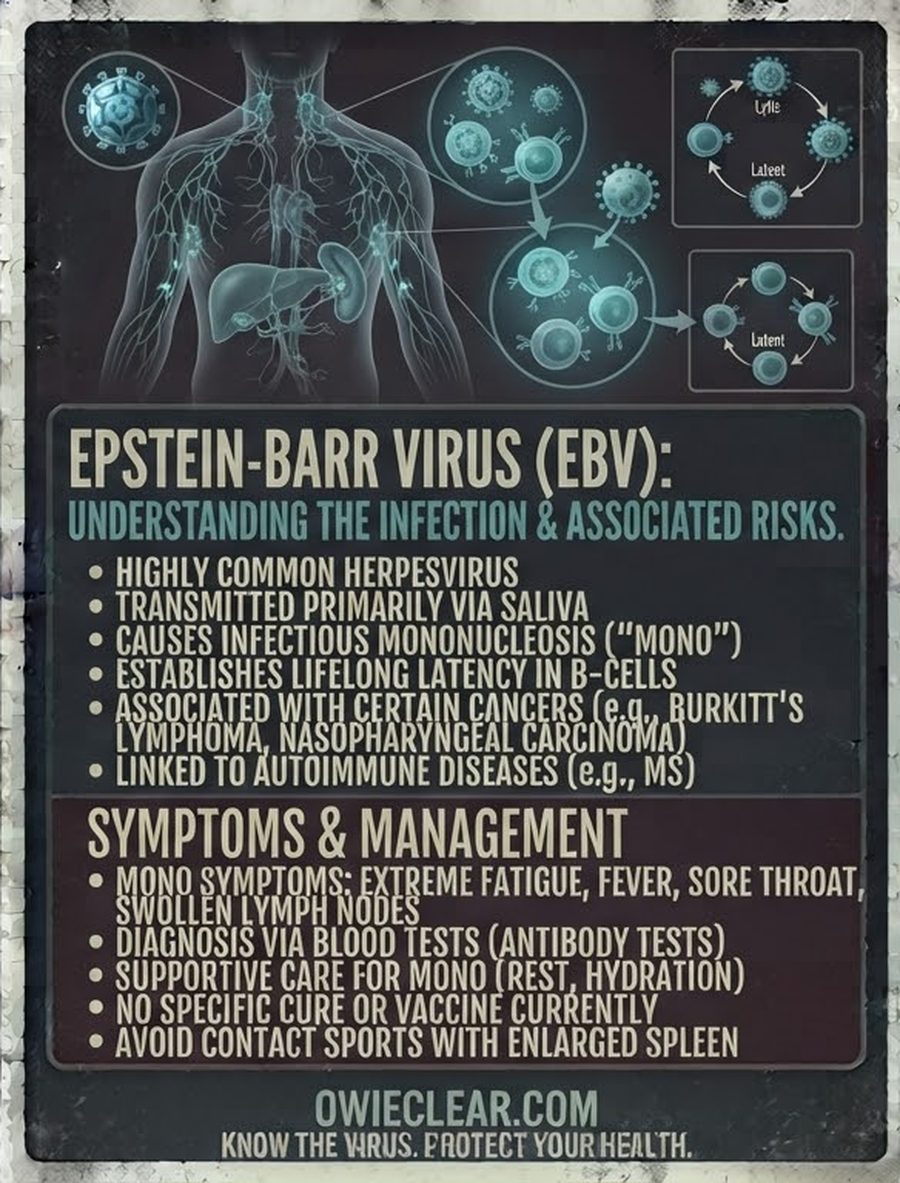
Related pages: Epstein-Barr virus (EBV) infection · Mononucleosis (mono)
The bottom line
- EBV infects more than 90 percent of adults worldwide.
- It is associated with several cancers, usually alongside other factors.
- Prior EBV infection is the strongest known environmental risk factor for MS.
- In immunosuppressed people, EBV can cause serious lymphoproliferative disease.
- Why EBV causes disease in a small minority and not in the rest.
- Whether preventing EBV infection would prevent MS, which a vaccine might one day answer.
The story, step by step
What the evidence labels mean
The common one
What happens
The illness most people associate with EBV, and the only one most will encounter.
What the research shows
- Primary infection in childhood is usually silent. In adolescence and adulthood it frequently causes infectious mononucleosis.
- That age difference is why mono is associated with teenagers and students rather than with toddlers.
- It resolves in most people over weeks, with fatigue lasting longer than the sore throat and fever.
- Complications include spleen enlargement and rupture, airway obstruction from swollen tonsils, hepatitis, and less commonly low platelets, anaemia or neurological involvement.
- A minority have prolonged fatigue afterwards, and a smaller minority develop lasting post-viral illness.
Why it matters
For the vast majority of people, this is the whole story of EBV: one illness, or none at all.
What's still uncertain
- Why the age at infection changes the illness so much is not fully explained.
Read more
- CDC: About infectious mononucleosisGovernment
- OwieClear: Mononucleosis (mono)OwieClear
Next: Cancers
Rare outcomes of a common virus
What happens
EBV is associated with several cancers, almost always in combination with other factors.
What the research shows
- Burkitt lymphoma, particularly the endemic form in parts of equatorial Africa, where repeated malaria appears to be the co-factor.
- Hodgkin lymphoma, where EBV is found in the tumour cells in a share of cases.
- Nasopharyngeal carcinoma, strongly associated with EBV and concentrated in southern China and south-east Asia, with genetic and dietary co-factors.
- A proportion of stomach cancers carry EBV, and it is associated with some lymphomas in people with HIV.
- The common thread is that EBV alone is not sufficient. Billions carry it; these cancers are rare.
Why it matters
Carrying EBV is not a cancer risk worth worrying about individually. The geographic clustering shows how much the co-factors matter.
What's still uncertain
- How EBV contributes to each of these cancers differs and is not fully worked out.
Read more
- National Cancer Institute: Infectious agents and cancerGovernment
- OwieClear: Burkitt lymphomaOwieClear
Next: Multiple sclerosis
The strongest link
What happens
The association that has strengthened most in recent years.
What the research shows
- A large study of US military personnel, using stored blood samples, found MS risk rose roughly 32-fold after EBV infection, and that infection essentially always preceded it.
- Almost everyone with MS has had EBV. Almost nobody with EBV develops MS.
- Having had symptomatic mono, rather than a silent childhood infection, is associated with a further increase in risk.
- Proposed mechanisms include molecular mimicry, where immune responses to an EBV protein cross-react with a protein in the nervous system.
- This is why an EBV vaccine is of interest well beyond preventing mono.
Why it matters
EBV looks close to a necessary condition for MS rather than a sufficient one. That is a meaningful scientific result and not a reason for an individual carrier to worry.
What's still uncertain
- Whether preventing EBV would prevent MS is unknown and untested.
Read more
A different situation
What happens
In people whose T cell surveillance is impaired, EBV behaves very differently.
What the research shows
- Post-transplant lymphoproliferative disorder is an uncontrolled growth of EBV-infected B cells after organ or stem cell transplantation, and it can be life-threatening.
- Risk is highest when an EBV-negative recipient receives an organ from an EBV-positive donor, which is why serostatus is checked before transplantation.
- Transplant teams monitor EBV viral load and can reduce immunosuppression or treat early if it rises.
- EBV-specific T cell therapies, growing immune cells that target the virus, are used for some of these cases.
- EBV can also trigger haemophagocytic lymphohistiocytosis, a rare and serious overreaction of the immune system, and causes more severe disease in certain inherited immune disorders.
Why it matters
This is the context where EBV is genuinely dangerous, and it is managed by specialists with monitoring rather than by anything an individual does.
What's still uncertain
- Prevention of PTLD remains an active area of research.
Read more
- NIAID: Epstein-Barr virus researchGovernment
- CDC: About Epstein-Barr virusGovernment
Next: Proportion
Holding the numbers together
What happens
How to think about all of this.
What the research shows
- More than 90 percent of adults carry EBV. The conditions on this page affect a tiny fraction of them.
- There is no screening for EBV-related cancer in the general population, and no reason for a healthy carrier to be monitored.
- Nothing a healthy person does with supplements or protocols changes these risks. Not smoking and not drinking heavily do reduce risk of the head, neck and oesophageal cancers EBV is associated with.
- The groups where EBV is actively managed are transplant recipients, people with certain inherited immune disorders, and people with HIV, all of whom are already under specialist care.
- For everyone else the practical reality is: you have it, so does nearly everyone, and it almost certainly will not cause you a problem.
Why it matters
If an EBV result has prompted worry about cancer, the honest framing is that this is a near-universal virus and these outcomes are rare.
What's still uncertain
- Absolute risk estimates for individual carriers are not meaningfully calculable.
Read more
More plain-language reading
- OwieClear: Does the mono virus cause MS?OwieClear
- OwieClear: The phases of EBVOwieClear
- OwieClear: How EBV hijacks your cellsOwieClear