The virus almost everyone has: EBV from first contact to lifelong tenant
Last reviewed November 15, 2026. OwieClear editorial team. Waiting for clinician review. Not medical advice. Talk with your doctor about your own care.
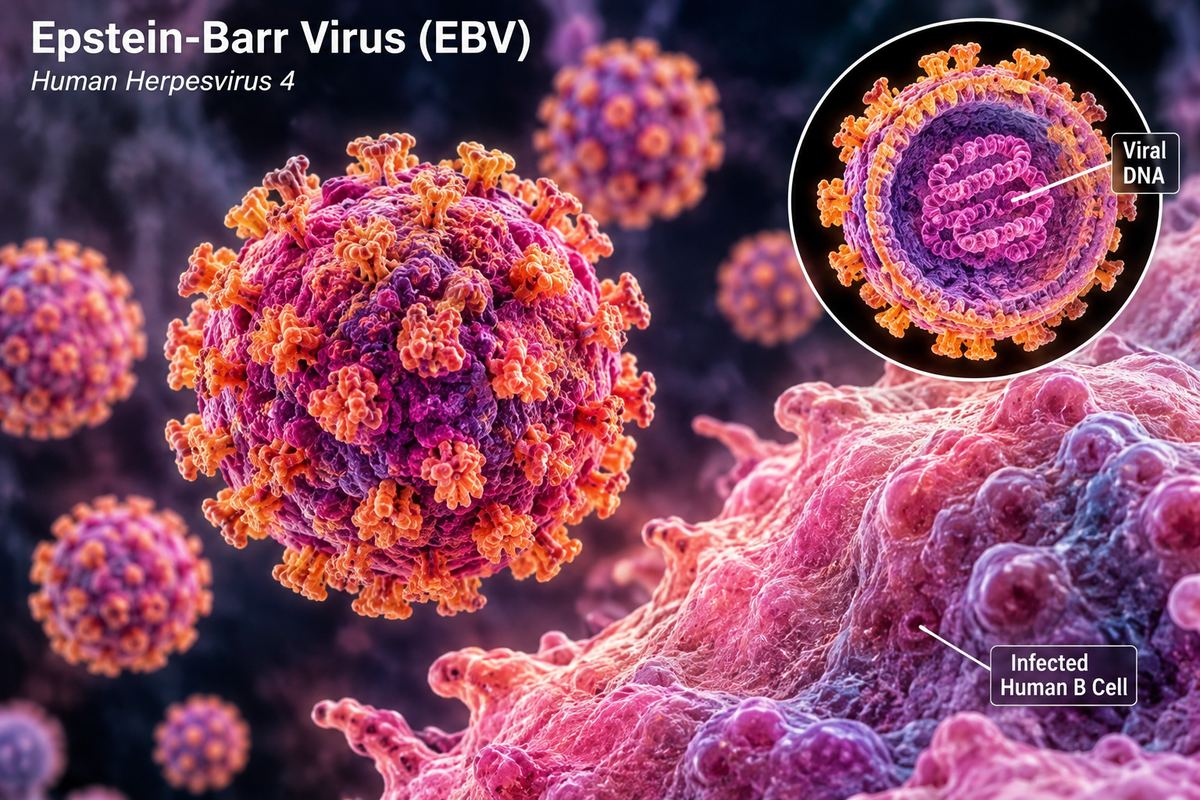
Epstein-Barr virus is one of the most successful organisms on Earth by the only measure that counts for a virus: it lives in almost every human being, for life, and most of them never know.
This page follows it from the outside world into your body, through the three phases it moves through, and ends with the honest state of the research linking it to chronic illness.
Related pages: Epstein-Barr virus (EBV) infection · Mononucleosis (mono)
The bottom line
- Around 90% to 95% of adults worldwide carry EBV.
- It spreads through saliva, mostly from healthy carriers, which makes it close to impossible to avoid.
- Caught in early childhood it usually causes nothing. Caught as a teenager or adult it causes mono about a third to a half of the time.
- It is the trigger for nearly all multiple sclerosis, on current evidence.
- How much it contributes to lupus, rheumatoid arthritis, thyroid disease and long COVID.
- Whether reactivation explains long-lasting fatigue in otherwise healthy people.
The story, step by step
- 1. Nearly everyone (CDC and global seroprevalence reviews)
- 2. How it travels (CDC and clinical virology reviews)
- 3. Getting in (Clinical studies of primary infection)
- 4. Phase one ()
- 5. Phase two (Thorley-Lawson and colleagues)
- 6. Phase three ()
- 7. The chronic illness link (Bjornevik 2022; Lanz 2022; long COVID research groups)
What the evidence labels mean
90% to 95% of adults carry it, most without knowing
What happens
Blood tests for EBV antibodies show who has ever been infected. Researchers pooled these surveys across countries.
What the research shows
- Roughly 90% to 95% of people are infected by age 25, and a small group, about 5% to 10%, never are.
- In the United States, about 95% of adults aged 35 to 40 have been infected.
- Infection happens at younger ages in some regions than others, which changes how much mono a country sees.
Why it matters
A positive EBV antibody test in an adult is the expected result, not a finding. This is the single most misunderstood thing about EBV.
What's still uncertain
- Seroprevalence surveys vary a lot in quality and in who they sampled.
Read more
- Systematic review of EBV seroprevalence and risk factorsJournal
- CDC: About Epstein-Barr virusGovernment
Next: How it travels
Saliva, mostly from people with no symptoms
What happens
Researchers tracked where the virus is found and how it passes between people.
What the research shows
- It spreads through saliva: kissing, sharing drinks, utensils, toothbrushes, or toys a child has mouthed.
- More than 90% of healthy infected people shed virus in their saliva on and off for life. They are the main source of spread.
- It can also pass through blood transfusion, organ transplant and semen, but those routes are far less common.
- Humans are the only known host.
Why it matters
Because healthy carriers do most of the spreading, prevention advice has limits. Not sharing drinks during an illness is sensible; avoiding EBV over a lifetime is not realistic.
What's still uncertain
- It is not an airborne virus in the way flu is, though coughing close up can move saliva.
Read more
- CDC: About Epstein-Barr virusGovernment
- Dunmire 2018, Journal of Clinical Virology: Primary EBV infection (PubMed)PubMed
Next: Getting in
Four to six quiet weeks before anything happens
What happens
Researchers followed people from the moment of infection, mostly university students, testing them repeatedly.
What the research shows
- Symptoms, when they come, start about 4 to 6 weeks after exposure.
- The virus infects the lining of the throat and then B cells, the antibody-making white blood cells.
- In teens and young adults, first infection causes mono roughly 35% to 50% of the time; some studies of followed students found higher rates.
- The exhaustion of mono comes largely from the immune response itself, a huge expansion of killer T cells hunting infected B cells.
Why it matters
You cannot trace mono to one kiss on one night. The incubation period is long enough that the source is usually unknowable.
What's still uncertain
- Young children are rarely studied directly, so what happens in them is partly inferred.
Read more
- Dunmire 2018, Journal of Clinical Virology: Primary EBV infection (PubMed)PubMed
- OwieClear: How EBV hijacks your cellsOwieClear
Next: Phase one
The acute phase: nothing at all, or several hard weeks
What happens
The first infection plays out very differently depending on age.
What the research shows
- In young children it usually causes no symptoms or something indistinguishable from a mild cold.
- In teens and adults it can cause fever, a severe sore throat, swollen neck glands and heavy fatigue, with an enlarged spleen in many cases.
- Most people recover in 2 to 4 weeks. Fatigue can linger for weeks to a few months afterward.
- A rash often follows if amoxicillin or ampicillin is given for a suspected strep throat. It is usually not a true penicillin allergy.
Why it matters
Age at first contact, not the virus, is what mostly decides whether this is a non-event or the worst month of your year.
What's still uncertain
- Why older first infection hits harder is still not fully explained.
Read more
- CDC: About Epstein-Barr virusGovernment
- Dunmire 2018, Journal of Clinical Virology: Primary EBV infection (PubMed)PubMed
Next: Phase two
The dormant phase: decades of silence inside memory B cells
What happens
After the immune system wins the first battle, the virus retreats rather than leaves.
What the research shows
- It settles in resting memory B cells with its DNA as a closed ring and essentially no proteins being made.
- With nothing to see, killer T cells can't find it. It is invisible rather than defeated.
- The number of cells carrying it stays remarkably steady for decades.
Why it matters
This is the permanent state for nearly everyone reading this. It is not a disease and needs no treatment.
What's still uncertain
- Exactly how the body keeps the infected pool at a steady size is not fully worked out.
Read more
- OwieClear: How EBV hijacks your cellsOwieClear
- Thorley-Lawson 2013Journal
Next: Phase three
Reactivation: common, usually silent, often misread
What happens
The virus periodically switches back on, makes copies and sheds into saliva.
What the research shows
- This happens routinely in healthy people and causes no symptoms.
- Studies of medical students during exams found higher EBV antibody levels at exam time than a month before, consistent with less immune control under stress.
- In people whose immunity is suppressed, by transplant drugs or HIV, uncontrolled reactivation can cause serious disease.
Why it matters
Stress-related reactivation is real as a laboratory measurement. That is not the same as stress making you ill through EBV.
What's still uncertain
- The stress studies measured antibody levels, not illness.
- Many commercial 'EBV reactivation' panels will flag results in perfectly healthy people.
Read more
- Glaser 1991, Brain Behavior and Immunity (PubMed)PubMed
- OwieClear: How your body keeps EBV locked downOwieClear
Next: The chronic illness link
Why EBV keeps turning up, and where the evidence is actually strong
What happens
Because EBV lives inside immune cells and makes proteins that resemble human ones, researchers have looked for it behind many long-term illnesses.
What the research shows
- Multiple sclerosis: the strongest case by far. In 10 million US military recruits, MS risk rose 32-fold after EBV infection, and a viral protein called EBNA1 was shown to closely resemble a brain protein, GlialCAM. Antibodies that bind both were found in 20% to 25% of MS patients.
- Lupus and rheumatoid arthritis: associations are reported, but the comparison is hard. In one dataset 99.5% of people with lupus carried EBV against 95% of controls.
- Long COVID: several studies found more signs of recent EBV reactivation in people with long COVID than in those who recovered. One careful study also found long COVID in people with no sign of EBV reactivation at all.
Why it matters
EBV is a real cause of MS and a real suspect elsewhere. The honest summary is one strong link, several open questions, and a lot of claims running ahead of the data.
What's still uncertain
- Because nearly everyone carries EBV, finding it in sick people proves very little on its own. That is the central difficulty in this whole field.
- EBV reactivation is not required for long COVID, so it cannot be the whole explanation.
- Chronic fatigue after mono is common and is not the same thing as chronic active EBV, which is rare and serious.