What happens inside an arthritic finger joint
Last reviewed November 17, 2026. OwieClear editorial team. Waiting for clinician review. Not medical advice. Talk with your doctor about your own care.
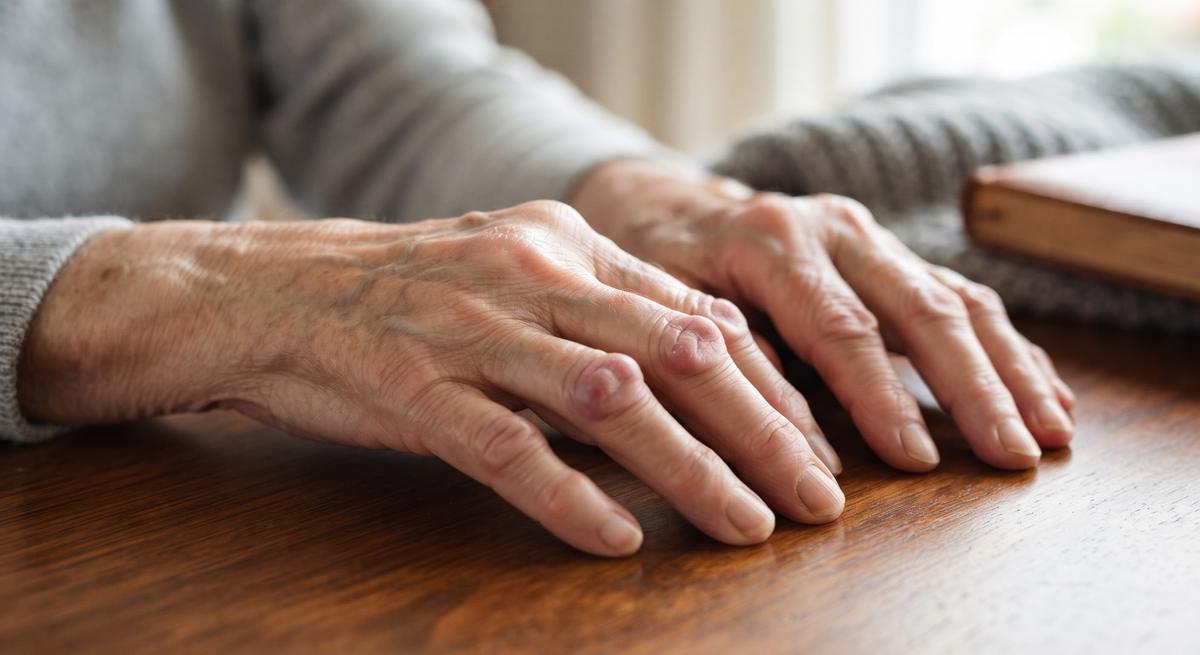
Finger joints are small, superficial and easy to examine, which makes hand osteoarthritis the clearest window onto what osteoarthritis actually does to a joint.
Following the process explains the bumps, the sideways drift and the painful phase that later settles.
Related pages: Osteoarthritis of the hand
The bottom line
- Cartilage thins and the bone underneath thickens, as in any osteoarthritic joint.
- Bone spurs at the joint margins are what produce the visible nodes.
- Low-grade inflammation of the joint lining contributes to pain and to the painful phase.
- Ligament laxity and capsule thickening cause the sideways drift.
- The joint usually becomes less painful once the structural changes settle.
- Why node formation is so strongly inherited.
- Whether anti-inflammatory treatment during the active phase changes the result.
- Why some joints stabilise and others continue to change.
The story, step by step
What the evidence labels mean
Where it starts
What happens
The same process as elsewhere.
What the research shows
- The cells that maintain cartilage shift toward breaking it down faster than they rebuild it, driven by enzymes that cut collagen and the large water-holding molecules beside it.
- The tissue loses its stiffness, the surface roughens and fissures, and in places wears through to bone.
- Cartilage has no blood supply and no nerves, so it heals poorly and does not itself hurt.
- In fingers, the joint surfaces are small, so a given amount of cartilage loss represents a larger proportion of the joint than in a knee.
- Joint space narrowing on a hand X-ray is this cartilage loss, seen indirectly.
- The process takes years, which is why hand osteoarthritis appears gradually rather than suddenly.
Why it matters
The small size of these joints is why hand osteoarthritis shows up clearly on X-ray relatively early.
What's still uncertain
- Why finger cartilage is particularly susceptible.
Read more
- NIAMS: OsteoarthritisGovernment
- MedlinePlus: OsteoarthritisGovernment
- American Academy of Orthopaedic Surgeons: OrthoInfoNonprofit
Next: The bone
How a node forms
What happens
New bone at the margins.
What the research shows
- As cartilage thins, the bone beneath it thickens and hardens, and small cysts can form in it.
- At the edges of the joint, where cartilage meets the joint capsule, new cartilage and bone grow outward. These are osteophytes.
- In fingers these osteophytes are just under the skin, so they are visible and palpable as hard knobs. That is all a Heberden's or Bouchard's node is.
- They form over months to years, often accompanied by pain, redness and tenderness while active.
- Once formed, they usually stop changing and become much less painful, though they do not shrink.
- They can restrict how far the joint bends, which is part of the loss of dexterity.
Why it matters
That nodes are permanent is worth knowing early, so that treatment is aimed at pain and function rather than at making the bumps go away.
What's still uncertain
- What determines how large nodes become.
Read more
- NIAMS: OsteoarthritisGovernment
- MedlinePlus: OsteoarthritisGovernment
- Arthritis FoundationNonprofit
Next: The lining
Inflammation in a non-inflammatory disease
What happens
Low-grade, but real.
What the research shows
- The joint lining, the synovium, becomes mildly inflamed in osteoarthritic joints, probably in response to cartilage fragments and altered mechanics.
- This is low-grade compared with rheumatoid arthritis, but it is enough to cause pain, tenderness and mild swelling after use.
- It is why anti-inflammatory treatment helps, and why hand osteoarthritis can have genuinely inflamed-looking episodes.
- In the erosive variant this inflammation is considerably more marked, with hot swollen joints and erosion of the joint surface.
- Small fluid-filled mucous cysts at the joints nearest the nails arise from the joint and can press on the nail bed.
- The distinction from inflammatory arthritis is one of degree, pattern and cause rather than inflammation being absent.
Why it matters
Describing osteoarthritis as non-inflammatory is a simplification that confuses people who clearly have inflamed joints, so it is better put as low-grade.
What's still uncertain
- Whether treating the inflammation changes the course.
- What triggers the inflammatory episodes.
Read more
- NIAMS: OsteoarthritisGovernment
- Arthritis FoundationNonprofit
- MedlinePlus: OsteoarthritisGovernment
Next: Shape and stability
Drift, laxity and squaring
What happens
Why fingers change shape.
What the research shows
- Ligaments around the affected joints stretch and the capsule thickens unevenly, so the joint no longer tracks straight.
- Fingers can deviate sideways at the affected joint, which is usually more of a cosmetic concern than a functional one in the fingers.
- At the thumb base, the joint can partly shift out of position, giving the squared-off appearance seen in advanced disease, and the joint above it may hyperextend to compensate.
- Muscle around the hand weakens with reduced use, which further reduces grip and pinch.
- This is why hand therapy aims at maintaining movement and the stabilising muscles, rather than at strengthening grip against resistance.
- Movement through full pain-free range, done regularly, is what keeps the joints usable even as their shape changes.
Why it matters
The practical consequence is that daily gentle movement matters more here than heavy strengthening, which is the opposite of the advice for a knee.
What's still uncertain
- Whether exercise changes deformity.
- What determines which joints drift.
Read more
- NIAMS: OsteoarthritisGovernment
- Arthritis FoundationNonprofit
- MedlinePlus: RehabilitationGovernment