What hand osteoarthritis actually is
Last reviewed November 17, 2026. OwieClear editorial team. Waiting for clinician review. Not medical advice. Talk with your doctor about your own care.
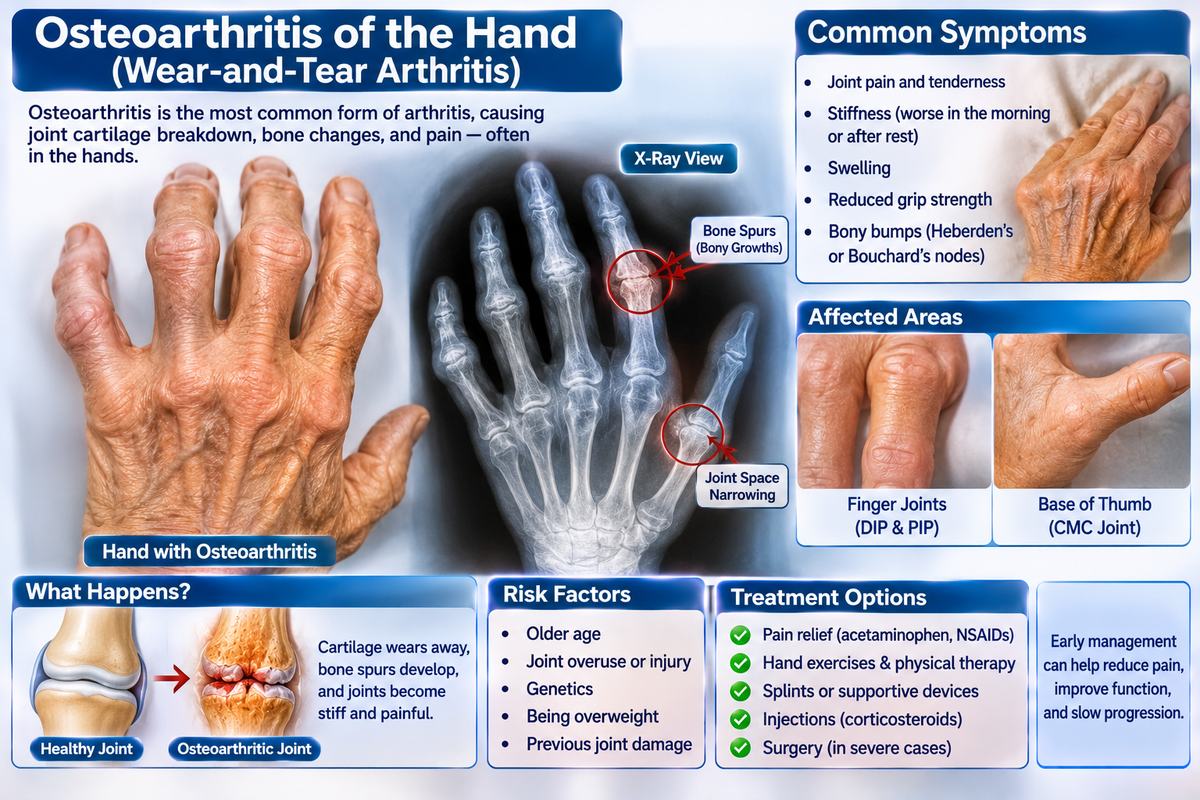
Hand osteoarthritis is the form people can see. The knobby finger joints are recognisable across a room, which is both why it gets diagnosed early and why it causes distress out of proportion to the pain.
It has a strikingly specific pattern: it picks certain joints and leaves others alone, and that pattern is most of the diagnosis.
Related pages: Osteoarthritis of the hand
The bottom line
- It favours the joints nearest the nails, the middle finger joints and the thumb base.
- The knuckles are usually spared, which separates it from rheumatoid arthritis.
- The bumps are new bone, not swelling, and are called Heberden's and Bouchard's nodes.
- Morning stiffness usually eases within 30 minutes.
- An uncommon erosive variant is more inflammatory and more painful.
- Why hand osteoarthritis is so strongly hereditary.
- Why some joints are picked and the knuckles spared.
- How best to treat the erosive variant.
The story, step by step
What the evidence labels mean
Which joints, and which not
What happens
Three places, reliably.
What the research shows
- The joints nearest the fingernails, the distal interphalangeal or DIP joints, are the most commonly affected.
- The middle finger joints, the proximal interphalangeal or PIP joints, come next.
- The joint at the base of the thumb, where the thumb meets the wrist, is the third classic site and often the most disabling.
- The knuckles, the metacarpophalangeal joints, are usually spared. Prominent involvement there points toward rheumatoid arthritis or another cause.
- The wrist itself is not often affected by primary osteoarthritis, and wrist arthritis usually follows an injury or another condition.
- The pattern is often symmetrical, affecting the same joints on both hands, although one hand is typically worse, usually the dominant one.
Why it matters
If a clinician looks at the backs of both hands for a few seconds before asking anything, this pattern is what they are reading.
What's still uncertain
- Why these particular joints.
- Why the knuckles are spared.
Read more
- NIAMS: OsteoarthritisGovernment
- MedlinePlus: OsteoarthritisGovernment
- MedlinePlus: Finger injuries and disordersGovernment
Next: The nodes
Why the bumps are hard
What happens
New bone at the joint margins.
What the research shows
- Firm enlargements at the joints nearest the nails are called Heberden's nodes, after William Heberden, who described them in the 18th century.
- The same enlargements at the middle finger joints are called Bouchard's nodes.
- They are osteophytes, new bone and cartilage growing at the joint margins, plus thickened soft tissue. They are not swelling and they do not go down.
- Hard and fixed is the key distinction from inflammatory arthritis, where swelling is soft, warm and can come and go within days.
- The nodes often develop through a painful, inflamed phase lasting months to a couple of years, which then settles. The finger can end up looking worse and feeling considerably better.
- Small fluid-filled cysts, mucous cysts, sometimes appear at the joints nearest the nails and can groove or ridge the nail. They are related to the arthritis and are usually left alone unless troublesome.
Why it matters
Knowing that the painful phase typically settles is genuinely reassuring, and it is rarely said out loud.
What's still uncertain
- Why node formation is painful in some people and silent in others.
Read more
- NIAMS: OsteoarthritisGovernment
- MedlinePlus: OsteoarthritisGovernment
- Arthritis FoundationNonprofit
Next: What it feels like
Pain, stiffness and grip
What happens
Use-related, with short stiffness.
What the research shows
- Pain is worse with use, particularly with gripping and pinching, and eases with rest.
- Morning stiffness lasts under 30 minutes in most people, which is one of the clearest clues it is not an inflammatory arthritis.
- Grip and pinch strength decline, which shows up as dropping things, struggling with jars, buttons, keys and bottle tops.
- Fine dexterity reduces, affecting handwriting, needlework, playing instruments and fastening small items.
- Fingers can deviate sideways at the affected joints over years, which is cosmetic as much as functional.
- Mild swelling after a day of heavy hand use is common. Hot, red, markedly swollen joints are not typical and need assessment.
Why it matters
The functional losses, jars and keys and buttons, are what actually matter day to day, and they are what treatment is aimed at.
What's still uncertain
- Why grip strength falls faster than pain rises in some people.
Read more
- MedlinePlus: OsteoarthritisGovernment
- NIAMS: OsteoarthritisGovernment
- Arthritis FoundationNonprofit
Next: The erosive variant
An uncommon, harder version
What happens
More inflammation, more damage.
What the research shows
- Erosive hand osteoarthritis is an uncommon subtype, more frequent in women around and after menopause.
- It is more painful and more inflammatory than typical hand osteoarthritis, with episodes of hot, swollen, tender finger joints.
- X-rays show characteristic central erosions of the joint surface, sometimes described as a gull-wing appearance, which ordinary hand osteoarthritis does not produce.
- It can cause more joint destruction, instability and deformity, and more functional loss.
- Because it looks and behaves inflammatory, it is often mistaken for rheumatoid or psoriatic arthritis, and the X-ray pattern and blood tests are what separate them.
- Treatment is not well established. It is managed much like other hand osteoarthritis, and rheumatology input is often sought because the usual measures are less sufficient.
Why it matters
If hand arthritis is unusually painful, hot and swollen, this variant is worth asking about by name rather than accepting that it is just bad osteoarthritis.
What's still uncertain
- Whether erosive osteoarthritis is a distinct disease.
- Which treatments help it.
Read more
- NIAMS: OsteoarthritisGovernment
- MedlinePlus: Rheumatoid arthritisGovernment
- Arthritis FoundationNonprofit
Next: The outlook
What to expect over years
What happens
Slow, and usually manageable.
What the research shows
- It progresses slowly over years, and symptoms fluctuate rather than worsening steadily.
- The painful phase of node formation usually settles, leaving a bumpier but less painful finger.
- Most people keep doing most things, with adaptations to how tasks are done rather than giving them up.
- Thumb base arthritis is the part most likely to cause lasting functional trouble, because pinch is involved in so much.
- Hand osteoarthritis is often part of generalized osteoarthritis, so knees, hips and spine deserve attention too.
- There is no cure and no treatment proven to stop progression, but there is a great deal that improves pain and function.
Why it matters
Framing it as something to adapt to rather than fight produces better outcomes than waiting for a treatment that restores the joint.
What's still uncertain
- Whether any treatment slows hand osteoarthritis.
- What predicts rapid progression.
Read more
- NIAMS: OsteoarthritisGovernment
- MedlinePlus: OsteoarthritisGovernment
- Arthritis FoundationNonprofit