Which joints osteoarthritis affects, and how each one behaves
Last reviewed November 17, 2026. OwieClear editorial team. Waiting for clinician review. Not medical advice. Talk with your doctor about your own care.
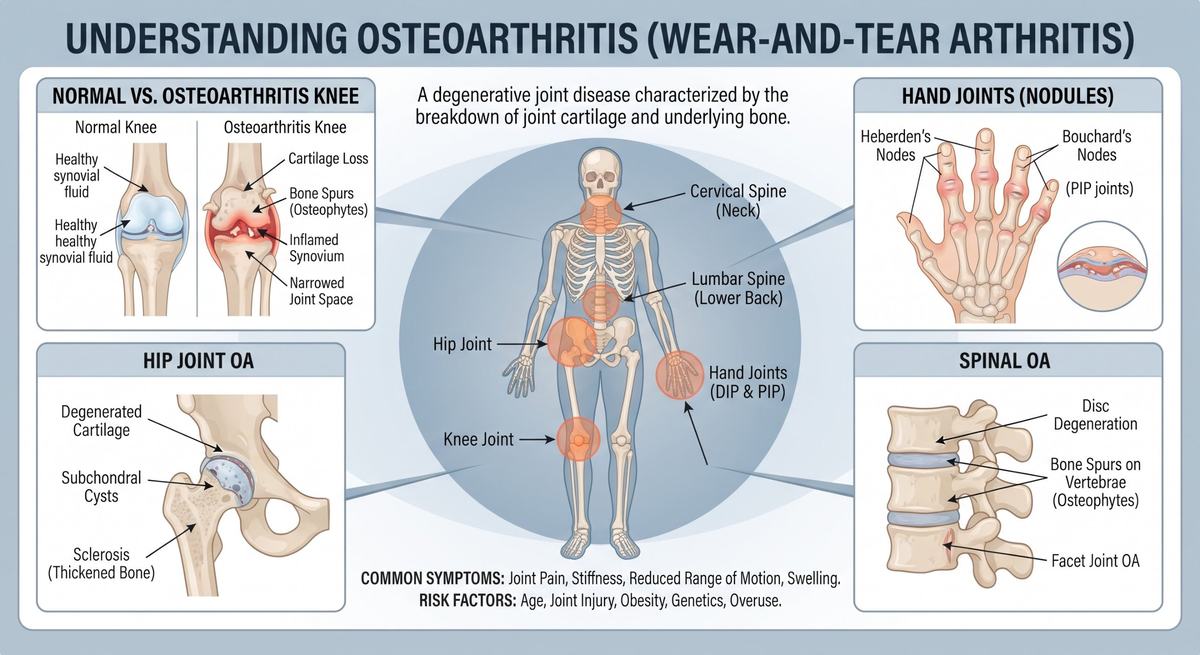
Osteoarthritis is not one experience. Hip osteoarthritis presents as groin pain and difficulty putting on socks; hand osteoarthritis presents as bony bumps and a weak pinch. The treatments differ too.
The pattern of which joints are involved is also diagnostic information, because inflammatory arthritis picks different joints.
Related pages: Osteoarthritis in several joints (wear-and-tear arthritis)
The bottom line
- The commonly affected joints are knees, hips, hands, the spine and the big toe.
- Hip osteoarthritis usually causes groin pain, not outer hip pain.
- Hand osteoarthritis favours the fingertip and middle finger joints and the thumb base.
- Involvement of several joint groups at once is called generalized osteoarthritis.
- Which joints are spared is as informative as which are involved.
- Why osteoarthritis favours some joints and spares others.
- Whether generalized osteoarthritis is a distinct condition or a severity marker.
- How much joint shape at birth determines later risk.
The story, step by step
- 1. Knees ()
- 2. Hips ()
- 3. Hands ()
- 4. Spine and other joints ()
What the evidence labels mean
The most common site
What happens
Weight-bearing, and hard to avoid using.
What the research shows
- Knee osteoarthritis typically causes pain on walking, and particularly on stairs, slopes and standing up from a chair.
- Stiffness after sitting is common, as is crepitus, and the knee may swell after activity.
- The inner compartment is most often affected, which over years can bow the leg outward and shift load further onto the damaged side.
- A feeling of the knee giving way usually reflects quadriceps weakness rather than instability of the ligaments, and it responds to strengthening.
- Previous meniscal or ligament injury, including surgically treated injury, substantially raises the long-term risk.
- Quadriceps strengthening is one of the best-evidenced treatments and is often the first thing a physiotherapist works on.
Why it matters
A knee that gives way is usually telling you the muscle is weak, not that the joint is unstable, and that distinction changes the treatment entirely.
What's still uncertain
- How best to prevent osteoarthritis after knee injury.
- Which exercise programme works best.
Read more
- NIAMS: Knee problemsGovernment
- MedlinePlus: Knee replacementGovernment
- American Academy of Orthopaedic Surgeons: OrthoInfoNonprofit
Next: Hips
Pain in the groin
What happens
Often mislocated by patients and clinicians alike.
What the research shows
- Hip osteoarthritis classically causes pain in the groin, sometimes radiating to the front of the thigh or the knee. Knee pain can be the only complaint.
- Pain on the outside of the hip is more often from the tendons and bursa there than from the joint itself.
- Loss of internal rotation is typically the first movement restriction, which shows up as difficulty putting on socks and shoes or getting in and out of a car.
- People often develop a limp that shortens time spent on the painful leg.
- Walking with a stick held in the opposite hand reduces load on the affected hip considerably.
- Hip replacement is one of the most effective operations in medicine for pain and function when conservative measures have been exhausted.
Why it matters
Because hip osteoarthritis can present as knee pain, a knee that is not improving is often a reason to examine the hip.
What's still uncertain
- How to select patients and timing for replacement.
- Whether joint shape explains most hip osteoarthritis.
Read more
- NIAMS: Hip replacement surgeryGovernment
- MedlinePlus: Hip replacementGovernment
- American Academy of Orthopaedic Surgeons: OrthoInfoNonprofit
Next: Hands
Bumps and a weak pinch
What happens
The most visible form.
What the research shows
- Hand osteoarthritis favours the joints nearest the fingernails, the middle finger joints, and the joint at the base of the thumb.
- Firm bony enlargements at the fingertip joints are called Heberden nodes; at the middle joints they are Bouchard nodes.
- These bumps are bone, not swelling. They are hard rather than soft and puffy, which is a useful distinction from inflammatory arthritis.
- Thumb base osteoarthritis causes pain on pinching and gripping: turning keys, opening jars, pinching a pen.
- The joints at the knuckles are usually spared. Prominent involvement there points toward rheumatoid arthritis instead.
- An uncommon variant, erosive hand osteoarthritis, is more inflammatory and more painful, with specific X-ray changes, and may need rheumatology input.
Why it matters
The bumps often develop over an inflamed, painful phase that eventually settles, so the finger can end up looking worse and feeling better.
What's still uncertain
- Why hand osteoarthritis is so strongly hereditary.
- How to treat erosive hand osteoarthritis.
Read more
- NIAMS: OsteoarthritisGovernment
- MedlinePlus: OsteoarthritisGovernment
- Arthritis FoundationNonprofit
Next: Spine and other joints
Neck, back, feet
What happens
The rest of the pattern.
What the research shows
- Osteoarthritis of the small facet joints of the neck and lower back is extremely common and contributes to stiffness and aching.
- Bone spurs around the spine can narrow the space for nerve roots or the spinal canal, which can cause radiating pain, numbness or weakness. That is a different problem needing different assessment.
- The joint at the base of the big toe is often affected, causing pain on push-off and limiting how far the toe bends.
- The shoulder is affected less often, usually after injury or in heavy manual workers.
- The ankle is rarely affected without previous injury, which is one of the arguments against the simple wear-and-tear model.
- Involvement of three or more joint groups is described as generalized osteoarthritis and is more common in women and strongly associated with hand involvement.
Why it matters
Spinal X-ray changes are nearly universal with age and correlate poorly with pain, so they are interpreted cautiously rather than treated as the explanation.
What's still uncertain
- Why spinal degeneration correlates so poorly with symptoms.
- Whether generalized osteoarthritis is one condition.
Read more
- NIAMS: Back painGovernment
- MedlinePlus: Back painGovernment
- MedlinePlus: Neck injuries and disordersGovernment