What osteoarthritis actually is
Last reviewed November 17, 2026. OwieClear editorial team. Waiting for clinician review. Not medical advice. Talk with your doctor about your own care.
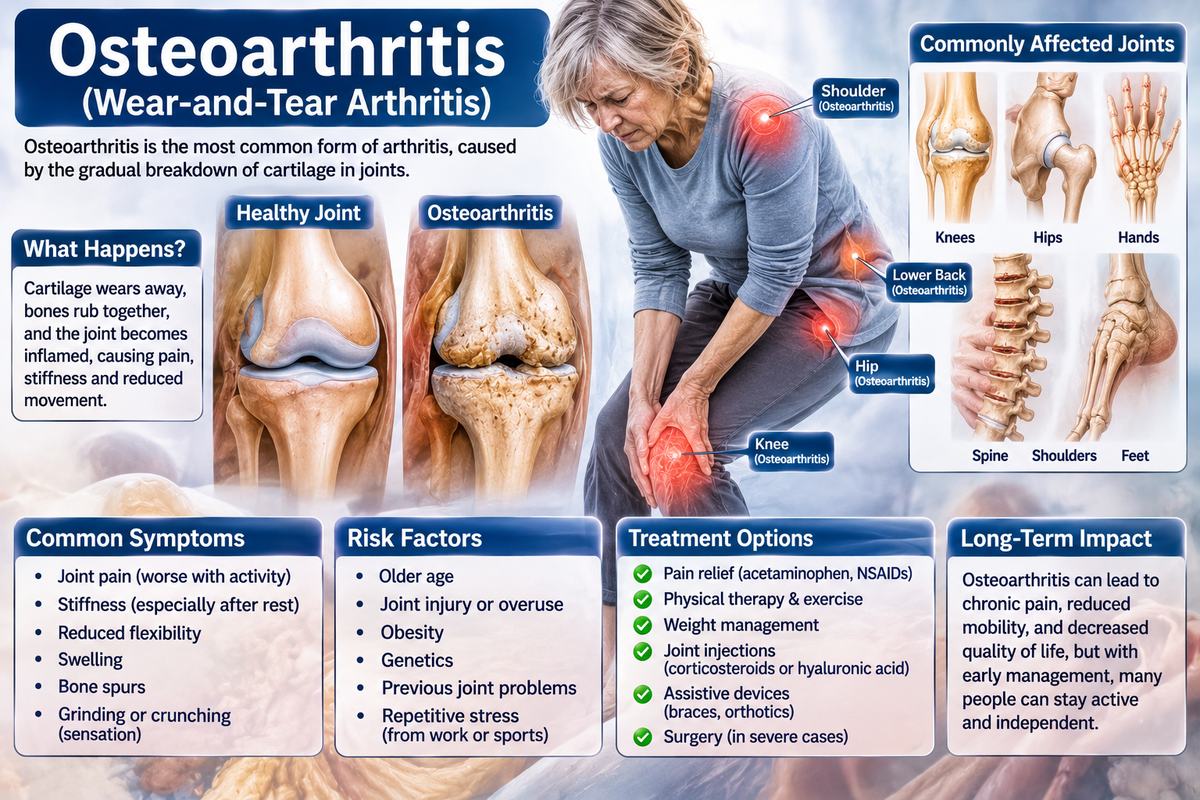
Osteoarthritis is the most common form of arthritis. It is usually described as wear and tear, and that phrase is doing a lot of damage: it suggests the joint is simply used up and that resting it is the answer.
The current understanding is different. Osteoarthritis is an active disease of the whole joint, and movement is one of the few things proven to help.
Related pages: Osteoarthritis in several joints (wear-and-tear arthritis)
The bottom line
- Osteoarthritis involves cartilage, bone, synovium and surrounding muscle, not cartilage alone.
- It is not simply the result of aging or of using a joint too much.
- Exercise is one of the best-supported treatments, not something to avoid.
- Weight loss substantially reduces load on the knees and hips.
- There is no cure, but symptoms and function can usually be improved a great deal.
- Why some people with severe X-ray changes have little pain.
- Whether any treatment can slow structural progression.
- How much of the pain comes from the joint itself versus the nervous system.
The story, step by step
- 1. The healthy joint ()
- 2. What changes ()
- 3. Why not just wear and tear ()
- 4. What it feels like ()
- 5. What helps ()
What the evidence labels mean
What cartilage does
What happens
A surface with almost no friction.
What the research shows
- The ends of the bones in a moving joint are capped with articular cartilage, a smooth, slippery, rubbery layer a few millimetres thick.
- It spreads load across the joint surface and lets the bones glide with less friction than ice on ice.
- The joint is enclosed in a capsule lined by synovium, which produces synovial fluid. That fluid lubricates the joint and carries nutrients.
- Cartilage has no blood supply of its own. It is fed by synovial fluid being squeezed in and out as the joint moves, which is one reason movement matters.
- It also has no nerve supply, so damaged cartilage itself does not hurt. The pain in osteoarthritis comes from bone, synovium, capsule and surrounding tissues.
- Muscles around the joint absorb a large share of the load, which is why weak muscles make a joint problem worse.
Why it matters
Two facts here shape everything else: cartilage is fed by movement, and cartilage itself cannot produce pain.
What's still uncertain
- How much nutrient exchange different kinds of activity produce.
Read more
- NIAMS: OsteoarthritisGovernment
- MedlinePlus: OsteoarthritisGovernment
- American Academy of Orthopaedic Surgeons: OrthoInfoNonprofit
Next: What changes
The whole joint, not just the cushion
What happens
Four things happen at once.
What the research shows
- Cartilage thins and roughens. The matrix of collagen and proteoglycans that gives it its springiness is broken down faster than it is rebuilt.
- The bone underneath responds. It thickens and hardens, a change called subchondral sclerosis, and can develop small cysts and microfractures.
- New bone grows at the joint margins, forming osteophytes, better known as bone spurs. These are what produce the bony bumps on fingers.
- The synovium becomes mildly inflamed. This is low-grade inflammation, different in kind and degree from rheumatoid arthritis, but it is real and contributes to pain.
- Ligaments loosen, the capsule thickens, and surrounding muscle weakens, which changes how the joint moves and loads.
- This is why osteoarthritis is now described as a whole-joint disease rather than a cartilage disease.
Why it matters
Treating it as a cartilage problem alone leads people to look for cartilage repair. Treating it as a joint and muscle problem leads to the things that actually work.
What's still uncertain
- Which tissue drives the process first.
- Whether inflammation is a cause or a consequence.
Read more
- NIAMS: OsteoarthritisGovernment
- CDC: OsteoarthritisGovernment
- MedlinePlus: OsteoarthritisGovernment
Use is not the enemy
What happens
The mechanical story is incomplete.
What the research shows
- If osteoarthritis were simple wear, the most-used joints would always be the worst affected, and they are not. The ankle takes enormous load and is rarely affected; the hand is affected often.
- Regular physical activity, including running in most studies, is not associated with a higher risk of knee osteoarthritis in people with normal joints.
- What does raise risk is a previous joint injury, particularly a ligament or meniscal tear, which can lead to osteoarthritis years later even in young people.
- Obesity raises the risk in the hands as well as in the knees and hips, which cannot be explained by load alone and points to metabolic and inflammatory factors.
- Genetics plays a substantial part, particularly for hand and hip osteoarthritis.
- The current model is an active, cell-driven process in which the joint attempts repair and the repair response itself contributes to the damage.
Why it matters
This matters practically: it is the reason exercise is prescribed rather than restricted, and the reason joint injuries are taken seriously in young athletes.
What's still uncertain
- How much of the risk is genetic.
- Why some joints are spared.
Read more
- NIAMS: OsteoarthritisGovernment
- CDC: OsteoarthritisGovernment
- Arthritis FoundationNonprofit
Next: What it feels like
The pattern
What happens
Mechanical pain, short stiffness.
What the research shows
- Pain is typically worse with use and better with rest, at least early on. Later it can be present at rest and at night.
- Stiffness after sitting or resting is characteristic, often called gelling, and it usually eases within a few minutes of moving.
- Morning stiffness in osteoarthritis usually lasts under 30 minutes. This is one of the most useful clues separating it from rheumatoid arthritis, where it typically lasts longer.
- Crepitus, a grinding or crackling sensation, is common and by itself is not a sign of damage.
- Joints may enlarge from bone spurs and thickened tissue, and range of movement gradually reduces.
- Mild swelling after activity can occur. Hot, red, markedly swollen joints are not typical and need assessment for infection or crystal arthritis.
Why it matters
The symptoms often fluctuate over weeks and months, which makes it easy to credit whatever was tried most recently for an improvement that was going to happen anyway.
What's still uncertain
- Why pain fluctuates so much.
- Why X-ray appearance and pain match so poorly.
Read more
- MedlinePlus: OsteoarthritisGovernment
- NIAMS: OsteoarthritisGovernment
- CDC: OsteoarthritisGovernment
Next: What helps
The honest summary
What happens
No cure, considerable improvement.
What the research shows
- There is no treatment proven to regrow cartilage or reverse the structural changes.
- Exercise is one of the most strongly supported treatments for pain and function, in both strengthening and aerobic forms, and it works across knee, hip and hand osteoarthritis.
- Weight loss in people with excess weight produces meaningful pain relief, and is more effective still when combined with exercise.
- Topical and oral anti-inflammatory medicines help symptoms. Topical versions are preferred where practical because they carry less systemic risk.
- Joint replacement is highly effective for advanced hip and knee osteoarthritis when other measures are no longer enough.
- Supplements such as glucosamine and chondroitin have been studied extensively and the evidence does not support a meaningful benefit for most people.
Why it matters
Setting the expectation correctly matters: the goal is less pain and better function, not a restored joint, and a great deal of that goal is achievable.
What's still uncertain
- Whether any treatment slows structural progression.
- Which exercise programmes work best for which joints.
Read more
- NIAMS: OsteoarthritisGovernment
- CDC: Physical activity for arthritisGovernment
- MedlinePlus: OsteoarthritisGovernment