What trichomoniasis is
Last reviewed November 16, 2026. OwieClear editorial team. Waiting for clinician review. Not medical advice. Talk with your doctor about your own care.
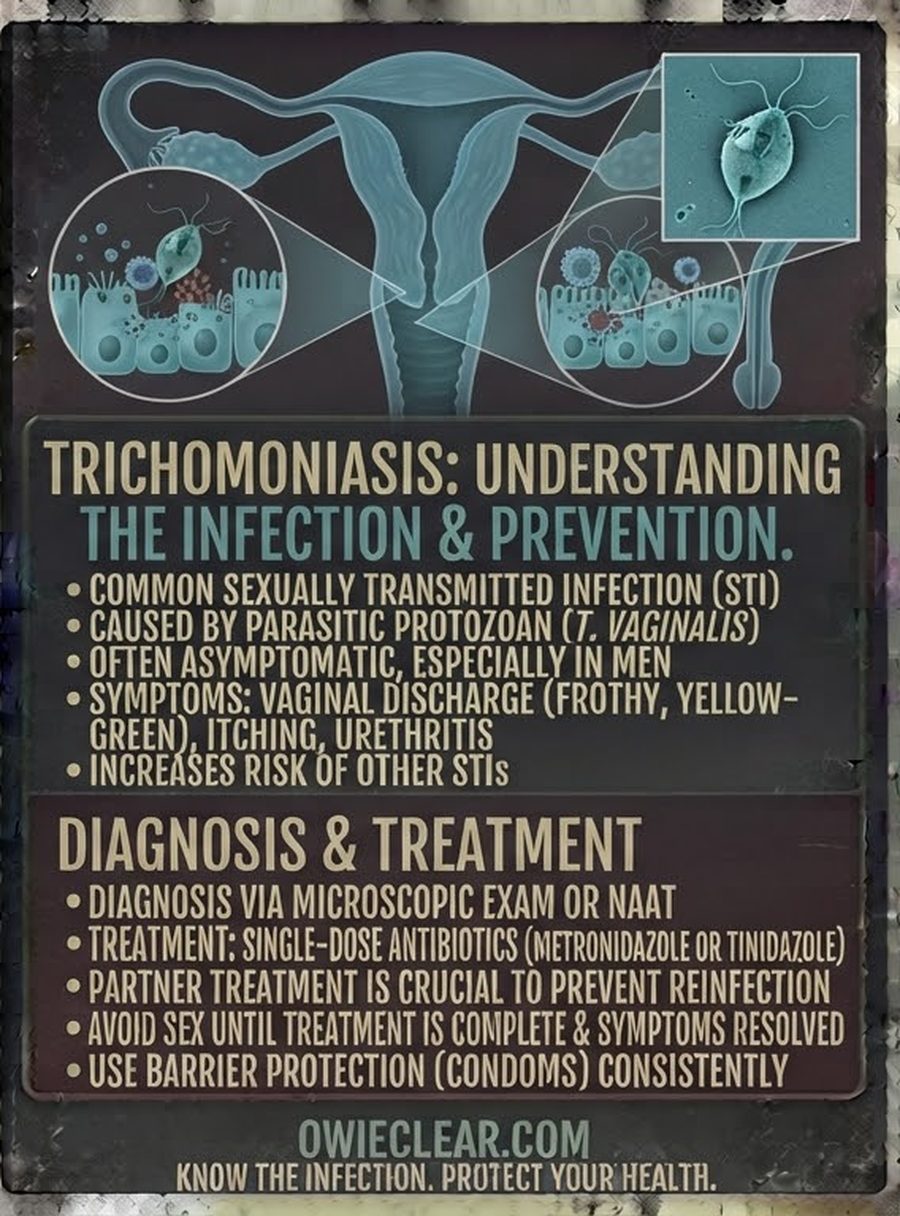
Trichomoniasis is caused by a single-celled parasite rather than a bacterium or a virus, which is why it is treated with a different kind of drug and why some prevention strategies that work for other STIs do nothing here.
It is the most common curable sexually transmitted infection worldwide, and the large majority of people who have it have no symptoms at all.
Related pages: Trichomoniasis · Vaginitis (vaginal inflammation)
The bottom line
- Trichomoniasis is caused by a protozoan parasite.
- Most infections cause no symptoms.
- It is curable with antiparasitic medication.
- Previous infection gives no lasting immunity.
- Why some infections cause symptoms and most do not.
- How often infection in men resolves on its own.
The story, step by step
What the evidence labels mean
Not a bacterium
What happens
What Trichomonas vaginalis is, and why that matters.
What the research shows
- It is a protozoan, a single-celled organism with whip-like flagella that propel it, visible moving under a microscope.
- It infects the lower urogenital tract: the vagina, vulva, cervix and urethra. It does not normally infect the throat or rectum, which distinguishes it from the bacterial STIs.
- Because it is a parasite rather than a bacterium, ordinary antibiotics do not treat it. It needs nitroimidazole drugs, metronidazole or tinidazole.
- This also means doxycycline post-exposure prophylaxis, which reduces syphilis, chlamydia and to a lesser extent gonorrhea, does nothing against trichomoniasis.
- There is no vaccine, and no immunity follows a cured infection. Reinfection on re-exposure is entirely possible.
Why it matters
Prevention strategies designed for bacterial STIs do not cover this one. That gap is worth knowing if you rely on doxy-PEP.
What's still uncertain
- Whether infection at other body sites occurs is not well established.
Read more
- CDC: TrichomoniasisGovernment
- OwieClear: How Trichomonas invades the mucosaOwieClear
Next: How common
More than people think
What happens
Prevalence, and who it affects.
What the research shows
- It is the most common curable non-viral sexually transmitted infection worldwide, with millions of infections each year.
- In the United States it is more common than chlamydia and gonorrhea combined by some estimates, though it receives far less attention.
- Unlike most STIs, prevalence rises with age rather than falling. It is common in women in their thirties, forties and beyond.
- Rates are substantially higher in some populations, reflecting differences in access to testing and treatment rather than behaviour.
- It is frequently not tested for, because it is not included in many standard STI panels unless specifically requested.
Why it matters
Because prevalence rises with age, assuming it is a young person's infection leads to it being missed in exactly the people who most often have it.
What's still uncertain
- Prevalence estimates vary widely with the test used.
Read more
- CDC: TrichomoniasisGovernment
- CDC: STI screening recommendationsGovernment
Next: Symptoms in women
When there are any
What happens
What it causes, in the minority who notice anything.
What the research shows
- Roughly 70 to 85 percent of infected people have no symptoms at all.
- When symptoms occur: discharge that may be frothy, yellow-green or grey, often with a noticeable odour.
- Itching, burning, soreness or redness of the vulva and vagina.
- Burning on passing urine, and discomfort during sex.
- Symptoms can fluctuate, worsening around menstruation.
- A clinician may see a cervix with small red spots, described as a strawberry cervix, which is characteristic but present in only a minority.
Why it matters
There is no symptom pattern that reliably identifies this rather than bacterial vaginosis or thrush. A test is what distinguishes them.
What's still uncertain
- Symptom descriptions overlap heavily with other causes of vaginitis.
Read more
- MedlinePlus: TrichomoniasisGovernment
- OwieClear: Vaginitis (vaginal inflammation)OwieClear
Next: In men
The quiet reservoir
What happens
What happens in men, which is where most of the missed infection sits.
What the research shows
- Most infected men have no symptoms whatsoever.
- When symptoms occur: irritation inside the penis, mild discharge, burning after urinating or after ejaculation.
- It is a recognized cause of non-gonococcal urethritis, and is frequently not tested for in that situation.
- Infection in men may clear on its own over weeks in some cases and persist in others, and which happens is not predictable.
- Men are rarely screened, which means they often remain infected and reinfect partners. This is the single biggest reason trichomoniasis keeps coming back in couples.
- Testing for men is available using urine or a urethral swab, and is usually done because a partner tested positive.
Why it matters
Untreated male partners are the main engine of repeat infection. Treating the partner matters as much as treating the person who tested positive.
What's still uncertain
- Natural history of infection in men is poorly characterized.
Read more
- CDC: STI treatment guidelines, trichomoniasisGovernment
- CDC: TrichomoniasisGovernment
Next: Why it matters
Beyond the symptoms
What happens
The reasons it is treated even when it causes nothing.
What the research shows
- It increases the risk of acquiring HIV, and of transmitting it, by causing inflammation and disrupting the mucosal barrier.
- It is associated with pelvic inflammatory disease, particularly in women living with HIV.
- In pregnancy it is associated with preterm birth, premature rupture of membranes and low birth weight, though the relationship with treatment is more complicated than that association suggests.
- It is associated with increased susceptibility to other STIs through the same inflammatory mechanism.
- It can persist for months or years untreated, which is why a positive test says nothing about when it was acquired.
- Treatment is short, cheap and effective, which is the practical argument for testing rather than waiting for symptoms.
Why it matters
The strongest argument for treating a symptom-free infection is the HIV link, not the discharge.
What's still uncertain
- Whether treating asymptomatic infection improves pregnancy outcomes is unresolved.